
 Information for
 Quick links
 Faculties


Research
The biomedical and food chemical research in the Rother laboratory focuses on how food-associated exposures, bioactive food constituents and glycan-based molecules regulate cellular signaling, matrix remodeling and tissue responses. Chronic inflammatory diseases, impaired wound healing, metabolic dysfunction and cancer are closely linked to changes in the cellular microenvironment, including altered glycosaminoglycan assembly, glycation processes and stress responses. Understanding how dietary compounds, food-derived metabolites and polysaccharide structures influence these processes is essential for evidence-based risk assessment and for the development of safe, functional and sustainable food systems.
Glycosaminoglycans cover and surround all cells as part of the cell membrane and the extracellular matrix. These long, unbranched polysaccharides are key regulators of tissue development, homeostasis and regeneration. Due to their ability to bind proteins such as growth factors, cytokines and extracellular matrix components, they direct the localization, stability and activity of bioactive mediators. In our research, we extend this concept to food-relevant glycans and biopolymers, including levan, a microbial polysaccharide also formed during sourdough fermentation, which we investigate as a glycosaminoglycan-mimetic material.

Currently, we study how food-associated exposures, reactive metabolites and bioactive food constituents influence glycan-dependent signaling, cell activation and extracellular matrix function. Particular interest is given to reactive dicarbonyl compounds, advanced glycation end products, plant-derived bioactives and polysaccharide-based structures. We investigate how these compounds affect inflammation, barrier function, cellular stress responses and tissue regeneration, and how their effects depend on molecular structure, dose, matrix context and biological sex.
In parallel, we develop artificial extracellular matrices, biomimetic coatings and hydrogels functionalized with glycosaminoglycans or food-derived polysaccharides. These systems serve as defined 2D and 3D cell culture models to study how mediator proteins, food-related exposures and the cellular microenvironment shape biological responses. Such glycan-based materials also provide opportunities for sustainable biomaterials, controlled release systems and food-inspired delivery platforms for bioactive compounds.
Our group aims to answer the following questions:
- How do food-associated compounds, reactive metabolites and bioactive glycans regulate extracellular matrix remodeling, inflammation and growth factor signaling?
- Which structural features of glycosaminoglycans, food-derived polysaccharides and glycation products determine protein binding, receptor recognition and signal transmission?
- How do altered glycan–protein and food compound–cell interactions affect barrier function, cell activation, cell–cell communication and cell–matrix interactions in health and disease?
- How can sustainable food-derived biopolymers, such as levan, be used as glycosaminoglycan mimetics, biomimetic matrices or delivery systems for bioactive compounds?
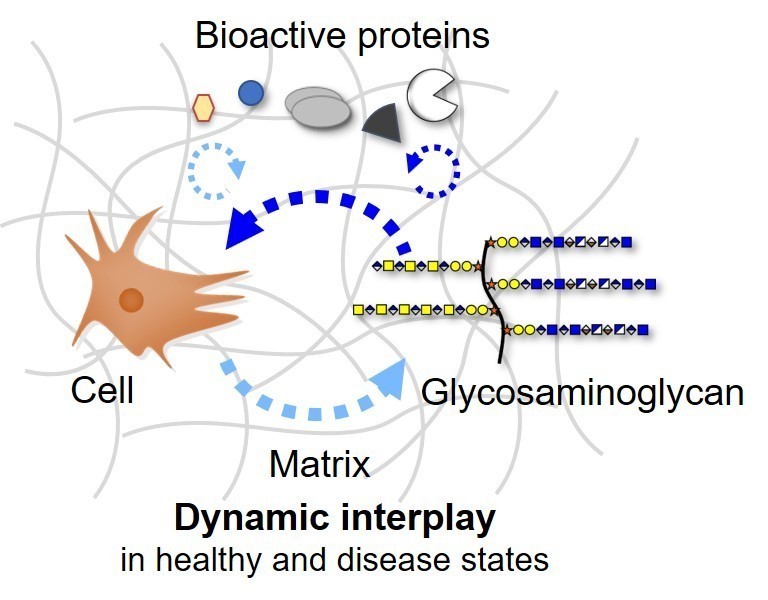
With a deeper molecular understanding of food-associated and glycan-dependent signaling processes, new biomarkers for exposure, early cellular dysfunction and disease risk can be identified. This knowledge may support future strategies in food toxicology, precision nutrition, functional food design and innovative intervention approaches. The work in the Rother lab includes real-time sensor-based interaction studies using surface plasmon resonance, fluorescence-activated cell sorting (FACS), LC-MS-based analysis of glycosaminoglycan composition and food-related exposure markers, CRISPR/Cas9-based cell models, glycan engineering and matrix design. By combining food chemistry, toxicology, cell- and glycobiology and biomaterials research, we investigate how food constituents and glycan-based microenvironments influence cellular function in health and disease.