
 Information for
 Quick links
 Faculties


Open positions
We currently are looking for new PhD students with an interest in protein and redox homeostasis who like to investigate molecular mechanisms and their organismal effects. Please, find an outline of both projects below. The positions are fully funded (T-VL E13, 65%) at Saarland University, Campus Saarbrücken. The UdS has an international focus and strong research profile in Natural Sciences and Technology. Saarbrücken and surroundings are beautiful and affordable areas to work and live.
If you are interested in our lab and like to find out more about our research, please contact: kathrin.ulrich@uni-saarland.de
Project 1: Evolutionary conservation of stress-sensing chaperones
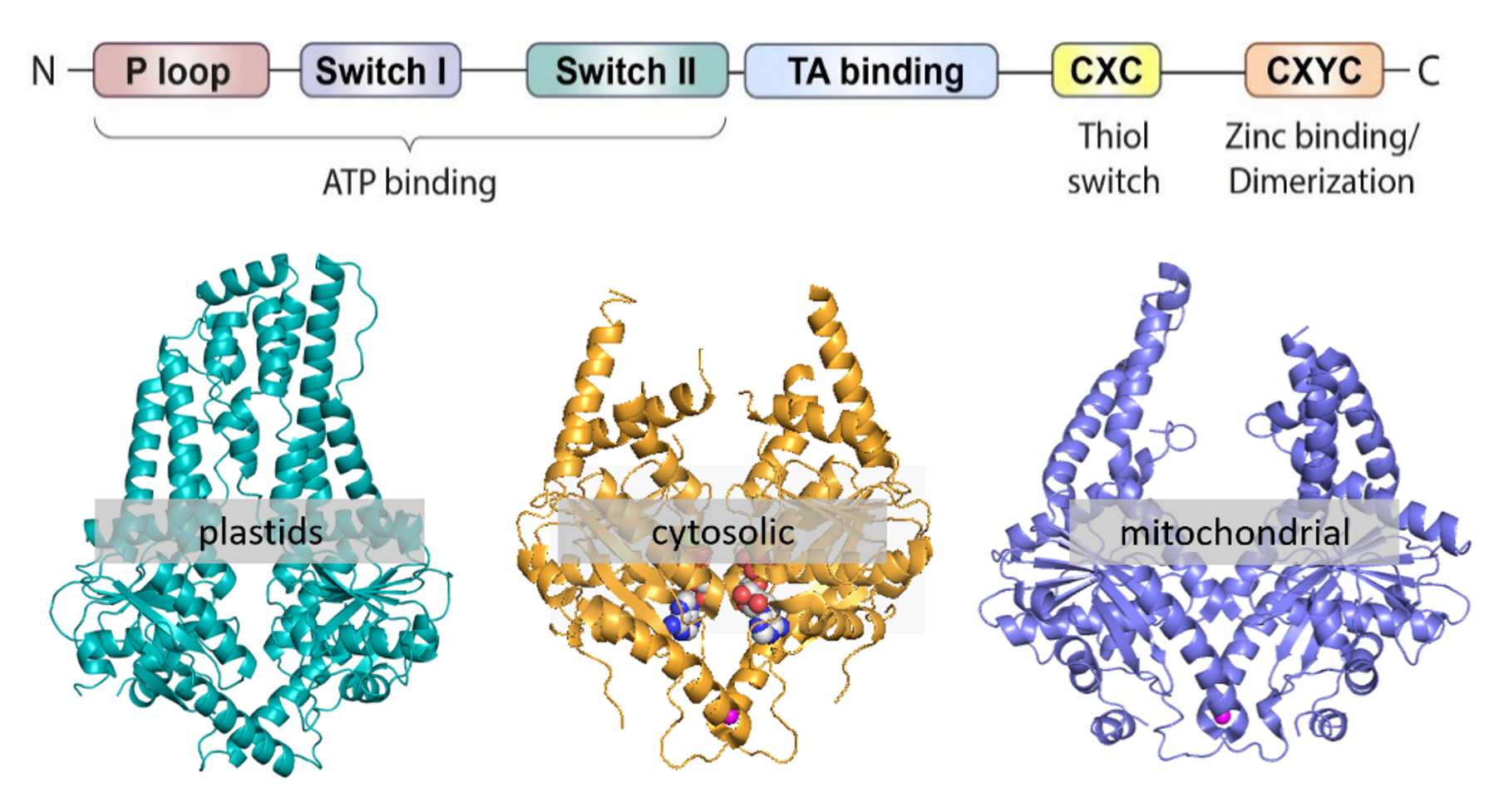
Background and Significance: Stress-sensing chaperones are fast-acting, dynamic components of the proteostasis network to prevent protein aggregation upon sudden environmental changes [1,2]. The cytosolic yeast protein Get3 (ASNA1/TRC40 in human) functions as a redox-regulated, ATP-independent chaperone that protects cells against oxidative stress and starvation [3,4]. Under non-stress conditions, it mediates the ATP-dependent targeting of tail-anchored (TA) proteins to the ER membrane [5]. The switch into the chaperone-active state is induced by reversible thiol oxidation of a conserved CXC motif which is under direct control of Get3’s nucleotide-binding state, making it an ideal sensor of ATP-depleting, oxidative stress [6].
Research Plan: The goal is to explore the evolutionary conservation of the chaperone function of Get3-like proteins found among all phyla – from bacteria to human. We aim to investigate Get3-like proteins in organelles and elucidate their role as sensors of endogenous and environmental stresses, protecting cellular proteostasis against redox imbalances. The project focuses on structural and functional characterization of recombinant Get3-like proteins from various organisms and aims to elucidate the molecular mechanism, evolved to regulate the stress-specific chaperone activation. Complementation studies in yeast or human cells will reveal the physiological role of the ancient chaperone function and serve to explore the crosstalk between redox and protein homeostasis.
References
[1] Ulrich (2023) Biochem Soc Trans 51: 1169-1177; [2] Reichmann et al. (2018) Mol Cell 69: 203-213; [3] Powis et al. (2013) J Cell Sci 126: 473-483; [4] Voth et al. (2014) Mol Cell 56: 116-127; [5] Schuldiner et al. (2008) Cell 134: 634-645; [6] Ulrich, et al. (2022) Mol Cell 82: 3226-3238 e3227
Project 2: Redox control of chaperones and organismal proteostasis
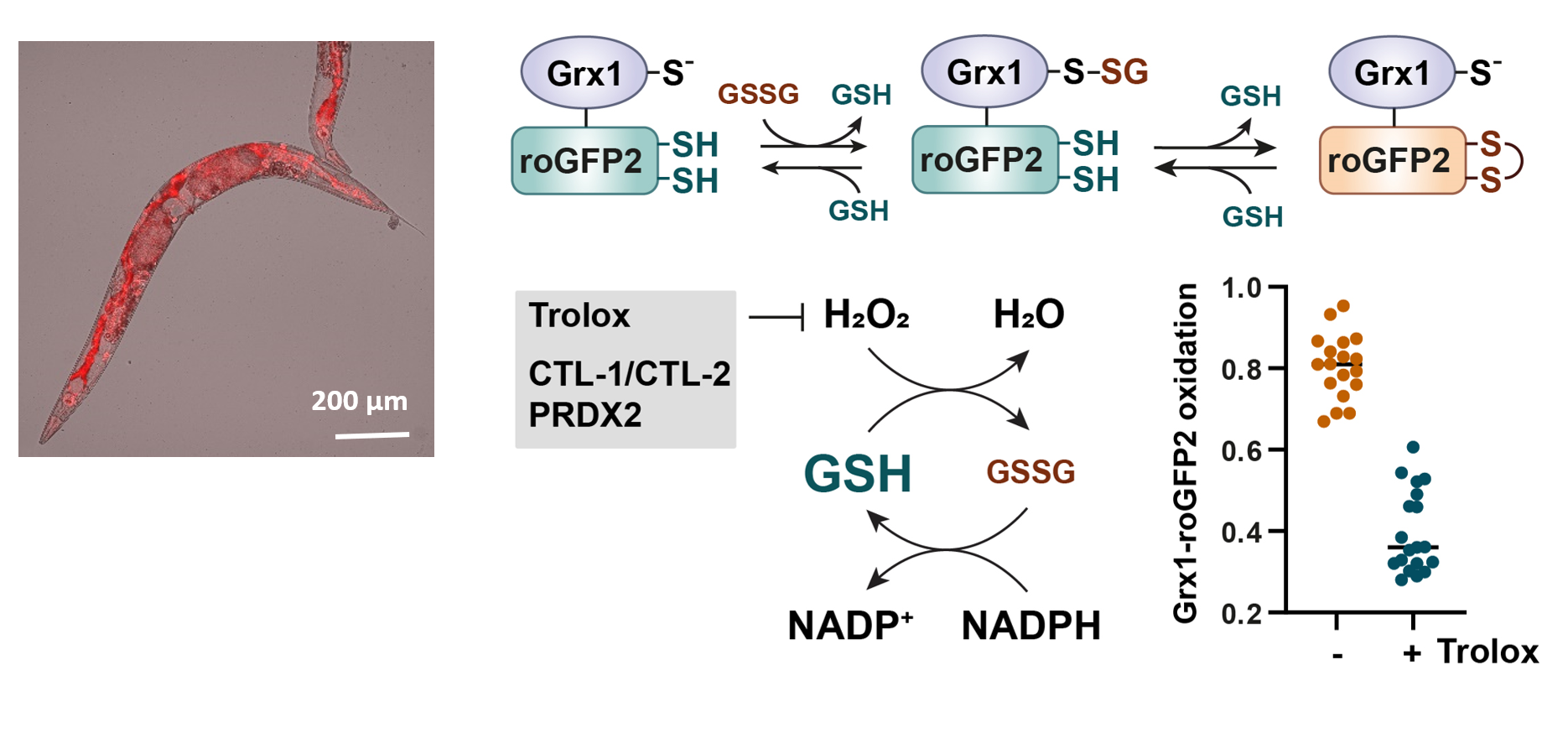
Background and Significance: The accumulation of reactive oxygen species (ROS) has been long known to damage proteins, causing unfolding and aggregation, which endanger organismal integrity and health. Redox-regulated chaperones, which become activated upon oxidative unfolding stresses, serve as a first line of defense to protect the proteome from wide-spread aggregation [1,2]. We identified the tissue-specific role of the highly conserved redox-regulated chaperone and targeting factor Asna-1 (shown in red) in maintaining redox balance and proteostasis in C. elegans during aging and proteotoxic stress.
Research Plan: Using genetically encoded fluorescent probes [3], we will study the tissue-specific function of C. elegans ASNA-1/human TRC40 in maintaining redox and protein homeostasis. Endogenous H2O2 level will be genetically or pharmaco-logically manipulated. Proteomics will identify oxidized and folding-sensitive proteins depending on Asna-1/TRC40 [4]. We further will investigate its crosstalk with longevity pathways. Our main goal is to define Asna-1’s function as a redox-sensitive node interconnecting proteostasis and redox balance in order to maintain a healthy organismal proteome during oxidative challenges and aging.
References
[1] Ulrich (2023) Biochem Soc Trans 51: 1169-1177; [2] Ulrich, et al. (2022) Mol Cell 82: 3226-3238 e3227; [3] Bazopoulou, …, Ulrich, et al. (2019) Nature (576), 301–305; [4] Ulrich, et al. (2017) Antioxid Redox Signal 27(9): 517-533