
 Infos pour
 Accès direct
 UFR
UFR


Maser Collective

The Maser Collective studies strong collective effects in spin – resonator hybrid systems. Collective effects manifest in ensembles of two-level systems, such as spins, interaction with a common electromagnetic field mode. As a result, a spin ensemble undergoes a synchronisation effect, where spins act in unity across macroscopic length scales. Potential disadvantages of the individual systems can be overcome while the combined hybrid system features fascinating effects like collective strong coupling, improved protection against decoherence mechanisms or superradiance. This has great potential to find applications in modern (quantum) information technologies, high fidelity sensing and ultra stable frequency standards.
Research Projects:
Strong Collective Effects in Maser Oscillators
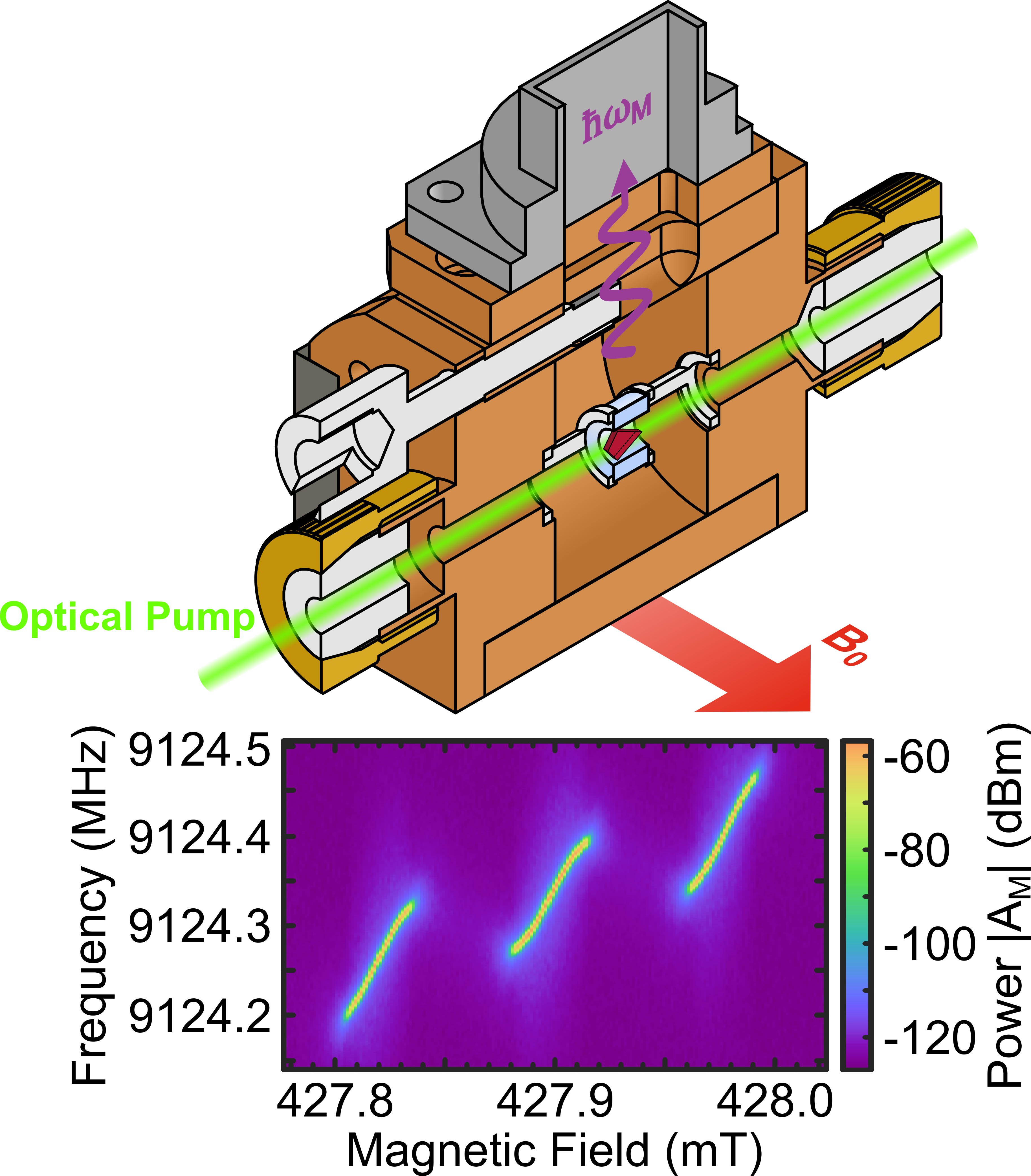
This project is aimed at advancing solid-state maser (Microwave Amplification by Stimulated Emission of Radiation) research by harnessing its inherent collective many particle effects. A large ensemble of emitters strongly coupled to a common resonator mode can give rise to a superradiance effect, where the individual emitters begin to synchronise. This results in a stronger emission as well as a more coherent emission, which spectrally corresponds to a large intensity and an ultra-narrow frequency-linewidth. To enter this regime, we use a maser based on NV centres in diamond at room temperature. The figure to the right shows a schematic of our maser resonator setup. The dielectric sapphire ring resonator (central blue half-cylinder) is iris coupled to the detection electronics. A 532 nm optical pump laser initialises the NV centre spins, while a static magnetic field B0 is tuning the energy of the spins. The diamond sample is placed inside the sapphire resonator. Below an emission spectrum is shown, when the maser operates in a regime where collective effects are not yet strong [1]. This will enable the experimental realisation of a superradiant maser [2], featuring an ultra-narrow spectral linewidth, ideal for a microwave-based frequency standard or highly sensitive sensing, establishing room-temperature masers in modern technologies.
Strong Collective Effects in Spin – Resonator Hybrids
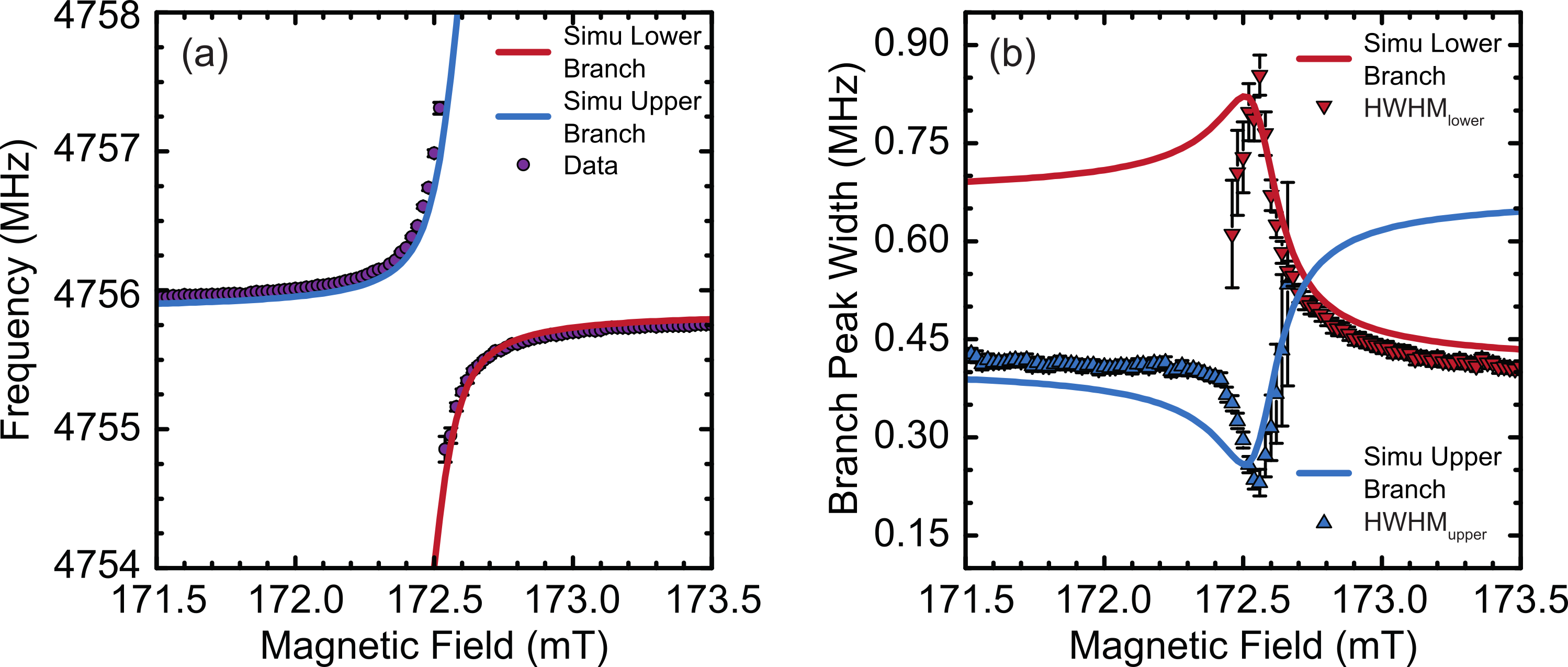
Strong collective coupling between a spin ensemble and a resonator mode results in a coherent energy exchange between the two systems, at a rate defined by the collective coupling strength. This can be extended by introducing an additional incoherent energy exchange pathway and practically opening the otherwise closed quantum system. The extra coupling can be modelled in a non-Hermitian Tavis-Cummings model where the coherent coupling between resonator and spins is opposed to a dissipative (indirect) coupling [3]. While coherent coupling describes a direct exchange of excitations between the resonator and spins, the dissipative coupling describes an indirect exchange of excitations via a lossy bath. Generally, strong coupling exhibits a normal mode splitting, where the two interacting systems hybridize and lift their energy degeneracy by creating two split energy levels, like the binding and anti-binding energy levels of a hydrogen molecule. For the case of a resonator – spin system the resonator mode splits into two hybrid modes. The splitting directly relates to the coupling strength, and the spectrum will show an avoided level crossing as a function of the detuning from the degeneracy point.
A dissipative component to a system with strong collective effects, holds a potential pathway towards entanglement generation [4]. The strong collective interaction between a resonator and an ensemble of spins exhibits coherent Rabi oscillations between the resonator mode and a maximally entangled Dicke state in the spin ensemble. The Rabi oscillation prevents utilizing this entanglement. However, a dissipative interaction component can suppress the Rabi oscillations, leaving the system in a continuous state of entanglement, which can be accessed more readily. A hallmark feature for dissipative coupling is an asymmetric linewidth of the split resonator – spin ensemble hybrid modes. The figure below shows the resonance frequency and linewidth of the avoided crossing for a collective strongly coupled spin – resonator system with dissipative coupling [5]. The solid lines in the figure below are the calculated eingenvalues from a non-Hermitian Tavis-Cummings model, including a dissipative coupling term. The theoretical model agrees very well with the experimental data, corroborating that the linewidth asymmetry originates from a dissipative coupling.
Chip-Scale Maser
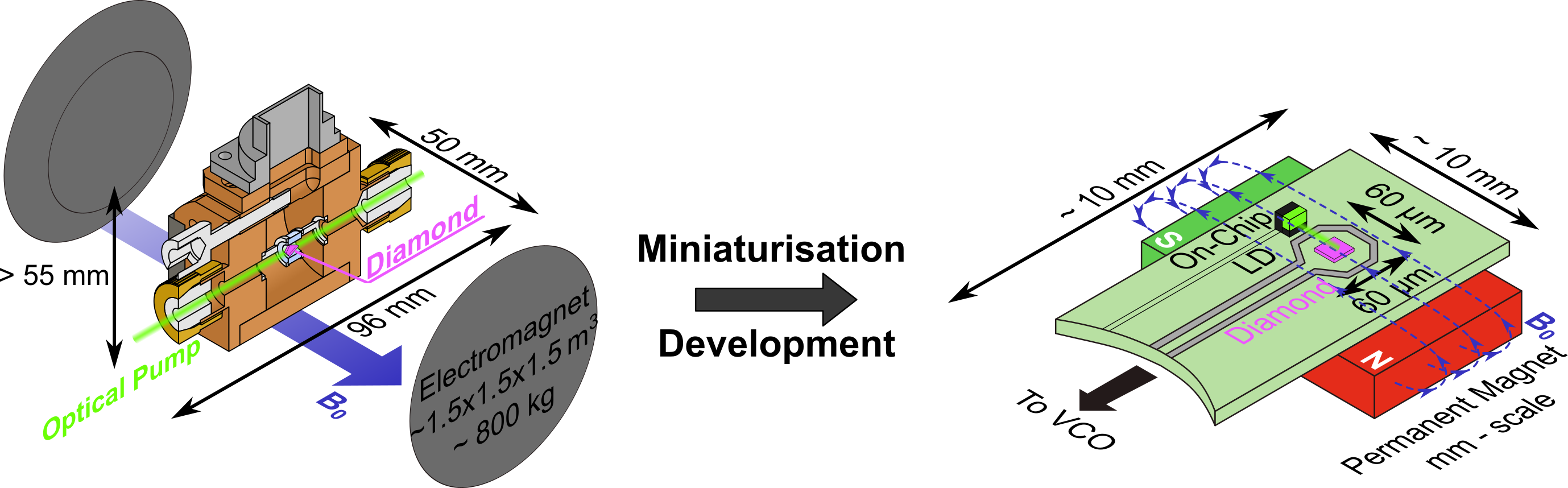
The goal of this project is to research and prototypically implement a miniaturised version of a solid-state maser. Masers are upon the most accurate reference frequency standards, like e.g. the hydrogen maser. Despite its exceptional spectral purity and potential in boosting accuracy in signal generation, communications, sensing, etc., it cannot be integrated into modern chip-scale technologies, due to size restrictions arising from the need for high-vacuum and/or cryogenic environments. With the discovery of room-temperature and ambient-condition solid-state masers [6], these size restrictions can be overcome. We plan to integrate a maser within the chip-scale architecture of a voltage-controlled oscillator (VCO), built with standard foundry processes. Solid-state maser systems naturally promote miniaturisation and VCOs are ideal counterparts to facilitate chip-scale resonant circuits. Initially, we will prototype a pulsed maser device using pentacene molecules in crystalline p-terphenyl and established VCO chips. The results will facilitate an optimised design and development of new high-quality factor VCOs. The newly developed chip will be combined with a maser comprised of negatively charged nitrogen vacancies (NV−) in diamond. The figure below depicts the miniaturisation development stages for this project. The final device will yield a highly integratable chip-scale maser for general and broad applications in high-purity and tunable frequency standards and high-accuracy sensors.
References
[1] Wu, Q. et al., A superradiant maser with nitrogen-vacancy center spins. Science China Physics, Mechanics & Astronomy 65, 217311 (2021) 10.1007/s11433-021-1780-6.
[2] Zollitsch, C. W. et al., Maser threshold characterization by resonator Q-factor tuning. Communications Physics 6, 295 (2023) 10.1038/s42005-023-01418-3.
[3] Harder, M., Yao, B. M., Gui, Y. S. & Hu, C.-M., Coherent and dissipative cavity magnonics. Journal of Applied Physics 129, 201101 (2021) 10.1063/5.0046202.
[4] Yuan, H. Y. et al., Steady Bell State Generation via Magnon-Photon Coupling. Physical Review Letters 124 (5), 053602 (2020) 10.1103/PhysRevLett.124.053602.
[5] Zollitsch, C., PhD thesis, 2016.
[6] Breeze, J. D., Salvadori, E., Sathian, J., Alford, N. M. & Kay, C. W. M., Continuous-wave room-temperature diamond maser. Nature 555, 493–496 (2018) 10.1038/nature25970.
Group Leader

Prof. Dr. Christopher W. M. Kay
Chair und Group Leader of ESR Spectroscopy
Geb. B2 2 Raum 0.24
Tel: +49 681 302 2213
Fax: +49 681 302 4759
christopher.kay(at)uni-saarland.de

Dr. Christoph Zollitsch
Head of Maser Collective
Geb. B2 2 Raum 0.20
Tel.: +49 681 302 64244
christoph.zollitsch(at)uni-saarland.de
(... more)
Scientific Staff and Student Members

Dr. Arundhati Adhikari
Postdoctoral Researcher
Geb. B2 2 Raum 0.20
arundhati.adhikari(at)uni-saarland.de


Maximilian Wolfanger, B.Sc.
Master Student