
 Information for
 Quick links
 Faculties


Mathematics (Bachelor)
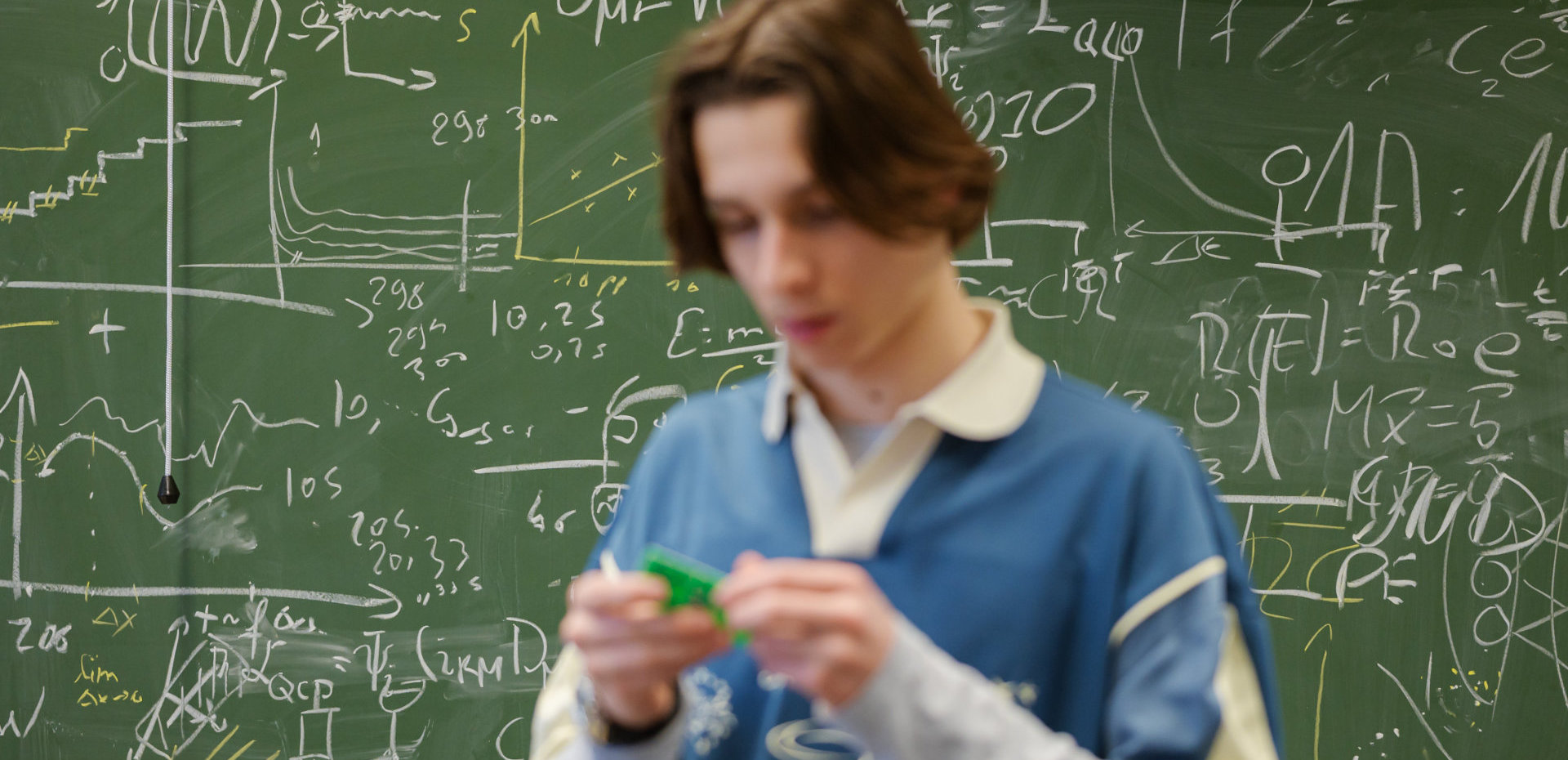
Mathematics is the invisible foundation of nearly every modern technology we use every day. Smartphones, for example, use mathematical methods to determine our exact location via GPS. Facial recognition, used to unlock smartphones, also relies on linear algebra and statistical patterns to match faces and facial features. Camera filters are also based on algorithms from mathematical image processing to, for example, change colors or sharpen edges.
When streaming videos, mathematics is used to compress huge amounts of data so that videos play smoothly and at a consistently high resolution. The encryption of messenger messages and emails is based on elements of number theory (e.g., prime factorization), thereby protecting message content from third parties.
Even the gaming industry would not exist without mathematics. In particular, the development of complex game engines—which are responsible for the graphical rendering of computer games—is based on mathematical methods that use modern numerical approaches to calculate 3D graphics in real time.
Mathematics is also found in areas outside of everyday life, such as in medical technology, where mathematical methods are used to generate a usable image from computed tomography scans. Banks and financial markets, too, would not function without the sophisticated tools of financial mathematics.
Mathematics, as a game with abstract structures, is fun and, in addition to its numerous applications, offers an inexhaustible supply of fascinating fundamental problems!
What sets the Bachelor’s program in Mathematics apart is its intensive and personalized support. Starting in the very first semesters, small-group exercise with a maximum of 20 participants complement the lectures and provide individualized support. The program’s manageable size fosters a close-knit atmosphere that encourages personal interaction between students and faculty. Students also benefit from excellent, personalized support when it comes to seminar presentations and the final-year research project. In addition, academic credits earned at other universities in Germany or abroad (particularly through the ECTS system) are recognized accordingly.
The main research areas in the Department of Mathematics at Saarland University are:
- Algebraic geometry and computer algebra
- Differential geometry, the calculus of variations, and partial differential equations
- Functional analysis and operator theory
- Numerical solutions of integral equations and partial differential equations
- Statistics and probability theory
- Number theory and arithmetic geometry
Subject at a glance
The Bachelor's degree programme in Mathematics , the standard duration of study for full-time students is six semesters until completion of the Bachelor’s examination. Upon request, parts of the program may be completed on a part-time basis. Students are expected to acquire mathematical skills that prepare them both for the practical demands of a professional career and for a subsequent Master’s program. The academic degree awarded is the Bachelor of Science (B.Sc.).
Regardless of the degree program, the mathematics major must be supplemented by the study of another subject. Possible minors in the bachelor’s program include economics, computer science, physics, biology, chemistry, engineering, or philosophy. Furthermore, upon request, the examination committee may approve any other subject that makes significant use of mathematical methods.
Career prospects
Graduates of the mathematics program not only acquire specialized mathematical knowledge but, above all, develop the ability to think logically, analyze problems, and devise new solutions. These skills are in high demand across numerous industries and can be applied to a wide variety of tasks.
Mathematicians work, for example, in data science and artificial intelligence, develop mathematical models for businesses, analyze risks in banking and insurance, and optimize processes in industry and logistics. Exciting career opportunities also exist in software development, cryptography, and research.
Kontakt
Zentrale Studienberatung
Campus Saarbrücken
Campus Center, Geb. A4 4, EG
Tel.: 0681 302-3513
studienberatung(at)uni-saarland.de
Studienfachberatung
Prof. Dr. Bildhauer
Campus Saarbrücken
Geb. E2 4, Raum 102
66123 Saarbrücken
Tel.: 0681 302-2384
bibi(at)math.uni-sb.de
Studienkoordination
Prof. Dr. Bildhauer
Campus Saarbrücken
Geb. E2 4, Raum 102
66123 Saarbrücken
studienkoord(at)math.uni-sb.de