
 Information for
 Quick links
 Faculties


About SOUNDS
An early warning system for society
Where does a debate tip into hatred? When does distrust in institutions grow? Where does language become radicalized?
Democratic societies rarely change suddenly. Usually there are early signs. SOUNDS makes these developments visible.
The Societal Observatory Using Novel Data Sources studies societal change using new data sources and scientific methods. To do this, the observatory uses traces that are already generated in everyday life: satellite imagery, social media posts, search queries, reviews, map services, and other data sources.
Just as a weather service measures changes in the atmosphere, SOUNDS observes societal developments and builds scientific foundations to understand change at an early stage.
SOUNDS is led by Prof. Dr. Daniela Braun (Political Science) and Prof. Dr. Ingmar Weber (Societal Computing).
Making societal questions visible
Society leaves digital and analog traces every day. SOUNDS connects these data sources to make visible developments that are difficult to capture continuously using classical methods.
What we observe
Individually, these sources tell only fragments of the story. Connected and viewed over time, they reveal societal developments closer to where they are unfolding.
In doing so, SOUNDS operates within applicable data protection and research regulations and uses new possibilities for regulated data access for research.


The question comes first
SOUNDS does not begin with a method, but with a societal question.
Which data helps to better understand a phenomenon? Which scientific methods fit? These decisions follow the question — not the other way around.
This is how computer science and social science work together from the very start, combining technical possibilities with societal expertise.
SOUNDS thus sees itself as a think-and-do tank that connects research with societal application.

Where do researchers from the SOUNDS team use computational methods to extend classical analytical approaches?
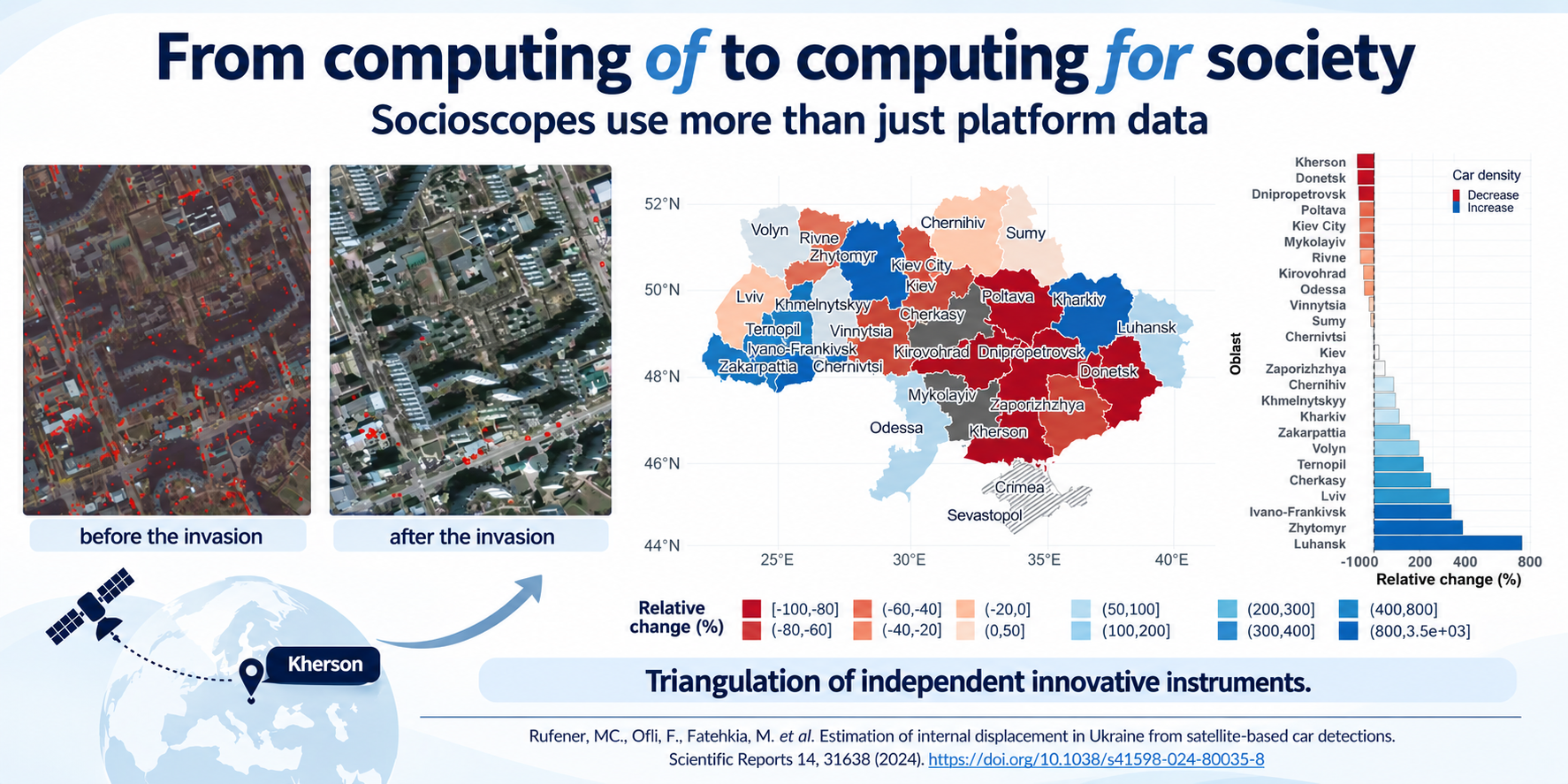
Computational methods are used across a wide range of areas in our work. Using computer vision techniques, we identify vehicles in satellite imagery to draw conclusions about internal displacement, for instance in the Ukrainian city of Kherson before and after the invasion. We contribute to AI-driven approaches for disaster response and monitoring displacement dynamics, and we combine survey data with digital behavioral traces, for example to study addictive behavior on TikTok. In the field of political communication, we use computational text analysis to work out the importance of key European points of contention in party competition, for example around the 2024 European elections or gender-related issues across Europe.
What innovative tools for data collection is our team developing, and which datasets have already emerged from this?
So far, this has produced, among other things, a multilingual, cross-platform dataset on European political online discourse and a dataset on political campaigning on Twitter during the 2019 European Parliament election.
At its core, however, a dataset is a static snapshot – a file you download once. The Socioscopes we're building are something different: measurement instruments that continuously observe societal phenomena rather than capturing them just once. In this direction, we are currently developing a system that continuously collects large volumes of online reviews in order to derive ongoing, societally relevant signals from them. This is shifting our approach increasingly from one-off data collection toward continuous, near-real-time observation of societal phenomena.
Where and how do researchers from the SOUNDS team use non-traditional data sources, and what ideas are we pursuing?
One example is the role of social media in election campaigns: How, for instance, does candidates' gender relate to their use of Twitter/X, how are candidates' digital religious profiles reflected online, and how visibly do Spitzenkandidaten position themselves in online campaigns? Similarly, we use Facebook and Instagram advertising audience data to make subnational gender gaps in internet and mobile access visible worldwide, and we use the same advertising data to capture internal displacement in crisis regions such as Ukraine in near real time – a method that helped significantly revise the official UN estimate upward. Looking ahead, we want to broaden this range of sources further, for example with Google Trends.
You can find a selection of our team’s publications and datasets here.
Why this matters for Saarland University
SOUNDS combines two particular strengths of the location: the computer science of the Saarland Informatics Campus and social science research.
With funding of 29 million euros from the Saarland Transformation Fund for Research and Knowledge Transfer, the project runs until August 2032. It strengthens computational social sciences, promotes interdisciplinary collaboration, and underscores the university's profile as a research location with societal impact.
SOUNDS thrives on exchange with science, politics, administration, business, and society. Do you have a societal question that new data sources and scientific methods could help address? We look forward to the exchange and to jointly developing new perspectives. |
|---|