
 Information for
 Quick links
 Faculties


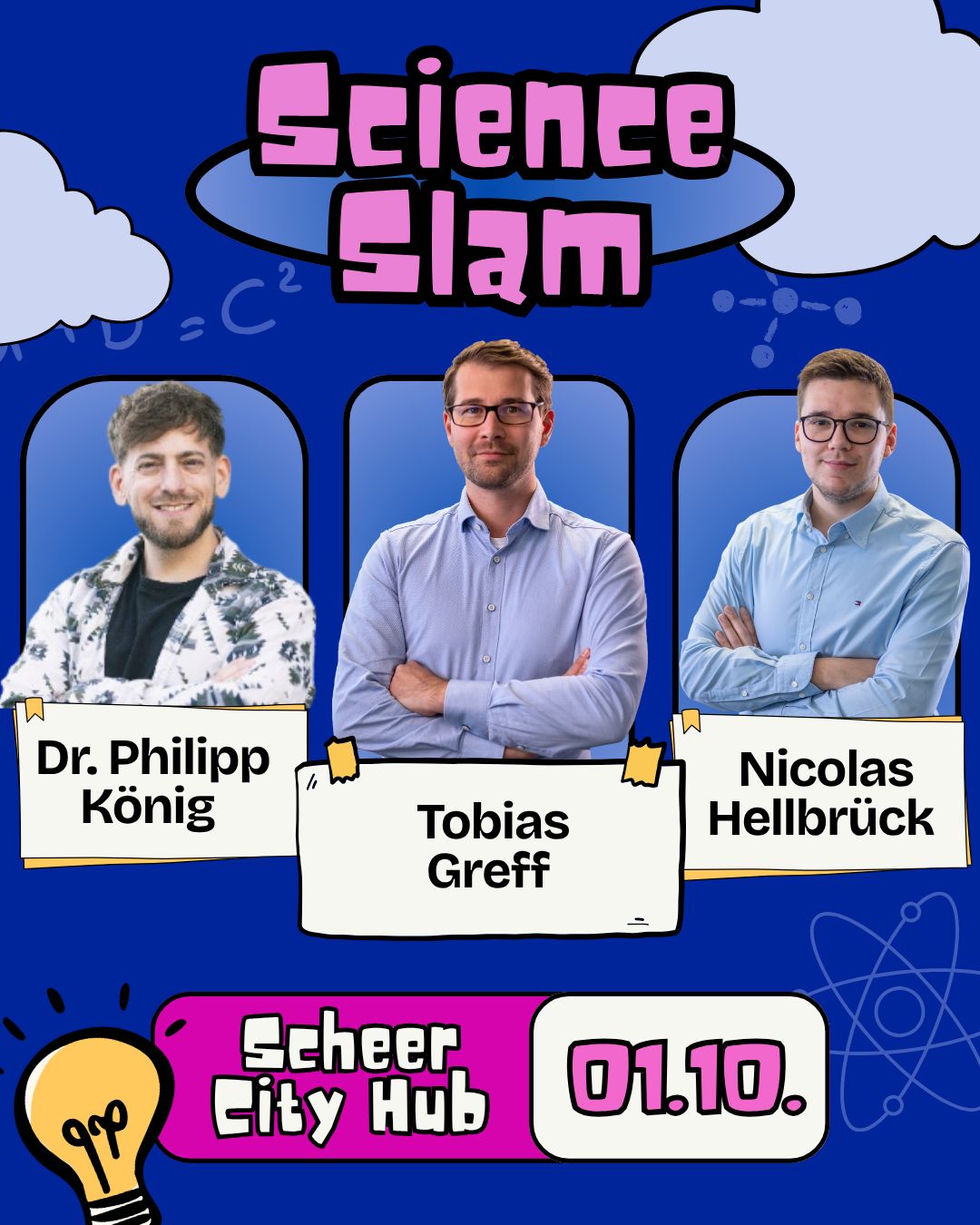
Dr. Philipp König zu Gast beim Science Slam des Scheer City Hubs | 1. Oktober
Am 1. Oktober bringt Dr. Philipp König, ehemaliges Mitglied im Nachwuchskolleg Europa am CEUS, seine Forschung zu politischen Influencer*innen auf die Bühne des Scheer City Hubs.
Politische Meinungsbildung verlagert sich zunehmend auf Plattformen und in Formate, deren Akteur*innen, Reichweiten und Wirkmechanismen wissenschaftlich bislang noch erstaunlich wenig untersucht sind. Beim Science Slam im Scheer City Hub fragt der Politikwissenschaftler unter dem Titel „Turn up the AMP! Politische Influencer und der neue Sound der Demokratie“, was diese neuen digitalen Öffentlichkeiten für politische Identitäten, gesellschaftliche Polarisierung und letztlich für unsere Demokratie bedeuten.
Dr. Philipp König promovierte bei CEUS-Clusterprofessorin Prof. Dr. Daniela Braun im Nachwuchskolleg Europa am CEUS und forscht heute im UdS-Leuchtturmprojekt Societal Observatory Using Novel Data Sources (SOUNDS) mit Methoden der Computational Social Science.
Zeit und Ort: 1. Oktober 2026, 19–21 Uhr
Scheer City Hub, St. Johanner Markt 25–29, 66111 Saarbrücken
Aufgrund begrenzter Plätze ist eine Anmeldung erforderlich.
Weitere Infos und Anmeldung | Webseite

Recap: SOUNDS Kick-off
Two weeks ago, SOUNDS (Societal Observatory Using Novel Data Sources) officially kicked-off. It was a truly special day at Saarland University.
Here are the photos by Jörg Puetz, Saarland University.
The entire SOUNDS team and our interested guests were able to exchange ideas about what we're building and why it matters. A big thank you to everyone who made this day possible and who joined us for this inspiring launch.
Special thanks go to our wonderful speakers: University President Ludger Santen for opening the day; Daniela Braun and Ingmar Weber for insights into our research; Anke Köhler, who introduced the essence of SOUNDS; Mayor Uwe Conradt and Jakob von Weizsäcker for their encouraging words; and Fabius Leibrock for excellent moderation.
A big thank you also goes to our two keynote speakers: Melanie Revilla shared insights from more than six years of ERC-funded research on new forms of data collection. Christina Elmer gave us a fascinating look into data journalism, showing how creative approaches like data donations and proxy data can help close data gaps on socially relevant topics. Two talks that made clear how much scientific and journalistic approaches to new data sources have in common.
A heartfelt thank you also goes to our workshop partners Triathlon and East Side Fab, who ran two hands-on workshops in the afternoon. In Triathlon's Design Thinking Fast Track, participants got to experience how research ideas or new technologies turn into real innovations. East Side Fab's workshop used LEGO® SERIOUS PLAY® to make abstract discussions about data literacy tangible and developed concrete starting points for future collaboration between SOUNDS and the Saarland business community as well as the City of Saarbrücken.
And of course, a big thank you to Wolfgang Maaß, who kept the evening's mood high as DJ at SOUNDS Beats!
The kick-off and our work were also covered in the media: in the Saarbrücker Zeitung on September 7 and in the "Aktueller Bericht" on Saarländischer Rundfunk on September 2.
Call for W3-Professur (m/w/x) im Bereich Computational Social Science
We are expanding our team! We are looking for a W3 Professorship (m/f/x) in Computational Social Science!
This professorial appointment is open regarding the candidate's specific research focus within the field of computational social science. The successful candidate will define their own research agenda, provided that it demonstrates excellence in computational social science, addresses current societal questions, makes use of novel digital data sources and establishes clear links with computer science.
We are looking for a researcher with excellent international standing in computational social science and a strong record of working with novel digital data sources applied to societally relevant questions. Your expertise should include computational methods such as network analysis, automated text analysis, the analysis of large-scale digital behavioural data and Al-based modelling. You should be open to a formal affiliation with the Department of Computer Science. You will have an established international research network, an excellent record of high-impact publication and of third-party funding, including grants secured and applications submitted. You should also be prepared to take on principal investigator roles in coordinated funding initiatives such as Collaborative Research Centres. A willingness to teach in English is expected, as is the willingness to teach in German in the medium term.
Application deadline: October 15th, 2026
Full call for applications: www.uni-saarland.de/fileadmin/upload/verwaltung/stellen/Wissenschaftler/W2906_W3_SOUNDS_CompSocScien_EN.pdf
We are looking forward to your applications.
Call for W2 Professorship (W3 tenure track) (m/f/x) in Political, Social or Communication Science
We are expanding our team! We are looking for a W2 Professorship (W3 tenure track) (m/f/x) in Political, Social or Communication Science!
This professorial appointment is open regarding the candidate's specific research focus within the field of political, social or communication science. The successful candidate will define their own research agenda, provided that it demonstrates excellence in the field, addresses current societal questions, makes use of novel digital data sources and establishes clear links with computer science.
We expect you to develop and lead externally funded research, including third-party funding applications at national and European level and to participate actively in coordinated funding initiatives such as Collaborative Research Centres. Your teaching duties will include courses on empirical social research, digital communication research and computational methods, which will also be offered as part of related degree programmes in neighbouring disciplines. The role also includes the supervision of student theses and the mentoring of early-career researchers.
We are looking for a researcher with excellent academic standing in political science, sociology and/or communication science, with an empirical and quantitative focus, and a strong record of working with novel digital data sources to address societally relevant questions. You should also be open to formal affiliation with the Department of Computer Science. You will have an established international research network and an excellent track record of relevant publication and of third-party funding, including grants awarded, applications submitted or applications being prepared. A willingness to teach in English is expected, as is the willingness to teach in German in the medium term. The tenure evaluation follows the criteria of the university's tenure-track regulations.
This professorial position is a fixed-term public sector appointment ('Beamtenverhältnis auf Zeit') for a maximum period of five years. If the tenure evaluation procedure (teaching appraisal and external assessment of research work) is positive, the appointee will be promoted to a permanent professorship (lifetime tenure) at the German academic salary scale W3.
Deadline for applications: October 15th, 2026
Full call for applications: www.uni-saarland.de/fileadmin/upload/verwaltung/stellen/Wissenschaftler/W2905_W2TTW3_SOUNDS_PolSocComScien_EN.pdf
We are looking forward to your applications.
Project of the SOUNDS co-lead selected as EU Commission "Success Story"
The European Commission has featured the project ActEU (Activating European Citizens' Trust in Times of Crisis and Polarization) as a "Success Story" on its Research & Innovation portal. The project mapped political trust, behaviour and perceptions of representation among European citizens, showing that trust in politics is unevenly distributed – highest at the local and regional level, while it fluctuates more at the national and EU level. The project's scientific lead is Prof. Dr. Daniela Braun, co-lead of SOUNDS. With further publications in preparation, the ActEU team continues its work on quantifying political and societal polarisation – as part of SOUNDS.
ActEU as “Success Story” of the European Commission
(This text was drafted with the help of AI)

AICS-SOUNDS Colloquium on AI and Law
The AICS-SOUNDS Colloquium on AI and Law brought together researchers from computer science, law, and the social sciences to explore emerging research at the intersection of artificial intelligence and legal studies. Organised jointly by AICS (AI, Computing & Society) and SOUNDS, the colloquium built on ongoing interdisciplinary collaboration to advance research on the application of Large Language Models (LLMs) to legal reasoning, empirical legal studies, and online content moderation.
The programme featured invited research presentations followed by a collaborative working session focused on identifying future research directions, strengthening interdisciplinary partnerships, and developing new collaborative research initiatives.
SOUNDS at the GESIS Institute Day
GESIS, the Leibniz Institute for Social Sciences, recently celebrated its 40th birthday. This year’s institute day was held under the motto “The Impact of Data”. In event's keynote Prof Dr Daniela Braun and Prof Dr Ingmar Weber presented the Societal Observatory Using Novel Data Sources (SOUNDS), which harnesses innovative data sources to systematically study societal transformations. SOUNDS bridges computer science and social sciences to advance research methodologies that leverage unconventional data such as social media analytics, satellite imagery, and web search trends. By combining Saarland University's expertise in informatics with insights from social science research, SOUNDS aims to become a central hub for innovative, empirical studies addressing contemporary societal challenges. Ultimately, SOUNDS seeks to inform decision-making, foster public engagement, and support democratic resilience, positioning itself as both a research powerhouse and a think-and-do tank dedicated to solving real-world societal issues.
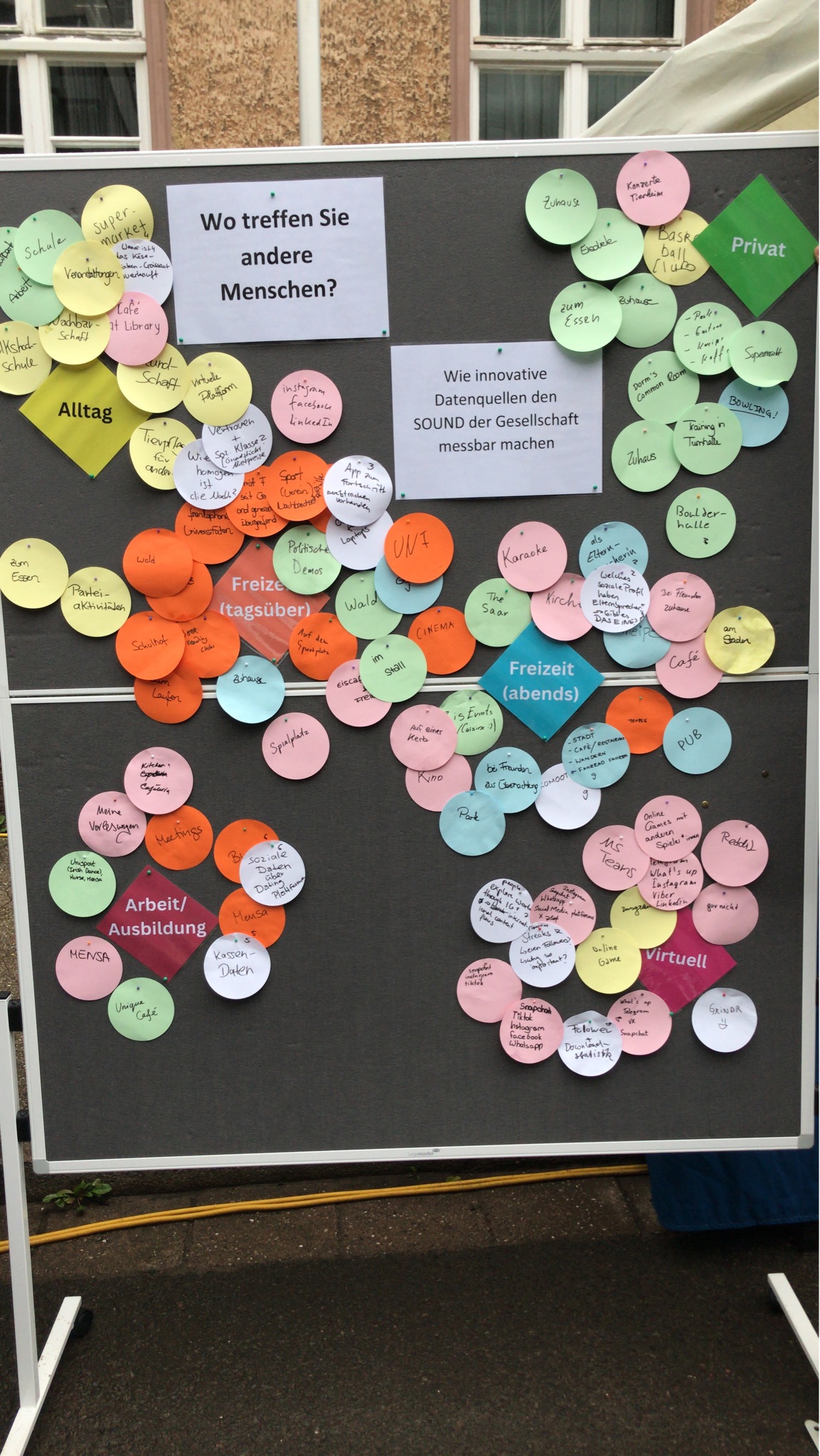
SOUNDS at the Campus Day
How can we make the SOUND of our society measurable? To answer this question, we used an interactive survey to ask visitors at the 2026 Open Campus Day: “Where do you meet other people?” The results show that - whether at work, in daily life, during leisure time, in the evening, or virtually - people enjoy meeting in a wide variety of places, but above all in locations where public life unfolds. These places form a vital foundation for democracy, for democracy takes place wherever people meet and exchange ideas. These encounters reflect the collective mood - the SOUND of society. And that is precisely what we aim to measure: using the Democracy Barometer.
Past news can be found in the archive.