
 Information for
 Quick links
 Faculties


SOUNDS

Title: Societal Observatory Using Novel Data Sources (SOUNDS)
General information:
- Homepage
- Start date: July 2025
- Funding: Transformationsprogramm Forschung und Wissenstransfer Saar
Contents: The Societal Observatory Using Novel Data Sources (SOUNDS), based at Saarland University and led by Prof. Ingmar Weber and Prof. Daniela Braun, is a pioneering interdisciplinary initiative designed to harness innovative data sources to systematically study societal transformations. SOUNDS bridges computer science and social sciences to advance research methodologies that leverage unconventional data such as social media analytics, satellite imagery, and web search trends. By combining Saarland University's expertise in informatics with insights from social science research, SOUNDS aims to become a central hub for innovative, empirical studies addressing contemporary societal challenges. Ultimately, SOUNDS seeks to inform decision-making, foster public engagement, and support democratic resilience, positioning itself as both a research powerhouse and a think-and-do tank dedicated to solving real-world societal issues.
The project originated at the Interdisciplinary Institute for Societal Computing (I2SC) at Saarland University, which was founded in 2023 by Prof. Dr. Daniela Braun and Prof. Dr. Ingmar Weber. The institute promotes interdisciplinary collaboration between the social sciences, the humanities and computer science, thereby laying the foundations for innovative research into societal issues in the digital age.


Science Slam: Dr. Philipp König Takes First Place
At the Science Slam at the Scheer City Hub, Dr. Philipp König impressed the audience and took first place at this year’s October event with his contribution, “Turn up the AMP! Political Influencers and the New Sound of Democracy.”
His talk explored how political influencers shape perceptions of political issues and how their presence on social media affects democratic processes. In doing so, König brought current questions of political communication to the stage.
König was a member of the CEUS European Junior Research College, where he completed his doctoral studies under CEUS Cluster Professor Prof. Dr. Daniela Braun. He is now part of the Saarland University flagship project Societal Observatory Using Novel Data Sources (SOUNDS), where he investigates societal developments using methods from computational social science.
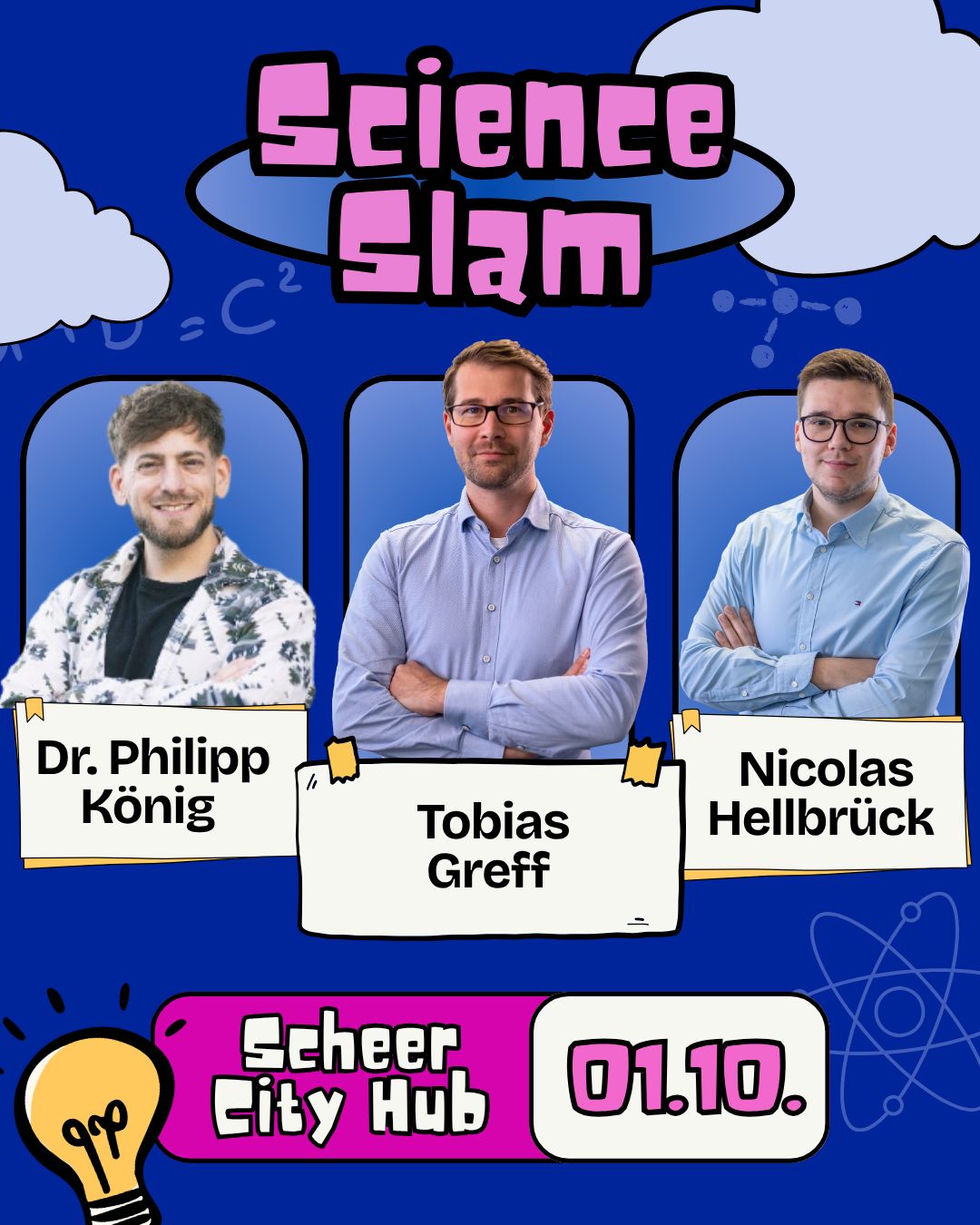
Dr. Philipp König zu Gast beim Science Slam des Scheer City Hubs | 1. Oktober
Am 1. Oktober bringt Dr. Philipp König, ehemaliges Mitglied im Nachwuchskolleg Europa am CEUS, seine Forschung zu politischen Influencer*innen auf die Bühne des Scheer City Hubs.
Politische Meinungsbildung verlagert sich zunehmend auf Plattformen und in Formate, deren Akteur*innen, Reichweiten und Wirkmechanismen wissenschaftlich bislang noch erstaunlich wenig untersucht sind. Beim Science Slam im Scheer City Hub fragt der Politikwissenschaftler unter dem Titel „Turn up the AMP! Politische Influencer und der neue Sound der Demokratie“, was diese neuen digitalen Öffentlichkeiten für politische Identitäten, gesellschaftliche Polarisierung und letztlich für unsere Demokratie bedeuten.
Dr. Philipp König promovierte bei CEUS-Clusterprofessorin Prof. Dr. Daniela Braun im Nachwuchskolleg Europa am CEUS und forscht heute im UdS-Leuchtturmprojekt Societal Observatory Using Novel Data Sources (SOUNDS) mit Methoden der Computational Social Science.
Zeit und Ort: 1. Oktober 2026, 19–21 Uhr
Scheer City Hub, St. Johanner Markt 25–29, 66111 Saarbrücken
Aufgrund begrenzter Plätze ist eine Anmeldung erforderlich.
Weitere Infos und Anmeldung | Webseite
New lecture series on Computational Social Science
Computational Social Science is the intersection between social sciences and computer science. This new discipline uses computational methods to address societally relevant research questions.
During the winter term 2026/27, SOUNDS offers a lecture series for students and guest listeners that introduces them to this new field. Every session introduces a societally relevant problem and shows the computational methods used to examine these problems. The lecture series takes place in English.
Who is this lecture series for?
- All students at Saarland University (LSF-Number 166580)
- Everyone who is interested in Computational Social Science (Guest listeners)
Who are the presenters? Researchers from …
- SOUNDS
- Interdisciplinary Institute of Societal Computing (I2SC)
- Max Planck Institute for Software Systems
- GESIS Leibniz-Institute for the Social Sciences
- Other German and international universities
For more information on the agenda, time and place, see here.
Two Professorships Open in the SOUNDS Research Initiative
SOUNDS (Societal Observatory Using Novel Data Sources) at Saarland University is recruiting for two professorial positions. SOUNDS is a collaborative research initiative that emerged from the cooperation between Prof. Dr. Daniela Braun and Prof. Dr. Ingmar Weber within the Interdisciplinary Institute for Societal Computing (I2SC), which they jointly founded. The initiative is co-directed by both researchers and aims to systematically investigate societal transformations using novel data sources.
By developing innovative methodological approaches, SOUNDS leverages data from sources such as social media platforms, satellite imagery, and web search behaviour to better understand and explain societal developments. Through the integration of computational methods and social science expertise, the initiative contributes to the advancement of empirical research methodologies. In the long term, SOUNDS seeks to establish itself as a leading research hub for the study of contemporary societal challenges and to provide scientifically grounded insights for policymakers, civil society, and the broader public.
Open positions:
- W3 Professorship in Computational Social Science (Reference No. W2906)
- W2 Professorship (Tenure Track to W3) in Political Science, Social Science, or Communication Science (Reference No. W2905)
Both positions offer the opportunity to contribute to the development of an emerging interdisciplinary field and to work within an international research environment.
Applications from qualified scholars from Germany and abroad are welcome. The SOUNDS initiative would also appreciate support in sharing these vacancies within relevant academic and professional networks to help reach suitable candidates.
Satellite images and online reviews: the SOUNDS data project explores their potential for Saarland
On 2 September at Saarland University's Innovation Center (Building A2 1), the SOUNDS data project will demonstrate how satellite imagery and Google Maps reviews can provide insights into life across Saarland. These kinds of analyses could also support decision-making processes in Saarland. SOUNDS is receiving financial support for this work from the Saarland state government's Transformation Fund. Businesses, public authorities and representative organizations are invited to attend the kick-off event free of charge and to contribute topics of their own.
When a damaged area of woodland is replanted in the Saarland, it takes years to see whether the young trees are taking root. Until now, this has only been visible on satellite images once a canopy has formed, often after five years. Angela Nyangate John has developed a method that detects reforestation around a year after planting. In a test area in Kenya, it identified 94 per cent of the sites where forest later grew, whilst a standard method detected only 47 per cent. Worldwide, several hundred million hectares of forest are set to regrow by 2030. This method would make it possible to assess whether this is successful much earlier. Partners from the Saarland forestry administration are registered to attend the event on 2 September and will take part in the discussions.

SOUNDS at the GESIS Institute Day
GESIS, the Leibniz Institute for Social Sciences, recently celebrated its 40th birthday. This year’s institute day was held under the motto “The Impact of Data”. In event's keynote Prof Dr Daniela Braun and Prof Dr Ingmar Weber presented the Societal Observatory Using Novel Data Sources (SOUNDS), which harnesses innovative data sources to systematically study societal transformations. SOUNDS bridges computer science and social sciences to advance research methodologies that leverage unconventional data such as social media analytics, satellite imagery, and web search trends. By combining Saarland University's expertise in informatics with insights from social science research, SOUNDS aims to become a central hub for innovative, empirical studies addressing contemporary societal challenges. Ultimately, SOUNDS seeks to inform decision-making, foster public engagement, and support democratic resilience, positioning itself as both a research powerhouse and a think-and-do tank dedicated to solving real-world societal issues.
The Chair at the Campus Day
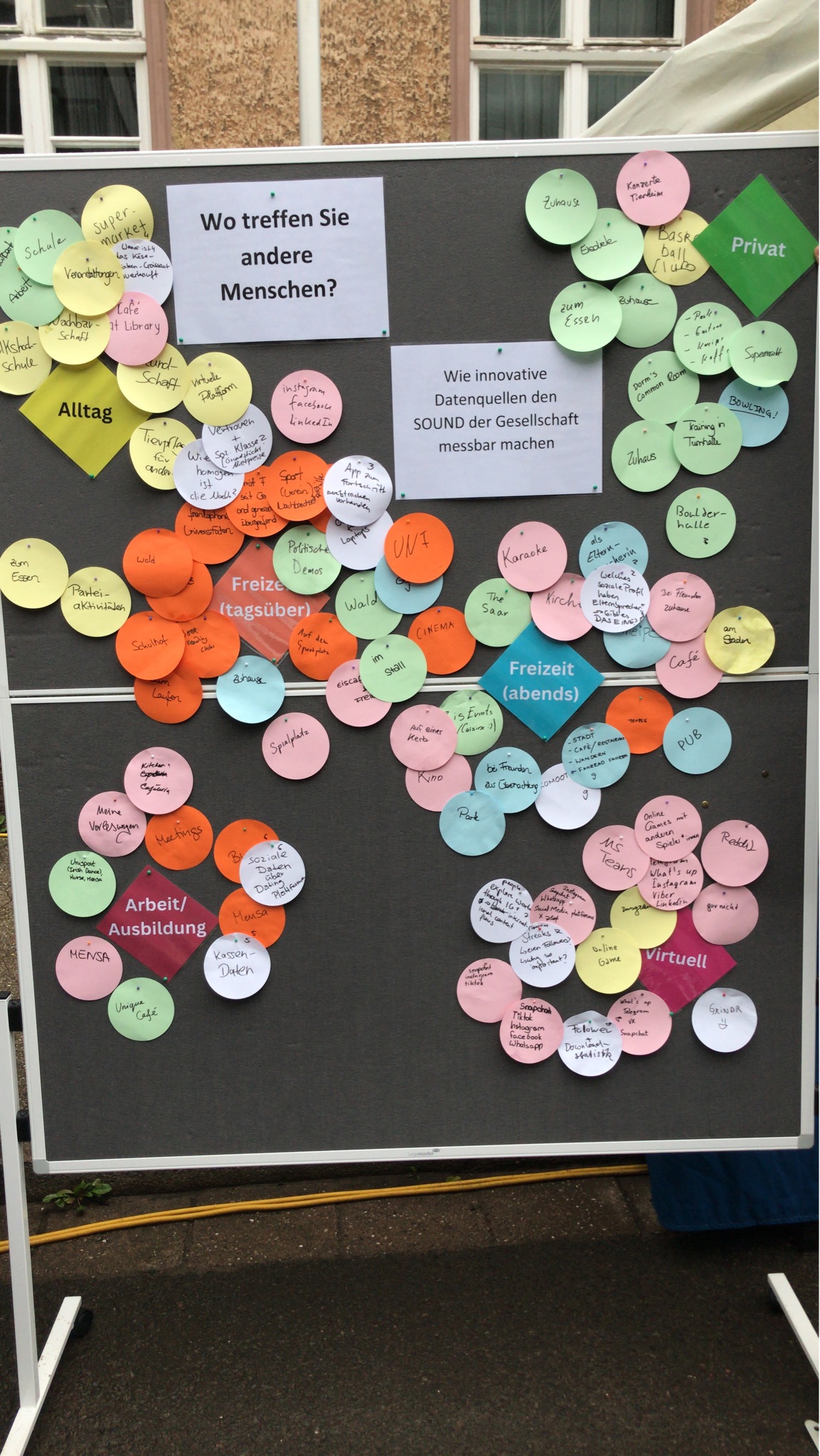
How can we make the sound of our society measurable? To answer this question, we used an interactive survey to ask visitors at the 2026 Open Campus Day: “Where do you meet other people?” The results show that - whether at work, in daily life, during leisure time, in the evening, or virtually - people enjoy meeting in a wide variety of places, but above all in locations where public life unfolds. These places form a vital foundation for democracy, for democracy takes place wherever people meet and exchange ideas. These encounters reflect the collective mood - the sound of society. And that is precisely what we aim to measure: using the Democracy Barometer.

Job advertisement: Teamlead Data Development Pool SOUNDS (m/w/d)
We are seeking a team lead for the SOUNDS data development pool (E14 TV-L, 100%, until July 2032, Saarland University). The application deadline is May 2, 2026.
What is SOUNDS?
SOUNDS stands for Societal Observatory Using Novel Data Sources – an interdisciplinary research program at Saarland University that investigates societal transformation processes using massive amounts of digital data and AI/ML methods. The program works with data sources that have so far been scarcely explored systematically in social research: social media streams, mobility data, satellite images, and transaction data. The goal is to combine methods from computer science with the questions posed by political science, sociology, and macroeconomics – with the long-term aim of establishing an independent institute.
Why is this position relevant to our network?
The Team Lead for the Data Development Pool is a classic interface role: technically demanding (data pipelines, data lakes, cloud architectures, streaming technologies), but embedded in a highly interdisciplinary scientific environment. We are looking for someone with several years of experience in data engineering and initial leadership experience – as well as the ability to work collaboratively with researchers from diverse disciplines. If you know any candidates in science management who work at or are looking to move into the interface between technology and science, this is the perfect opportunity.
Key Facts
- E14 TV-L, 100%, fixed-term contract until July 15, 2032, with the option to extend
- Application deadline: May 2, 2026
- Interviews: May 19, 2026, on-site in Saarbrücken
- Application: bewerbung@uni-saarland.de, reference number N2302
Job offer: Postdoctoral Researcher for the SOUNDS project
The political and social science research program of the Chair of European Integration and International Relations within the SOUNDS transformation programme is inviting applications for the following position commencing at the earliest opportunity: Academic Postdoctoral Researcher for Computational Social Sciences (m/f/x)
As a Postdoctoral Researcher, you will be part of the SOUNDS project at Professor Braun’s chair and conduct research at the intersection of Political Science and Computational Social Sciences (CSS).

Job advertisement: Research assistant and outreach and third mission officer with a focus on science communication at SOUNDS (m/f/d)
The Outreach and Third Mission Officer for Science Communication supports both the scientific project management and the executive management with regard to communication and visibility for SOUNDS. Specifically, he or she is responsible for the target group-oriented preparation and processing of scientific content and results, thereby contributing significantly to the dissemination of SOUNDS and the initiation of collaborations. The advisor also works together with the Outreach and Third Mission Advisor for stakeholder and partner management. The Science Communication Advisor also conducts their own scientific research as a research assistant in the field of Computational Social Sciences/Societal Computing in coordination with the scientific project management.

Report on SOUNDS in Die Zeit
To mark the journal's 80th anniversary, ‘Die ZEIT’ is publishing a special science issue. ‘Do we need a weather report for our society?’. The answer is provided by the SOUNDS project, initiated by Prof Dr Daniela Braun and Prof Dr Ingmar Weber at Saarland University, and funded by the Saarland Ministry of Finance and Science from the Transformation Fund. It is intended to help develop a kind of early warning system - a democracy barometer - to monitor the mood within our society. To achieve this, it combines interdisciplinary social and computer science approaches. It analyses social transformation processes using innovative data sources such as satellite images, social media and barcode scanners. The aim is to link computer and social sciences and strengthen the use of data-intensive methods. In the long term, the aim is to create an institute based on the structures that have been established.
New job offer: Postdoc Researcher positions (f/m/x) for Societal Computing
This position is a joint appointment between SOUNDS and the Societal Computing Group, reflecting the close scientific and strategic collaboration between both initiatives. The successful candidate will contribute to and shape research across both environments, benefiting from their complementary strengths in data-intensive, interdisciplinary research and international engagement. The joint nature of the position offers a unique opportunity to work at the interface of computer science and the social sciences, contribute to long-term institution-building efforts, and translate scientific insights into real-world societal and policy impact.

Job advertisement: Student assistant wanted
We are looking for a student/research assistant for the large-scale SOUNDS project!
- The tasks involve supporting project management in various organisational and administrative processes. For example:
- Supporting internal and external communication (e.g. website content, social media).
- Assisting with the creation of texts.
- Proofreading texts and presentations.
- Supporting the preparation, organisation and supervision of events, appointments, meetings and workshops.
- Conducting research.
- Supporting data management and analysis (no prior knowledge required).
Job advertisement: Project manager wanted
As part of the newly established interdisciplinary competence centre SOUNDS (Societal Observatory Using Novel Data Sources) at Saarland University, the following position is advertised with an application deadline of 10 October 2025:
Management of the large-scale SOUNDS project
In addition, further complementary positions as consultants and in the field of data engineering are planned in the near future, as well as a graduate college and the advertisement of new professorships in the field of computational social sciences.
We would be delighted if you could forward this advertisement to anyone who might be interested.

Saarbrücker Zeitung reports on SOUNDS
On 23 August, an article appeared in the Saarbrücker Zeitung introducing the new SOUNDS project, that is funded by the Saarland Ministry of Finance and Sciencefrom the Transformation Fund. It is intended to help develop a kind of early warning system - a democracy barometer - to monitor the mood within our society. To achieve this, it combines interdisciplinary social and computer science approaches. It analyses social transformation processes using innovative data sources such as satellite images, social media and barcode scanners. The aim is to link computer and social sciences and strengthen the use of data-intensive methods. In the long term, the aim is to create an institute based on the structures that have been established.

Millions in state funding: analysing society and the economy with new data sources
Satellite images, social media and barcode scanners in shops offer a wealth of data that has so far been little used in the social sciences. New AI-supported methods are helping with the evaluation of this data, but they require a great deal of IT expertise and legal and ethical classification. This interdisciplinary expertise is now to be pooled in a competence centre called "Societal Observatory Using Novel Data Sources (SOUNDS)".
The state government is supporting this with 29 million euros from the Transformation Fund in order to generate not only scientific insights but also concrete economic impetus for the transformation of the Saarland economy.

SR reports on SOUNDS
In its latest report, Saarländischer Rundfunk (SR) covers the SOUNDS project at Saarland University, which is dedicated to evaluating unconventional data such as social media analyses, satellite images and web search trends. SR interviewed political scientist Prof. Dr. Daniela Braun and computer scientist Prof. Dr. Ingmar Weber about the project. By combining the expertise of Saarland University in the field of computer science with findings from social science research, SOUNDS aims to become a central hub for innovative, empirical studies addressing current social challenges. Ultimately, SOUNDS aims to inform decision-making processes, promote public engagement and support democratic resilience, thereby positioning itself both as a research centre and as a think-and-do tank dedicated to solving real social problems.