
 Infos für
 Direkt zu
 Fakultäten


Red Blood Cell Properties and their Regulation at High Altitude
History
A major focus of our research is understanding how the body regulates red blood cell production and turnover when adapting to low-oxygen environments. In 2019, as part of a joint DACh research project, we conducted a high-altitude study at the Jungfraujoch Research Station in Switzerland. Using stable isotope techniques to track red blood cells throughout their lifespan, combined with measurements of total hemoglobin mass and detailed hematological analyses, we investigated the long-debated concept of neocytolysis—the proposed selective removal of young red blood cells after returning from high altitude. Our findings challenged this hypothesis as the primary mechanism responsible for the reduction in red blood cell mass1 following descent and sparked an international scientific discussion on how red blood cell turnover is regulated under changing oxygen conditions2,3.
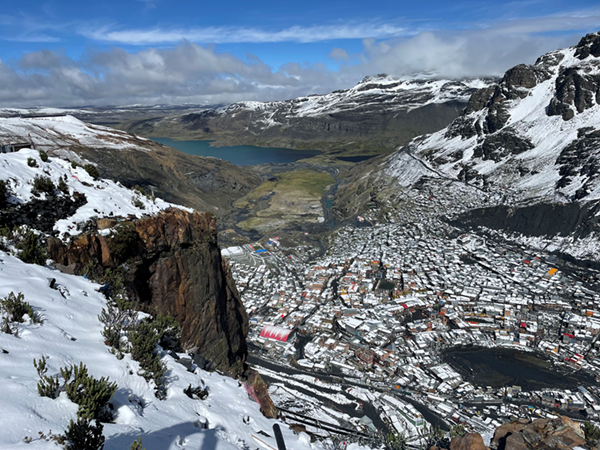
Building on this work, Prof. Kaestner participated in Expedition5300 in 2022, a large international research project led by the University of Grenoble and conducted in La Rinconada, Peru, the highest permanently inhabited settlement in the world. This unique natural laboratory provided an opportunity to study human adaptation to chronic hypoxia under extreme conditions. The project yielded new insights into red blood cell physiology at extreme altitude4,5, further questioning the concept of neocytolysis6 while uncovering novel links between oxygen transport, red blood cell metabolism, and genetic factors influencing adaptation to hypoxia7. The findings also contributed a novel perspective on the potential of red blood cells from chronic mountain sickness patients for transfusion purposes4.
1. Klein M, Kaestner L, Bogdanova AY, et al. Absence of neocytolysis in humans returning from a 3‐week high‐altitude sojourn. Acta Physiol 2021;232(3):e13647.
2. Recktenwald SM, Kaestner L, Bogdanova AY, Minetti G, Klein M, Mairbäurl H. “So is science …”1 : No evidence for neocytolysis on descending the mountains (Response to Rice and Gunga). Acta Physiol 2021;233(3):e13709.
3. Mairbäurl H, Kaestner L, Bogdanova AY, Klein M, Minetti G. Of mice and men1: How to achieve a better life with lower total Hb mass after returning from hypoxia to normoxia. (response to Song and colleagues). Acta Physiol 2021;233(3):e13720.
4. Stauffer E, Pichon A, Champigneulle B, et al. Making a virtue out of an evil: Are red blood cells from chronic mountain sickness patients eligible for transfusions? American Journal of Hematology 2024;
5. Champigneulle B, Caton F, Seyve L, et al. Are coagulation profiles in Andean highlanders with excessive erythrocytosis favouring hypercoagulability? Exp Physiol 2024;109(6):899–914.
6. Kaestner L, Champigneulle B, Stauffer É, et al. Neocytolysis after return from high altitude (5100 m): Further evidence for absentia. Acta Physiol 2023;238(3):e14002.
7. D’Alessandro A, Earley EJ, Nemkov T, et al. Genetic polymorphisms and expression of Rhesus blood group RHCE are associated with 2,3-bisphosphoglycerate in humans at high altitude. Proc Natl Acad Sci United States Am 2023;121(1):e2315930120.
Planned Work
While the previous studies have significantly advanced our understanding of how red blood cell mass is regulated in response to environmental oxygen availability, they have also revealed important unresolved questions. In particular, little is known about how lifelong high-altitude residents regulate erythropoiesis, red blood cell survival, iron metabolism, and plasma volume when moving between the chronically hypoxic environment of the Andes and sea-level conditions. Understanding these processes is essential, as Andean highlanders maintain one of the most pronounced physiological adaptations to chronic hypoxia found in humans.
Our planned research will address these questions through a unique longitudinal study in healthy Quechua highlanders from Cerro de Pasco, Peru, one of the highest permanently inhabited cities in the world. By following participants during residence at high altitude, after descent to sea level, and following re-ascent to altitude, we will investigate how elevated red blood cell mass is lost and subsequently regained within the same individuals. Combining stable-isotope techniques, measurements of total hemoglobin mass and plasma volume, assessments of red blood cell lifespan and turnover, and detailed analyses of iron metabolism and physiological performance, we aim to develop a comprehensive understanding of the mechanisms that regulate hematological adaptation in humans.
Beyond identifying how red blood cell mass is controlled, the project will also explore the physiological consequences of these adaptations, including their effects on exercise capacity, cardiovascular function, and pulmonary vascular responses. A particular focus will be placed on potential differences between women and men, an area that remains largely unexplored in altitude physiology. Together, these studies will advance our understanding of human adaptation to chronic hypoxia and reveal fundamental principles governing erythropoiesis, oxygen transport, and red blood cell turnover. These insights are relevant not only to altitude physiology and diseases associated with altered red blood cell regulation, but also to human health and performance in other extreme environments, including the prospect of long-duration space exploration.