
 Infos für
 Direkt zu
 Fakultäten


News
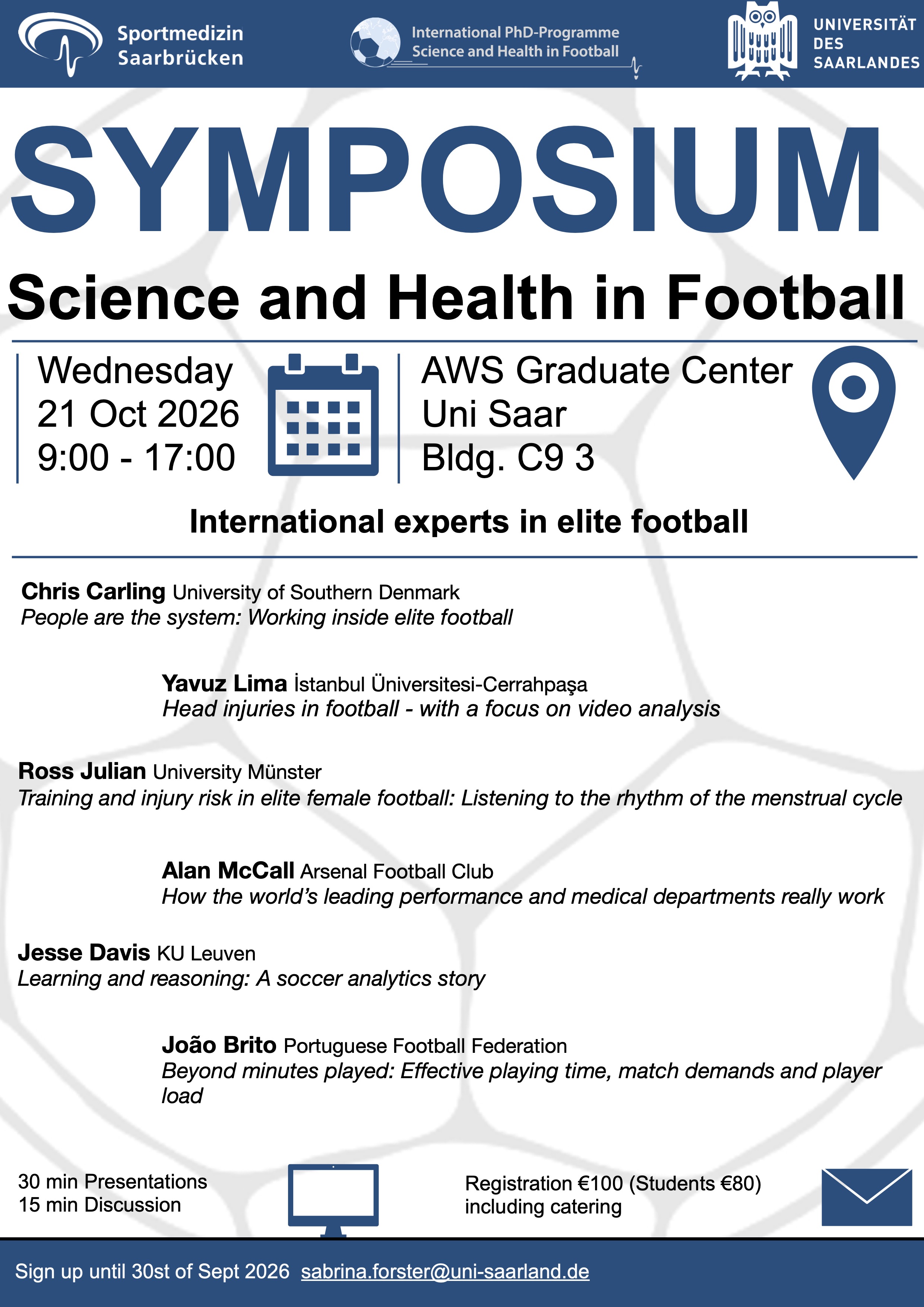
Science & Health in Football Symposium
Open registration and speaker announcement
We're excited to host the 6th Symposium Science and Health in Football here at Universität des Saarlandes:
When: October 21, 2026, 9 am – 5 pm
Where: Saarland University
We're delighted to welcome an internationally recognised line-up of scientists in football research:
Christopher C. (University of Southern Denmark)
João Brito (Portuguese Football Federation)
Jesse Davis (KU Leuven)
Ross Julian (PhD) (University Münster)
Yavuz Lima (İstanbul Üniversitesi-Cerrahpaşa)
Alan McCall (Arsenal Football Club)
Please register by September 30th via email to sabrina.forster(at)uni-saarland.de
We hope to see many of you here in Saarbrücken!
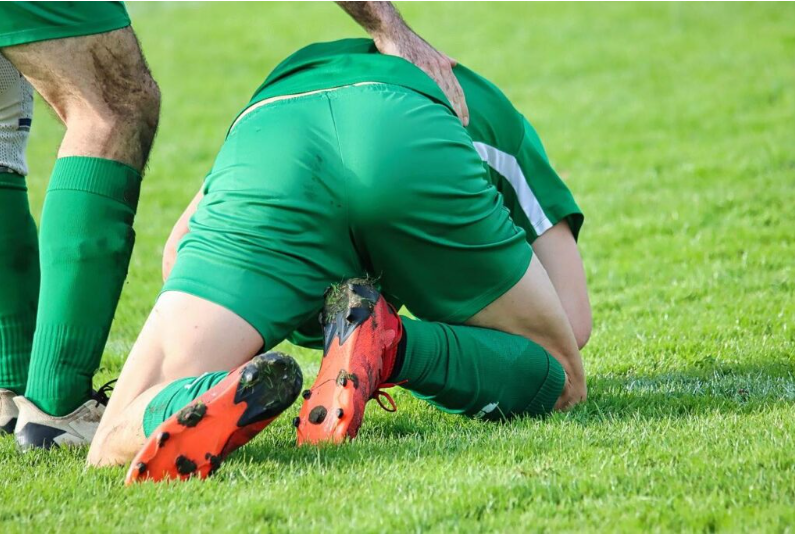
Verletzungsregister im Amateurfußball
Das Institut startet in Kooperation mit dem SFV eine Studie zur Erhebung von Verletzungsdaten im saarländischen Amateurfußball
Ziel ist es, Verletzungen im saarländischen Amateurfußball systematisch zu erfassen und auf dieser Grundlage wirksame Präventionsmaßnahmen zu entwickeln. Spieler können ihre Verletzungen künftig unkompliziert online melden. Die Angaben werden vom Verbandsarzt und seinem Team ausgewertet. Bereits nach der Meldung erhalten die Betroffenen eine erste telefonische Einschätzung. Bei Muskelverletzungen können zudem zeitnah Ultraschalluntersuchungen angeboten werden. Auch die teilnehmenden Vereine profitieren unmittelbar von dem Projekt. Sie erhalten nach Abschluss der Saison eine individuelle Verletzungsstatistik, die wertvolle Erkenntnisse über Art und Häufigkeit von Verletzungen im eigenen Verein liefert. Langfristig sollen die gewonnenen Daten dazu beitragen, gezielte Präventionsprogramme für den saarländischen Fußball zu entwickeln und das Verletzungsrisiko nachhaltig zu reduzieren. Der SFV und das Institut bitten alle Vereine, das Projekt zu unterstützen und den Teilnahmelink an ihre Spieler und Trainer weiterzugeben. Je mehr Fußballer sich beteiligen, desto aussagekräftiger werden die Ergebnisse und desto besser können Maßnahmen entwickelt werden, um Verletzungen künftig zu vermeiden. Ansprechpartner für das Projekt sind Dr. med. Florian Egger und Dr. med. Fritiof Lundström.

Hydratation bei den Special Olympics
Dr. Edgar Schwarz und Team im Einsatz
Die Special Olympics Nationalen Spiele 2026 fanden vom 15. bis 20. Juni im Saarland statt. Mit über 4.500 Athlet/innen und 11 Sportdisziplinen wurde hier ein Zeichen für Inklusion und Gemeinschaft gesetzt. Bei Temperaturen von >30 °C und vieler Sonnenstunden waren die Athlet/innen zusätzlich körperlich zusätzlich gefordert. Ein Team des Instituts, unter der Leitung von Dr. Edgar Schwarz, war vor Ort um sich den Einfluss der Umweltbedingungen genauer anzuschauen. Hierbei wurden Speichelproben und Fragebögen von Athlet/innen und Trainer/innen erhoben, um genauer herauszufinden, wie diese besondere Gruppe an Sportler/innen mit den Bedingungen umgeht und zurecht kommt. Die Ergebnisse der Speichelprobenlieferten außerdem einen direkten Aufschluss über den Hydratationsstatus der Athlet/innen, der vor Ort direkt in Empfehlungen an die Sportler/innen umgemünzt wurde.
Neues aus der Forschung
"Delaying Early Morning Training Time in Swimmers: Effects on Sleep, Recovery and Performance—A Randomized Controlled Trial"
Maxime M. E. Brandts, Sabrina Forster, Anne Hecksteden & Tim Meyer
Swimmers often fail to achieve recommended sleep durations. Early morning training, common in swimming, is associated with shorter sleep. Sleep extension through later wake-up times appears to be an appropriate measure to counteract this. Therefore, this study investigated whether delaying early morning training has an effect on sleep, recovery and performance, and whether changes in sleep mediate eventual effects on recovery and performance. Using cross-over design, 27 national-level swimmers (13 females, 14 males; age: 15.6 ± 1.0 years) completed two 8-day training camps in January and October 2023 in Saarbrücken, Germany. Morning sessions started at 07:00 AM (early) or 09:00 AM (late), with conditions randomized between camps. Sleep and recovery were assessed using actigraphy, sleep diaries, and the Short Recovery and Stress Scale. Performance was evaluated using 100 m main stroke and 800 m freestyle time-trials pre- and post-camp. Linear mixed-effects models and repeated measures analysis of variance were employed to assess the effect of training time on sleep, recovery and performance. Regression-based mediation analysis tested whether changes in sleep and recovery mediated the effects of training timepoint on recovery and performance. Sleep duration per night was significantly longer in the late compared to the early condition (1.0 ± 0.5 h; t = 14.0, p < .001). However, there was no significant effect on measures of recovery (p > .080), and 100 m and 800 m performance (p > .204). Mediation analysis showed no indirect effects of sleep duration on mental capacity or of mental capacity on performance (p > .05). Delaying early morning training from 07:00 AM to 09:00 AM increased sleep duration by one hour on average, but this did not significantly affect recovery or performance in elite swimmers. Nevertheless, the study provides evidence that early morning training is associated with reduced sleep duration and highlights the persistent sleep challenges faced by adolescent swimmers.
"Subsequent Injury Risk After Return-to-Play From Lower-Extremity Muscle Injuries in Professional Male Football (Soccer)"
Guangze Zhang, Michel S. Brink, Dominik Szymski, Lorenz Huber, Werner Krutsch, Volker Alt, Karen aus der Fünten, Tobias Tröß, Tim Meyer, Koen Lemmink, & Anne Hecksteden
Background:
Injuries to the upper extremity account for nearly half of the overall injury burden in professional football (soccer), with incidence rates differing across major muscle groups under both acute and overuse conditions. Importantly, they are commonly associated with an increased susceptibility to subsequent injury, especially in the weeks after return to play (RTP). However, the specific post-RTP risk trajectories after different lower-extremity muscle injuries remain insufficiently characterized.
Purpose:
To investigate the risk trajectory for noncontact subsequent injury after returning from major lower-extremity muscle injuries in professional football players, differentiating acute from overuse index injuries.
Methods:
Prospectively collected injury data from clubs in the first and second German Bundesliga over 3 seasons (2022-2023 to 2024-2025) were used for time-to-event analysis. Index injuries (ie, injuries from which players returned to play during the study period) of interest included hamstring, quadriceps, adductor, and calf injuries. Acute and overuse index muscle injuries were analyzed separately across these locations. Noncontact time-loss subsequent injuries occurring in the same season as RTP were considered the event of interest. Built upon previously published methodology, the Kaplan-Meier survival function was used to estimate the cumulative hazard function, from which the continuous hazard function was derived.
Results:
During the 3 analyzed seasons, 374 acute and 304 overuse index injuries were identified at the 4 lower-extremity muscle groups. Observed noncontact subsequent-injury rates were 27.9%, 26.2%, 39.3%, and 21.2% after acute hamstring, quadriceps, adductor, and calf index injuries, respectively, and 28.1%, 27.7%, 27.2%, and 27.4% for overuse index injuries. While the time course of noncontact subsequent injury risk globally aligned with previous findings, differences between muscle groups were observed. Players returning from acute hamstring and adductor injuries showed elevated risk, which diminished within approximately 12 and 4 weeks, respectively, and leveled off thereafter. By contrast, a delayed risk peak around 3 weeks after RTP was found for overuse calf index injuries.
Conclusion:
This descriptive study further confirms the time-varying nature of subsequent injury risk for specific lower-extremity muscle injuries. The observed differences in risk trajectories across muscle groups highlighted the need for careful RTP decision-making based on each index injury.
"Identifying targets for behavior change interventions to integrate biological maturation in German football development programs: A COM-B and Behavior Change Wheel analysis"
Lukas Arenas, Sabrina Forster, Tim Meyer, Jamie Salter & Monika Frenger
This study examines enablers and barriers to integrating biological maturation into talent identification and development processes within German football academies. Biological maturation significantly influences physical performance, selection decisions, and injury risk in youth football. Early maturing players are often favoured during talent identification, leading to premature deselection of talented late-maturing athletes. Using the COM-B framework (Capability, Opportunity, Motivation – Behaviour), we investigated stakeholders perceived barriers and enablers to implementing maturation strategies. An adapted COM-B-Qv1 questionnaire was distributed to 990 stakeholders across 56 elite academies and 344 regional training centres (June – July 2025), yielding 142 complete responses (14.3% completion rate). Internal consistency of the adapted scales was acceptable to good (Cronbach’s α = 0.67–0.84). Results showed that 78% of participants conduct maturation assessments, while 24% rarely or never considered it in player development and 51% did so only occasionally. Regional-affiliated stakeholders reported significantly higher barriers than league-affiliated participants (p < 0.05). Opportunity, expressed through the perceived lack of tools, time, and incentives, emerged as the strongest barrier (mean = 3.38 ± 1.30). These findings suggest that targeted training, enablement, and environmental restructuring may be particularly effective for improving the systematic integration of biological maturation in German football academies, especially in regional settings.
Alle Publikationen
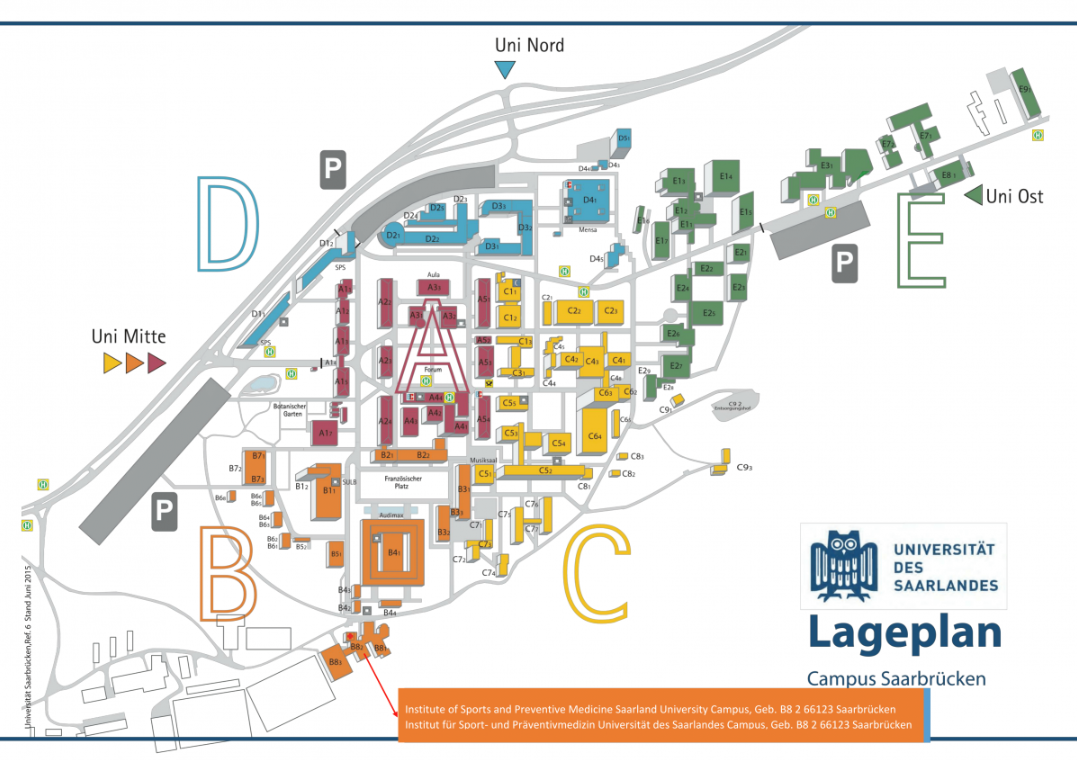
Kontakt
Institut für Sport- und Präventivmedizin
Universität des Saarlandes
Campus, Geb. B8 2
66123 Saarbrücken
Tel: +49 681-302 70400
Fax: +49 681-302 4296