
 Infos für
 Direkt zu
 Fakultäten


Research
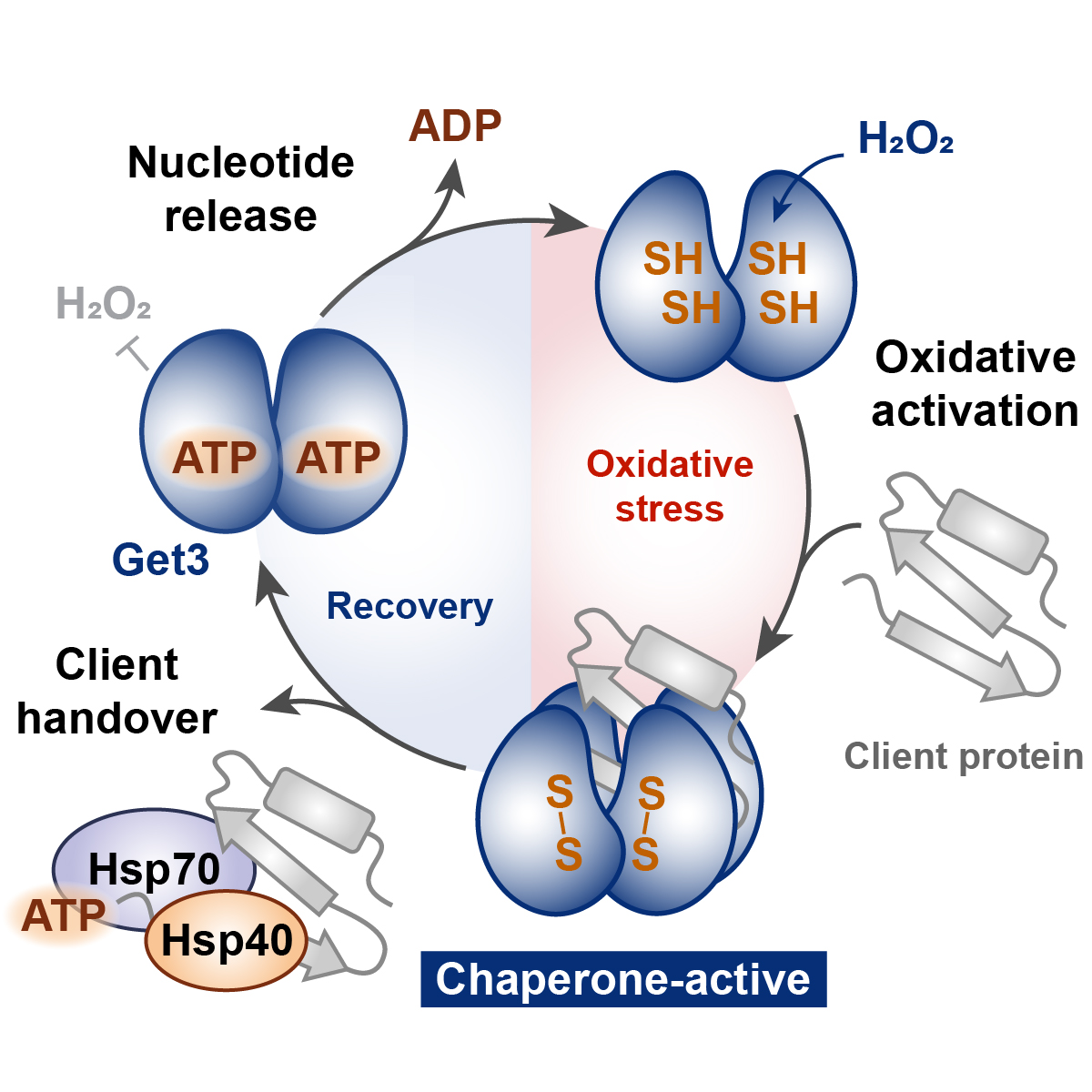
Redox-regulation of the stress-sensing chaperone Get3
In yeast, the oxidative activation of the cytosolic protein Get3 as an ATP-independent chaperone protects cells from oxidative stress. Under non-stress conditions, Get3 functions as an ATPase in the GET pathway mediating the Guided Entry of Tail-anchored proteins into the ER membrane. Upon oxidation, Get3 forms chaperone-active oligomers that localize at defined foci in the cell. Get3’s functional switch depends on the redox state of the highly conserved CXC motif which is under tight control of Get3’s nucleotide-binding state, making Get3 an ideal sensor for ATP-depleting, oxidative stress conditions. Vice versa, inactivation of the chaperone function requires the reduction of Get3 and rebinding of ATP, which then confers the switch back into its chaperone-inactive, ATPase-active form. This two-step mechanism ensures that clients are only released upon restoring both, the cellular redox homeostasis and ATP-levels, which are required for the energy-driven proteostasis system to refold or degrade clients.
Our overall goal is to identify client proteins that depend on Get3’s stress-induced chaperone function and focus on the crosstalk between the cellular redox homeostasis and proteostasis. Which cellular redox systems mediate (in)activation of Get3’s chaperone function and what happens to clients? How does the manipulation of Get3’s ATP-binding state and/or thiol switch affect client binding and the interaction with ATP-dependent proteostasis systems? Does Get3 also target irreversibly damaged proteins to degradation?
References
Ulrich, Schwappach, Jakob, Biol Chem. 2020. doi:10.1515/hsz-2020-0262; Ulrich et al. Mol Cell. 2022;82(17):3226-38 e7. doi:10.1016/j.molcel.2022.06.015; Voth, et al. Mol Cell. 2014;56(1):116-27. doi:10.1016/j.molcel.2014.08.017; Powis et al. J Cell Sci. 2013;126(Pt 2):473-83. doi:10.1242/jcs.112151
Tissue-specific proteostasis maintenance and healthy aging
The accumulation of reactive oxygen species (ROS) has been long known to be associated with cellular dysfunction and the onset and progression of many diseases during aging. Although efficient antioxidant systems have evolved to protect organisms from oxidative stress, ROS levels can exceed the antioxidant capacity and damage all cellular components. Oxidative protein unfolding can result in potentially toxic protein aggregation which endangers the integrity of the entire cell. Redox-regulated chaperones, which become activated upon oxidative unfolding stresses, serve as a first line of defense to protect the proteome form wide-spread aggregation.
We aim to better understand the tissue-specific role of stress-induced chaperones in proteostasis maintenance during aging, environmental stress and age-associated diseases. Studying the Get3 homolog ASNA-1 in C. elegans,, we investigate how chaperones affects the redox balance in C. elegans and explore the crosstalk with proteostasis systems to elucidate how this interplay will affect lifespan and healthy aging.

References
Ulrich and Jakob, Free Radic Biol Med. 2019;140:14-27. doi:10.1016/j.freeradbiomed.2019.05.035; Ulrich, Schwappach and Jakob, Biol Chem. 2020. doi:10.1515/hsz-2020-0262; Bazopoulou et al. Nature, 2019. 576(7786): p. 301-305; Ulrich et al. Mol Cell. 2022;82(17):3226-38 e7. doi:10.1016/j.molcel.2022.06.015. Kao et al. Cell, 2007. 128(3): p. 577-87; Hemmingsson et al. Cancer Res, 2010. 70(24): p. 10321-8; Raj et al. Sci Rep, 2021. 11(1): p. 8678.