
 Information for
 Quick links
 Faculties



Institute for Myopia and Myopia Management
Head: Prof. Dr. Hakan Kaymak
The Gottfried O.H. Naumann Endowed Chair for Epidemiology and Prevention of Myopia at Saarland University was established in 2024. As a research institute, we focus on the prevention and management of short-sightedness (myopia) in children and young adults. We work closely with Prof. Dr. Berthold Seitz, Director of the Eye Clinic, Prof. Dr. Achim Langenbucher, Head of the Institute for Experimental Ophthalmology in Homburg/Saar, and Prof. Dr. Frank Schaeffel, Head of the Section for Neurobiology of the Eye at the University of Tübingen. As a member of the International Myopia Institute (IMI), Prof. Kaymak also collaborates with researchers at an international level.
Myopia: prevalence and risks
Short-sightedness (myopia) is on the rise worldwide: according to the Gutenberg Health Study conducted by the University of Mainz, 35 per cent of adolescents and young adults in Germany are short-sighted. Among university graduates, researchers recorded a rate of 53 per cent.
The most common form is axial myopia, in which the eyeball grows excessively in length. This causes the structures of the rear pole of the eye to stretch and thin. Higher values increase the risk of eye diseases that threaten vision, such as retinal holes and detachments, cataracts and glaucoma. The more people are affected by high myopia, the more serious the social consequences.
Our goal: prevention of high myopia
One of the objectives of the endowed professorship is to prevent high myopia in particular through effective preventive measures in childhood. This is because myopia develops in most cases between the ages of 8 and 15, which is why it is also known as school myopia. On average, it reaches values of -3 to -6 dpt in adulthood. A value of -5 dpt and/or an axial length of the eyeball of ≧ 25.5 mm is referred to as high myopia.
Our focus: health services research
In order to quantify the prevalence, we are conducting school screening programmes and developing a screening programme for children. This means that our team visits schools and examines the children. We have found that the incidence is around 25 to 30 percent.
Half of these short-sighted children have not been diagnosed with myopia. This means that 40 to 50 per cent of pupils have a visual acuity of less than 63. This result further shows that the provision of effective diagnostic and therapeutic methods needs to be improved.
Our main areas of research
- Health services research
Conducting school screening programmes and developing and implementing a child screening programme. - Further development of age-matched myopia control
Assessment of risks and treatment success based on the physiological eye length growth of emmetropic girls and boys of the same age. - Research and comparison of myopia therapies
As part of a dose-finding study, the institute is determining the most effective dosage of atropine eye drops. Further pharmacological studies are planned, including innovative options such as contact lenses as drug delivery devices. The available therapies for myopia control in children also include various myopia-inhibiting spectacle lenses and contact lenses, as well as ortho-k lenses. These will be compared in terms of their effectiveness, tolerability and safety. - Effects of refractive correction procedures
According to current findings, eye length continues to increase in adults with high myopia. Therefore, the effects of various refractive correction procedures on this process will be investigated. - Development of new correction procedures
Against this backdrop, there are also plans to develop new correction procedures in collaboration with the University of Marburg.
Age-matched myopia control and myopia management (AMMC)
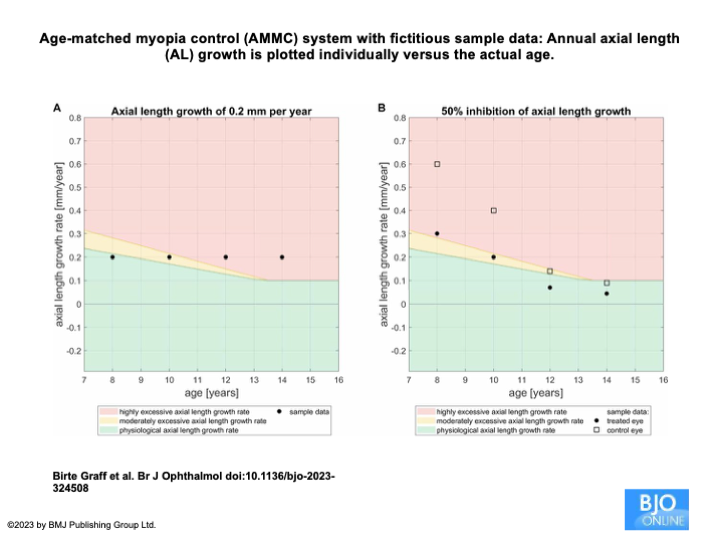
Until now, refraction has been used as the basis for both risk assessment and measuring the success of treatment. Since eye length plays a central role in axial myopia, we use physiological eye length growth as the benchmark for age-matched myopia control (AMMC), thereby initiating a paradigm shift.
- Risk assessment
The axial growth of the eye is assessed using percentiles. This allows increased growth to be detected at an early stage compared to a healthy emmetropic eye of a girl or boy of the same age. - Definition of the treatment goal
To date, there has been no therapeutic goal for myopia management. We have therefore defined physiological eye growth as the therapeutic goal. This also serves as a benchmark for reliably assessing the success of treatment. Physiological eye growth is a universal goal – for Europe, Asia and everywhere else in the world – and depends on the age and gender of the child. - Comparison of available treatments
The AMMC concept also offers reliable standards for comparing available therapies in terms of their effectiveness, efficacy and safety. - AMMC-Software for clinical use
Based on this concept, software has been developed for ophthalmologists that can be used to classify and assess individual values directly into one of three categories: normal growth, moderately accelerated growth and rapidly accelerated growth. It is available for biometric devices from all major manufacturers. Ophthalmologists can download the Myopia Solutions software free of charge. There are also plans to develop AI-based models to enable predictions to be made about the individual progression of myopia. - Comparison of biometric devices
A comparison will also be carried out to determine which biometric devices are suitable for myopia control in children.
About Prof. Dr. Hakan Kaymak
Prof. Dr. Hakan Kaymak is a research professor at the Gottfried O.H. Naumann Endowed Chair for Epidemiology and Prevention of Myopia. He is also a professor of experimental ophthalmology at Saarland University.
In addition, he is co-owner and director of the Macula Retina Myopia Centre in Düsseldorf, where he works as an ophthalmologist and senior eye surgeon.
Further informationen
Responsible for the contents of this webpage
Prof. Dr. Hakan Kaymak
Eye clinic (Augenklinik), Gebäude 22
Kirrberger Straße 100
66421 Homburg/Saar
Tel.: +49 6841 16-21218
dr.h.kaymak(at)gmail.com