
 Information for
 Quick links
 Faculties


Models and Methods for an Active Ageing workforce
Kurzbeschreibung
MAIA is a ‘Research and Innovation Staff Exchange’ funded by the Horizon 2020 research and innovation program. It develops an international academy, comprising of 14 academic partners: 7 European universities and 7 Third Countries universities. The academy will focus on active ageing industrial workforce problems and needs.
The network is multidisciplinary with leading expertises on ageing and psychosocial aspects, ergonomics, manufacturing system design, robotics/assistance technologies, and economics.
Eric Grosse is member of the Advisory Board of MAIA.
Publikationen
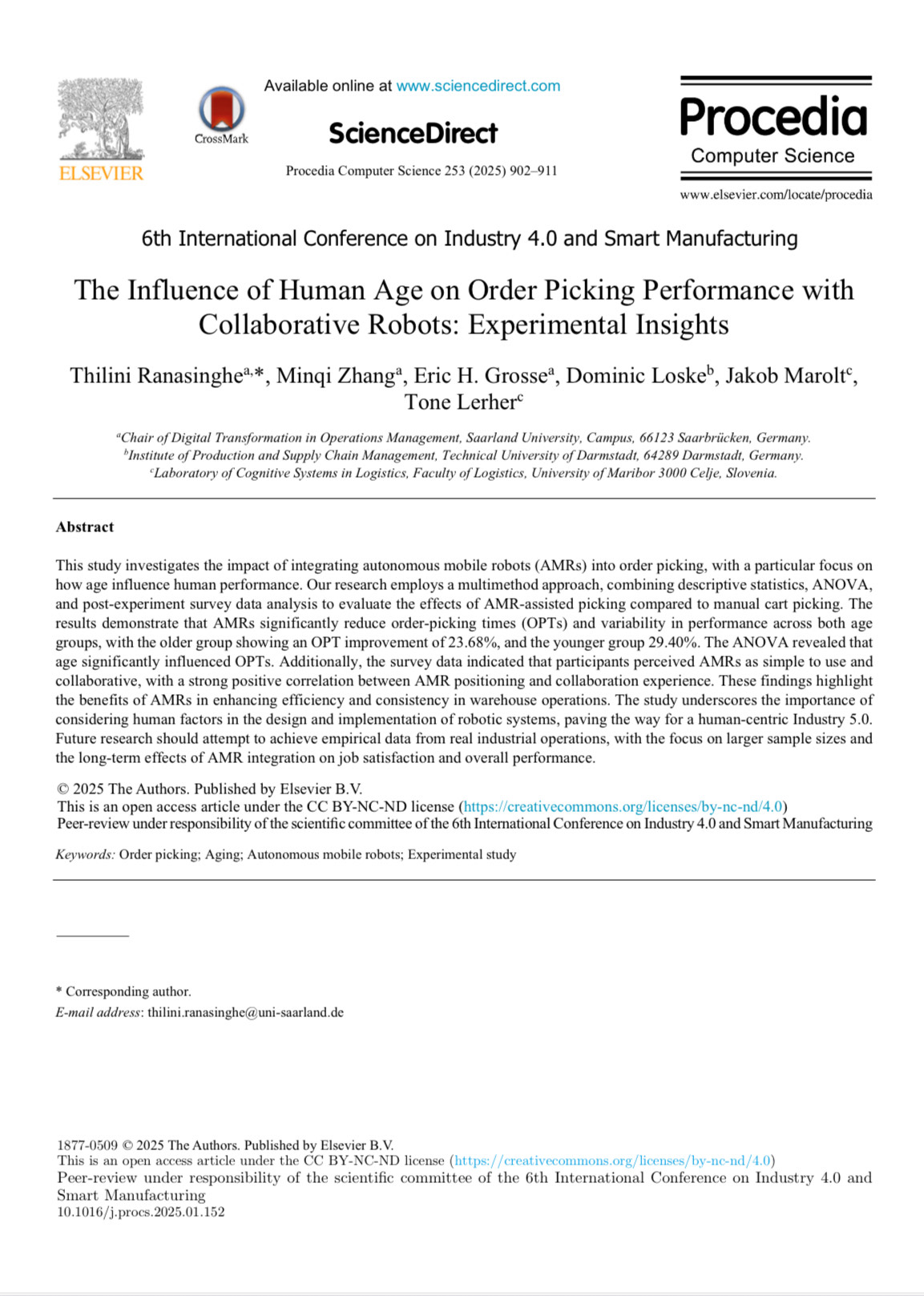
The Influence of Human Age on Order Picking Performance with Collaborative Robots: Experimental Insights
Ranasinghe, Zhang, Grosse, Loske, Marolt & Lerher (2025)
This study investigates the impact of integrating autonomous mobile robots (AMRs) into order picking, with a particular focus on how age influence human performance. Our research employs a multimethod approach, combining descriptive statistics, ANOVA, and post-experiment survey data analysis to evaluate the effects of AMR-assisted picking compared to manual cart picking. The results demonstrate that AMRs significantly reduce order-picking times (OPTs) and variability in performance across both age groups, with the older group showing an OPT improvement of 23.68%, and the younger group 29.40%. The ANOVA revealed that age significantly influenced OPTs. Additionally, the survey data indicated that participants perceived AMRs as simple to use and collaborative, with a strong positive correlation between AMR positioning and collaboration experience. These findings highlight the benefits of AMRs in enhancing efficiency and consistency in warehouse operations. The study underscores the importance of considering human factors in the design and implementation of robotic systems, paving the way for a human-centric Industry 5.0.
Future research should attempt to achieve empirical data from real industrial operations, with the focus on larger sample sizes and the long-term effects of AMR integration on job satisfaction and overall performance.
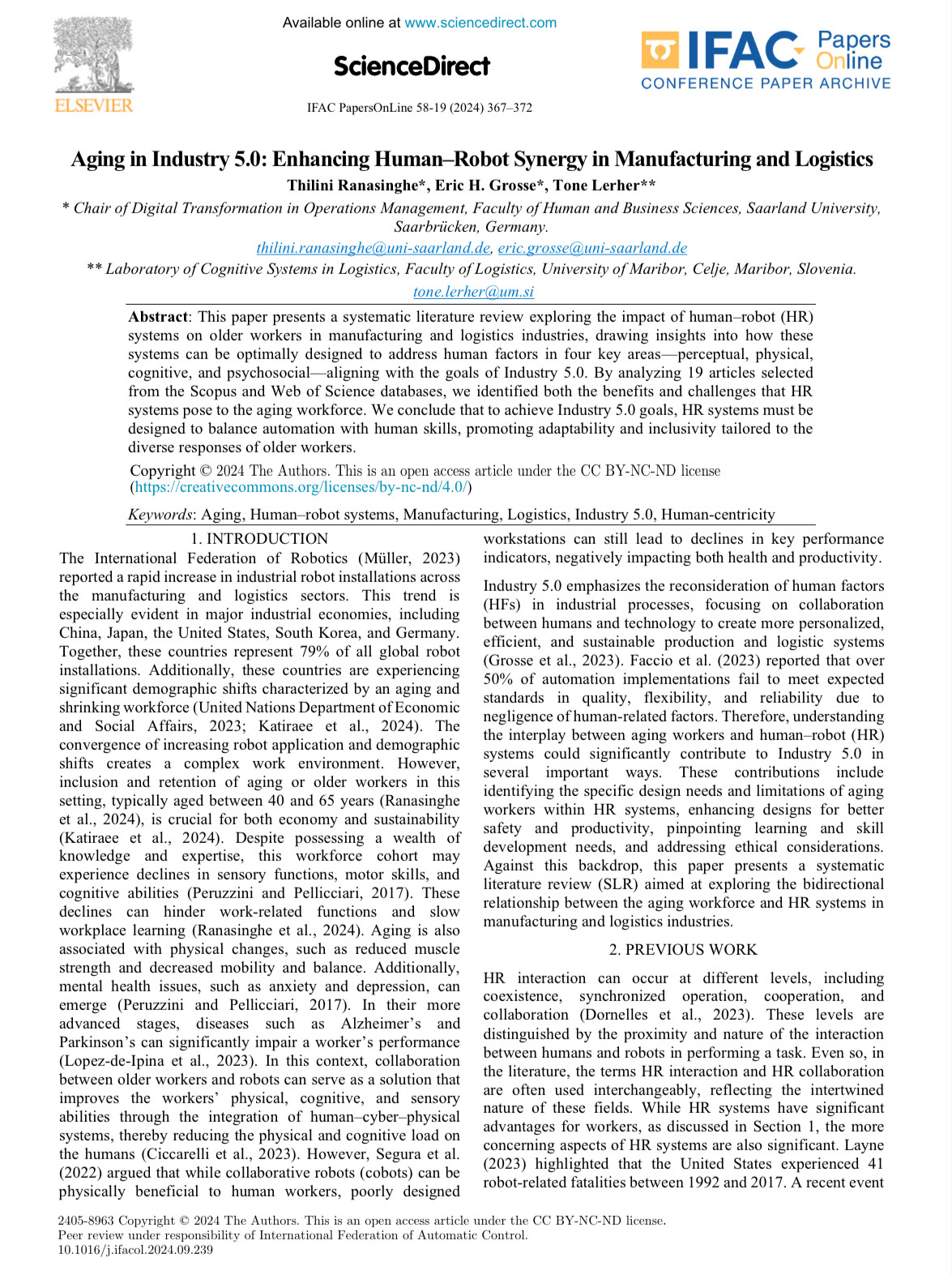
Aging in Industry 5.0: Enhancing Human–Robot Synergy in Manufacturing and Logistics
Ranasinghe, Grosse & Lerher (2024)
This paper presents a systematic literature review exploring the impact of human-robot (HR) systems on older workers in manufacturing and logistics industries, drawing insights into how these systems can be optimally designed to address human factors in four key areas—perceptual, physical, cognitive, and psychosocial-aligning with the goals of Industry 5.0. By analyzing 19 articles selected from the Scopus and Web of Science databases, we identified both the benefits and challenges that HR systems pose to the aging workforce. We conclude that to achieve Industry 5.0 goals, HR systems must be designed to balance automation with human skills, promoting adaptability and inclusivity tailored to the diverse responses of older workers.
Never too late to learn: Unlocking the potential of aging workforce in manufacturing and service industries
Ranasinghe, Grosse, Glock & Jaber (2024)
This study systematically reviews 51 articles from Scopus and Web of Science databases to investigate the learning of aging workers in the manufacturing and service industries. It focuses on three key research questions: factors influencing learning among aging workers, effective learning approaches for this demographic, and strategies for enhancing their learning outcomes. The factors influencing learning were categorized into individual, organizational, and societal dimensions, illustrating the sophisticated interaction that shapes the learning environment. Effective learning approaches identified include lifelong learning, utilizing technology, and intergenerational learning, which are interrelated and reinforce each other. Furthermore, we propose a sevenstep socio-technical system approach to enhance learning for the aging workforce. This novel approach considers technological tools, as well as human, organizational, and societal elements that play an essential role in the learning process. Our findings present a comprehensive perspective on the complexities of older workers’ learning and offer actionable insights to enhance their learning experience. The proposed socio-technical model contributes to creating an inclusive and supportive learning environment, aiming to boost key areas, such as job performance, satisfaction, health, and well-being. This study’s implications extend to organizations aiming to optimize the potential of an aging workforce in a rapidly evolving digital world.
Aging Workforce and Learning: State-of-the-art Aging Workforce and Learning: State-of-the-art
Ranasinghe, Grosse, Glock & Jaber (2023)
The population of most developed countries is aging; thus, the median age of the global workforce continues to rise. Human aging often results in a decline in physical and cognitive abilities, which may adversely affect the performance of
labor-intensive manufacturing systems. Older workers embody profound experience and refined skills, which are success factors for manufacturing companies. Therefore, it is important for manufacturing companies to ensure that older workers remain active and productive. Identifying the potential of an aging workforce, employing technical assistance systems to meet their needs, customizing work flow processes, imparting proper training, and utilizing their experience and skills may provide a competitive advantage for the company. This paper reviews the relevant literature to understand how aging influences workers’ learning in the manufacturing and service industries and identifies management concepts and technologies suitable to support an active aging workforce. We report preliminary insights and discuss selected papers on how aging influences learning-by-doing, and experiential knowledge retention. Finally, we propose some future research directions.