Information for
 Quick links
 Faculties


The Department of Transplantation and Infection Immunology was founded in 2009 as an interdisciplinary department to combine basic research with patient-oriented research. The scientific focus is on the regulation of cellular immune responses against clinically relevant pathogens and against donor tissue after organ transplantation. Another focus is on the monitoring of infectious complications under immunosuppression and on the quantification of the efficacy of immunosuppressive drugs.
The department includes a research laboratory as well as a diagnostic area offering the quantification of specific T cells against the cytomegalovirus as well as against the causative agent of tuberculosis using state-of-the-art technology. The scientific work is supported by the German Research Foundation (DFG), the Else-Kröner-Fresenius Foundation, the German José Carreras Leukemia Foundation, the Roche Organ Transplant Research Foundation (ROTRF), the European Union (EU), the German Federal Ministry of Education and Research (BMBF) and Staatskanzlei des Saarlandes.
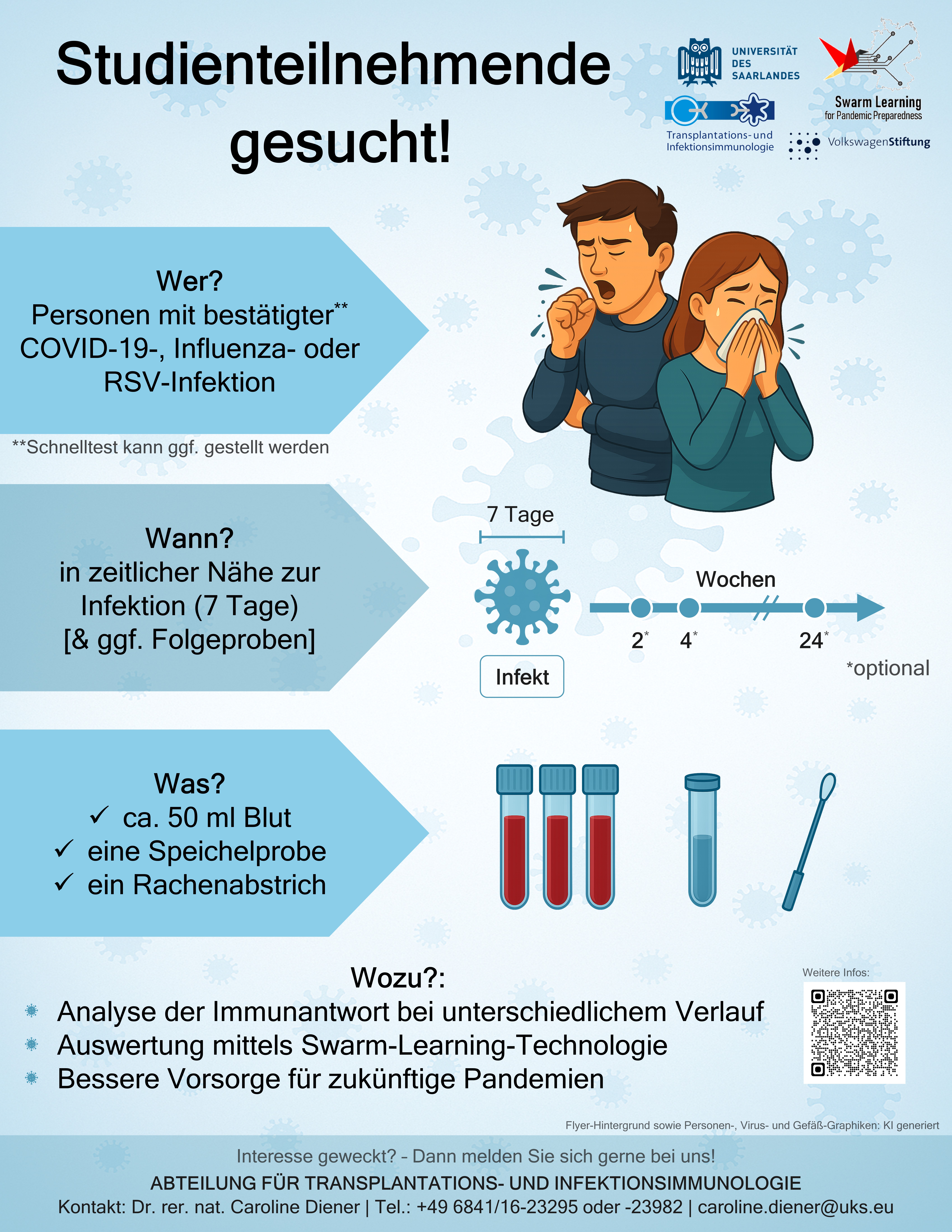
Using swarm AI against COVID and other diseases!
In collaboration with several German research centers, universities and university hospitals, we want to use artificial intelligence (AI) to jointly evaluate decentralized data on COVID-19. Our approach is based on “swarm learning”, a new type of AI technology that makes it possible to analyze distributed data sets while fully complying with data protection requirements. The three-year research project is being funded by the Volkswagen Foundation with five million euros. Experts from the field of scientific ethics will support the project. The aim of the initiative is to pave the way for an international research network and infrastructure to enable a better response to pandemics. The project is coordinated by the German Center for Neurodegenerative Diseases in Bonn. Interested in more details?
Click here for the press release.
Studie zur Gürtelrose-Immunität (Herpes Zoster)
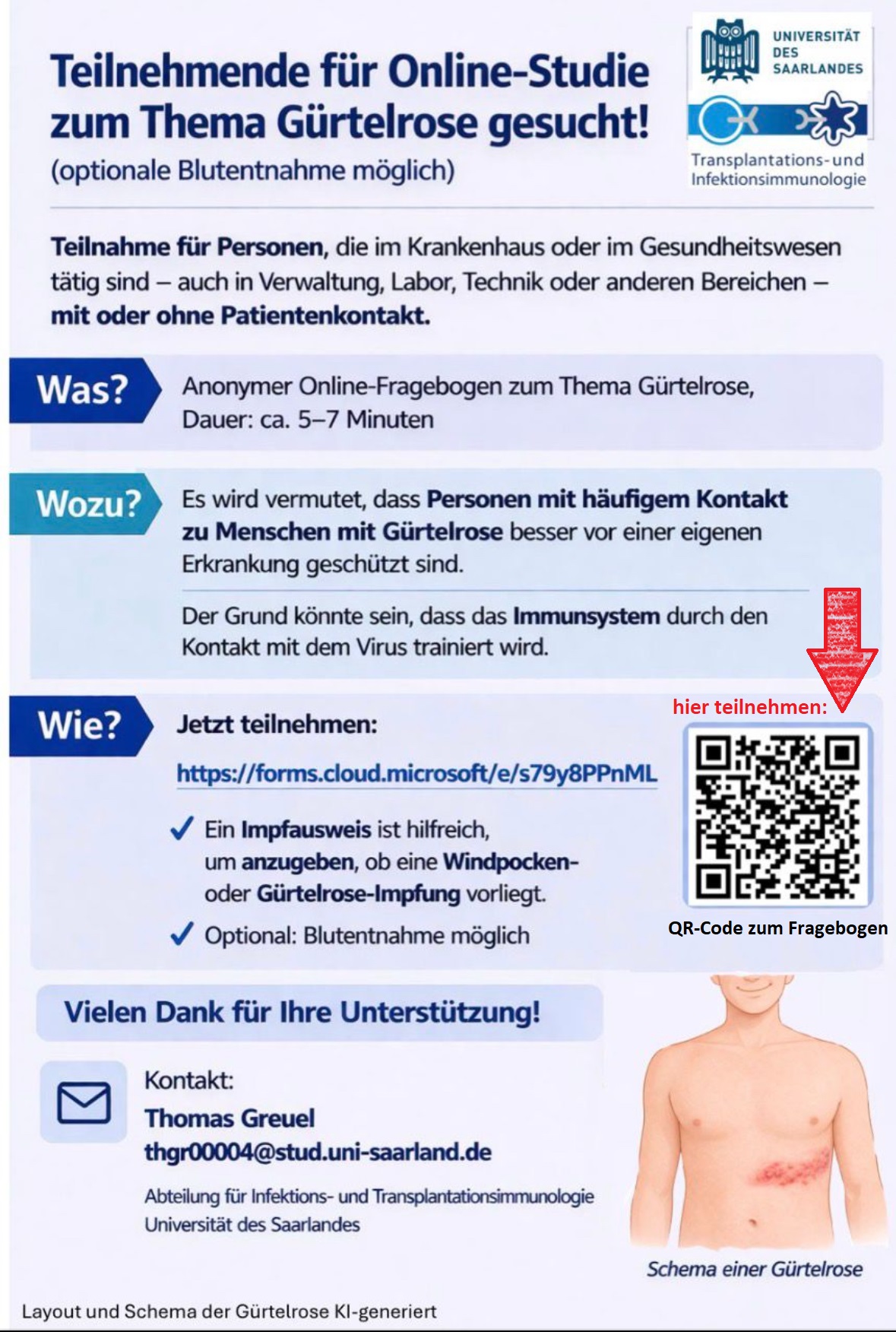
Gürtelrose (Herpes Zoster) ist eine durch das Varizella-Zoster-Virus verursachte Erkrankung. Nach einer Windpockenerkrankung verbleibt das Virus lebenslang im Körper und kann Jahre später erneut aktiv werden. Die Erkrankung kann mit starken Nervenschmerzen, Hautausschlägen und in einigen Fällen langfristigen gesundheitlichen Folgen verbunden sein.
In einem aktuellen Forschungsprojekt untersucht unsere Arbeitsgruppe, ob der regelmäßige Kontakt mit Menschen, die an Gürtelrose oder Windpocken erkrankt sind, das persönliche Risiko, an Gürtelrose zu erkranken, beeinflusst.
Hierfür suchen wir Teilnehmende mit regelmäßigem Kontakt zu Personen mit Gürtelrose oder Windpocken (z. B. im Gesundheitswesen) sowie Personen ohne direkten Kontakt als Kontrollgruppe.
Eine Teilnahme ist unabhängig davon möglich, ob Sie bereits Windpocken oder Gürtelrose hatten oder gegen Windpocken bzw. Gürtelrose geimpft sind.
Die Teilnahme beginnt mit einem anonymen Online-Fragebogen und dauert etwa 5–10 Minuten. Darüber hinaus besteht die Möglichkeit, freiwillig an einem zweiten Studienteil mit einer Blutentnahme teilzunehmen.
Die Angabe Ihrer Kontaktdaten ist ausschließlich für die Teilnahme am zweiten Studienteil erforderlich und erfolgt freiwillig. Sie können Ihre Kontaktdaten nach Abschluss des Fragebogens in einem dafür vorgesehenen Feld hinterlegen. Anschließend setzen wir uns mit Ihnen in Verbindung, um einen Termin für die Blutentnahme zu vereinbaren.
Zur Teilnahme gelangen Sie über den folgenden Link:
Alternativ können Sie den QR-Code auf dem Flyer zur Studie (siehe oben) scannen.
Wir freuen uns über Ihre Unterstützung und bedanken uns herzlich für Ihre Teilnahme!
EU Project HORUS approved
Within the HORIZON 2025 program, our department is a partner in the international HORUS project to study cytomegalivirus infection after organ transplantation. The project is coordinated by Dr. Hannah Kaminski from the University of Bordeaux. [Interested in more details?]
Swarm Projekt
New paper
New paper on humoral and cellular immune responses after herpes zoster vaccination in patients on dialysis
Hielscher, F., Schmidt, T., Enders, M., Leyking, S., Gerhart, M., van Bentum, K., Mihm, J., Schub, D., Sester, U., and Sester, M.
The inactivated herpes zoster vaccine HZ/su induces a varicella zoster virus specific cellular and humoral immune response in patients on dialysis.
eBioMedicine 2024; 108:105335; Fulltext Impact Punkte: 9.7.
This study shows that patients on dialysis respond very well to the vaccine against herpes zoster. Although immunity is slightly less pronounced than in immunocompetent individuals, the vaccination was very well tolerated and the data suggest a good protective effect. The work was part of Franziska Hielscher's doctoral thesis and was carried out in collaboration with the Völklingen Medical Centre and several medical practices in the Saarland region.
Please also read the press release by Saarland University.
New paper on the immune response after BA.4/5 bivalent vaccination in health care workers and dialysis patients
We show that the specific immune response induced after vaccination was found to differ depending on whether or not a SARS-CoV-2 infection had already occurred. We also found neutralizing antibodies and CD4 T cells as promising correlates of protection against subsequent infections.
The work was carried out by Rebecca Urschel as part of her Master's thesis in close collaboration with the University hospital´s medical center for health care workers, the Institute of Microbiology and Hygiene in Homburg and the Institute of Virology at the University of Frankfurt.
Urschel, R., Bronder, S., Klemis, V., Marx, S., Hielscher, F., Abu-Omar, A., Guckelmus, C., Schneitler, S., Baum, C., Becker, S.L., Gärtner, B.C., Sester, U., Martinez, L., Widera, M., Schmidt, T., and Sester, M.
SARS-CoV-2 specific cellular and humoral immunity after bivalent BA.4/5 COVID-19 vaccination in previously infected and non-infected individuals.
Nat Commun 2024; 15:3077; Fulltext Impact Punkte: 17.7.
Another study shows that dialysis patients respond similarly well to the BA.4/5 bivalent vaccine as immunocompetent individuals, and the vaccine was well tolerated. The vaccination is recommended for all health care workers and patients with immunodeficiencies by the german STIKO and a good immune response can be expected.
The work was carried out by Saskia Bronder in close collaboration with the Nephrology Department in Völklingen and the Virology Department at Frankfurt University Hospital.
Bronder, S., Mihm, J., Urschel, R., Klemis, V., Schmidt, T., Marx, S., Abu-Omar, A., Hielscher, F., Guckelmus, C., Widera, M., Sester, U., and Sester, M.
Potent induction of humoral and cellular immunity after bivalent BA.4/5 mRNA vaccination in dialysis patients.
NPJ Vaccines 2024; 9:25; Fulltext Impact Punkte: 9.2.
Please also read the "behind the paper"-Blog and the press release by Saarland University.