
 Infos für
 Direkt zu
 Fakultäten


(Patho-)Physiology of extracellular vesicles
Dr. rer. nat. Ahmad Aljohmani
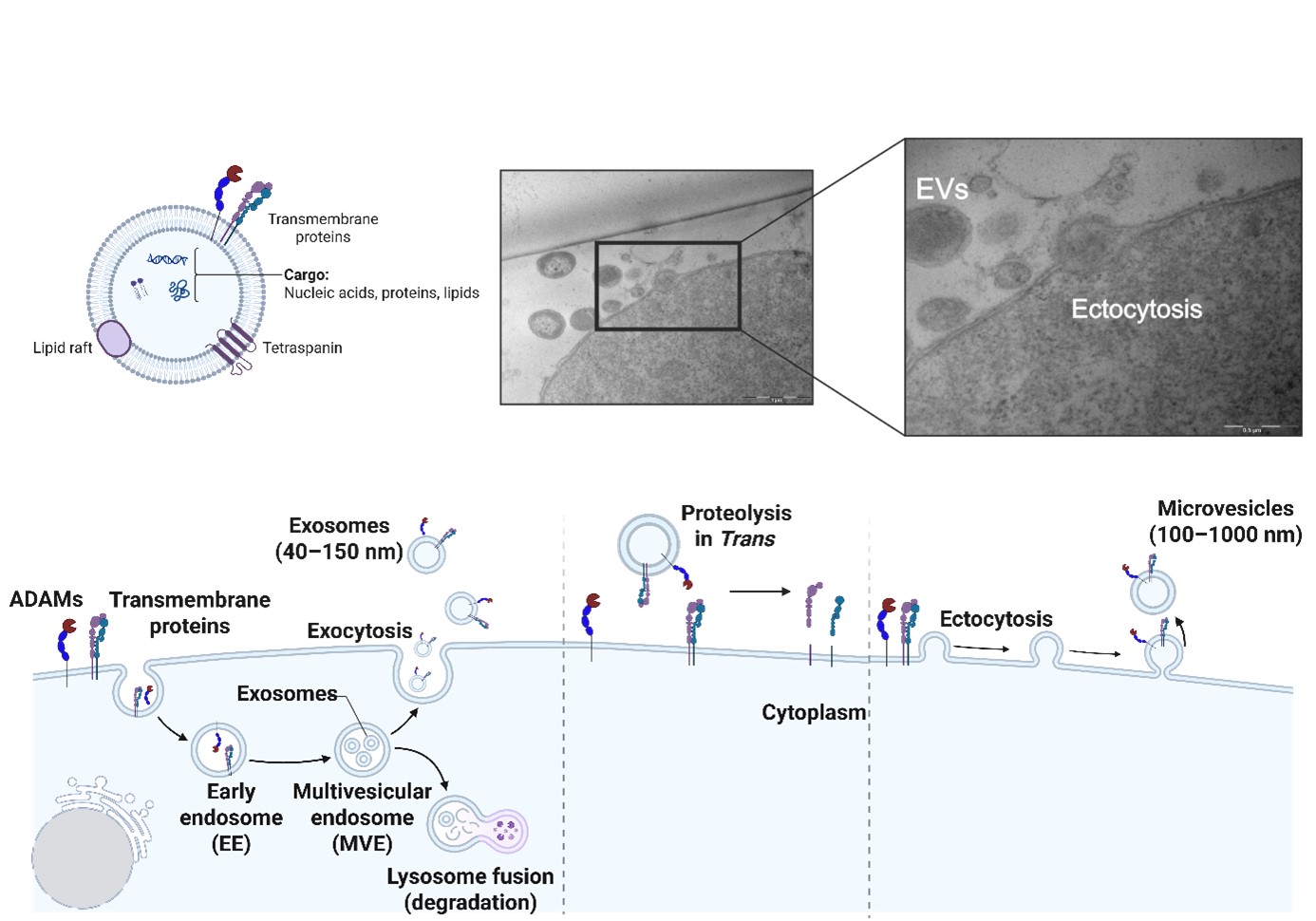
Extracellular vesicles (EVs) are nanoscale particles released by virtually all cells to coordinate local and systemic communication driving intra-organ communication. EVs arise through distinct biogenetic routes, exosomes bud inward into multivesicular bodies and are secreted upon fusion with the plasma membrane while ectosomes shed directly from the cell surface through actin–membrane remodelling. EVs carry selected proteins, lipids, metabolites, and nucleic acids (mRNA, miRNA, lncRNA), enabling them to edit receptor landscapes, tune immune activation, shape barrier integrity, and reprogramme metabolism in recipient cells. Because their cargo mirrors cellular state, EVs are increasingly leveraged as minimally invasive biomarkers of disease activity and therapy response, and as delivery vehicles for targeted interventions.
EVs can carry catalytically active ADAM proteases on their membranes, and can also encapsulate these proteases as internal cargo. After EV-cell fusion (or uptake), ADAMs can be incorporated into the recipient cell’s plasma membrane and shed surface receptors, adhesion molecules, and ligand precursors (cis shedding). Even without full fusion, EV-displayed ADAMs can cleave substrates on neighboring cells during contact (trans shedding). Through these routes, ADAM-positive EVs can drive inflammation, shape epithelial and endothelial barrier function, and modulate leukocyte-tissue interactions. In cancer, they can enhance proliferative signaling, invasion, and metastatic behavior.
We isolate EVs from serum, plasma, conditioned media, and other biofluids using ultracentrifugation, sucrose-density fractionation, and FFF-MALS for precise sizing. We are interested in investigating how EV composition characterizes the inflammation across epithelial, endothelial, and leukocyte compartments, and how EVs affect cancer progression, metastasis, and therapy response. These EVs are used to study barrier integrity, immune activation, migration, cytotoxicity, etc...