
 Infos pour
 Accès direct
 UFR
UFR


Ringvorlesung: Computational Social Science
Wie lassen sich gesellschaftliche Entwicklungen mit digitalen Daten untersuchen? Welche Erkenntnisse kann die Informatik über politische Prozesse, soziale Ungleichheit oder gesellschaftlichen Wandel liefern?
Im Wintersemester 2026/27 lädt die Ringvorlesung Computational Social Science dazu ein, ein neues spannendes Forschungsfeld kennenzulernen. Computational Social Science ist eine neue Disziplin an der Schnittstelle zwischen Sozialwissenschaften und Informatik.
Die Vorlesungsreihe vermittelt einen grundlegenden Einblick in zentrale Konzepte, Datenquellen und analytische Verfahren der computergestützten Sozialforschung. Anhand konkreter Beispiele wird veranschaulicht, wie digitale Daten und moderne Analysemethoden dazu beitragen können, komplexe gesellschaftliche Herausforderungen besser zu verstehen. Jede Veranstaltung widmet sich einer gesellschaftlich relevanten Fragestellung und zeigt, wie computergestützte Methoden eingesetzt werden, um diese wissenschaftlich zu untersuchen.
Die Vorlesung findet auf Englisch statt.
Teilnahme und Registrierung: Teilnahme ist kostenlos. Es wird kein Vorwissen in Computational Social Science vorausgesetzt. Teilnehmende dürfen sowohl einzelne Terminen als auch die gesamte Vorlesungsreihe besuchen. Registrierung wird vorausgesetzt. Bitte kontaktieren Sie martin.ulrich(at)uni-saarland.de
An wen richtet sich diese Ringvorlesung?
- Alle Studierende der Universität des Saarlandes (LSF-Nummer 166580)
- Alle, die sich für Computational Social Science interessieren (Gasthörer:innen)
- Wissenschaftler:innen aus allen Fachrichtungen mit Interesse an interdisziplinärer Zusammenarbeit
Wer sind die Vortragenden? Forschende von …
- SOUNDS
- Interdisciplinary Institute of Societal Computing (I2SC)
- Max-Planck-Institut für Software Systems
- GESIS Leibniz-Institut für Sozialwissenschaften
- Andere deutsche und internationale Universitäten
Themenübersicht
This session introduces students and guest listeners to the contents of the lecture series. Main questions are: What is Computational Social Science? What is the SOUNDS project? How will the lecture series proceed?
Vortragender: Dr. Martin Ulrich (SOUNDS)
This session presents novel data sources that can be used for Social Sciences thanks to its collaboration with informatics. These novel data sources range from social media advertising data to satellite imagery.
Vortragende: Prof. Daniela Braun (Universität des Saarlandes, I2SC & SOUNDS) & Prof. Ingmar Weber (Universität des Saarlandes, I2SC, SOUNDS)
Crisis, such as conflict and extreme weather events that significantly impact populations, can exacerbate existing societal inequalities, and make it challenging to provide humanitarian aid. By improving how such crises are anticipated, vulnerable communities can be supported in strengthening mitigation measures and humanitarian aid resources can be prepositioned for more efficient and effective responses. This talk will discuss how taking a complex systems approach to model and simulate crises can help decision-makers understand crises more holistically, how heterogeneous populations area affected, and how the impacts of crises compound over time.
Vortragender: Dr. Joseph Aylett-Bullock (University of Bristol)
Vortragende: Dr. Leah von der Heyde (GESIS Leibniz-Institut für Sozialwissenschaften)
tba
Presenter: Prof. Dongwon Lee (Pennsylvania State University)
Vortragende: Prof. Zoë Greene (University of Strathclyde, Glasgow)
tba
Vortragende: Dr. Pola Lehmann (Wissenschaftszentrum Berlin für Sozialforschung, WZB)
International crises and Euroscepticism have made European issues prominent in citizens’ lives. The article presented studies the role of three key European issues – migration, the environment, and EU integration – for political parties and citizens. The analysis centres on nine EU member states, combining party manifestos from the 2024 European Parliament elections with survey data. It finds a gap between the concerns of citizens and the political parties, an important consideration for election campaigns in general. Moreover, the analysis suggests that the salience in party manifestos has a modest direct influence and a stronger indirect impact on their appeal to citizens in most countries studied. Specifically, citizens concerned with migration and the environment evaluate parties based on the prominence they give to these issues during the campaign. The findings offer important avenues for further research on party issue emphasis and the measurement of issue salience via large language models (LLMs).
Vortragender: Dr. Alex Hartland (Universität des Saarlandes)
Digital technologies and large-scale data are transforming urban governance - so promises the smart city. GIS-based planning tools and open data platforms suggest that cities are becoming ever more data-driven. Yet the everyday reality of urban planners tells a more ambivalent story. Drawing on qualitative workplace interviews with planners in small and medium-sized cities in Germany, Austria and Switzerland, this lecture presents research on how digital transformation is actually embedded - and obstructed - in planning practice. We show that planners navigate between innovative ambitions and erratic everyday routines: ICTs become meaningful only when anchored in local knowledge practices, while limited resources, hierarchical procedures and incomplete digitisation produce persistent frictions. In a second step, we ask what Computational Social Science can contribute to understanding urban planning and governance. We discuss the potential of text-based methods (e.g. analysis of planning documents, public consultation records, or social media debates about urban development), spatial data approaches (GIS, remote sensing, urban mobility data), and participatory data sources for studying planning processes at scale - and reflect on where computational approaches reach their limits and where qualitative, practice-oriented research remains indispensable.
Vortragende: Jun.-Prof. Carola Fricke (Universität des Saarlandes)
tba
Vortragende: Brahmani Nutakki (Universität des Saarlandes, I2SC)
Prediction markets have emerged as a powerful source of real-time information about expectations of future events. In this lecture, we will first introduce the foundations of prediction markets, explain how they work, and discuss why they have become an increasingly valuable data source for computational social science and machine learning. We will then present our ongoing research on modeling the evolving state of the world using prediction market time series, including methods for identifying latent relationships between events, detecting market-wide anomalies, and uncovering potentially causal dependencies across interconnected markets. Finally, we will discuss how large language models can be used to characterize news and media sources by their influence on future market predictions, providing new perspectives on information diffusion, forecasting, and the interaction between media, human expectations, and AI. Overall, the lecture will highlight how prediction markets provide a unique setting for studying collective intelligence, forecasting, and AI, while outlining several open research challenges at the intersection of computational social science, economics, and machine learning.
Vortragende: Prof. Krishna Gummadi (Max-Planck-Institut for Software Systems), Prof. Marius Kloft (Rheinland-Pfälzische Technische Universität Kaiserslautern-Landau), Dr. Johnnatan Messias (Max-Planck-Institut for Software Systems)
Google Maps is used by billions of people every day — but beyond navigation, it holds a rich trove of data about how cities look, how businesses thrive or disappear, and how people experience public space. In this session, we explore how Google Maps data (street view imagery, place reviews, Points of Interest, and more) can serve as a novel data source for computational social science research. We discuss the unique advantages and limitations of this data, show how it can be combined with other datasets, and present concrete research examples that use it.
Vortragende: Ethel Elikem Afi Mensah (Universität des Saarlandes, I2SC)
tba
Vortragende: Prof. Vera Schmitt (Johannes-Gutenberg Universität Mainz)
Digital platforms have become central arenas of public life, where societal challenges (from climate change and migration to inequality and public health) are debated and shaped. To examine discourses, dynamics, and impacts across multilingual, multi-context digital publics, social scientists increasingly rely on AI-driven computational methods. This talk introduces methodological innovations in digital methods, focusing on computational multilingual text analysis and the problem of measurement validity. It present a validation framework that accounts for context-specific biases in automated measurement and demonstrate how it improves the robustness and comparability of findings across languages and platforms. In the second part, it showcases empirical studies that deploy the some of the tools to analyze public discourse around environmental and inequality-related policies, highlighting what AI can, and cannot, capture about actors, topics, and diffusion dynamics. The talk close with implications for research design, and the responsible use of AI in social science research.
Vortragende: Dr. Fabienne Lind
An diesem Termin findet die Klausur für die Studierenden der Vorlesung statt.
Wann und wo findet die Ringvorlesung statt?
Wann? Freitags, 12:15 - 13:45 Uhr
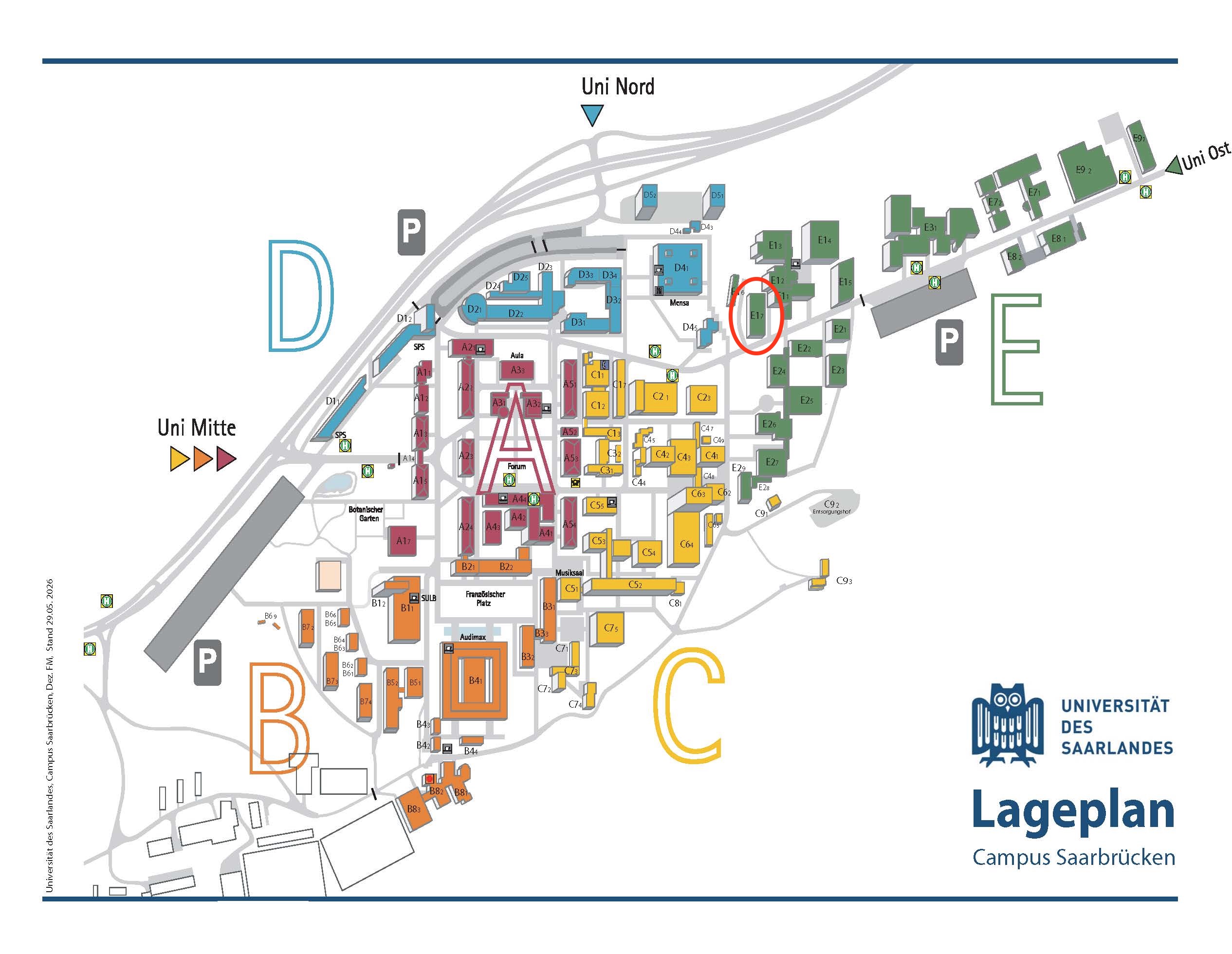
Wo? Campus Saarbrücken, Gebäude E1.7, Raum 3.23
Anfahrt:
- Mit Bus: Haltestelle “Universität Mensa, Saarbrücken” - Linien 101, 102, 109, 111, 112, 124, 136, 138, 150, 163, 170, 320, 817, 819, 821, 834
- Mit Auto:
- Aus Richtung Dudweiler: Dudweilerstraße L251, Einfahrt Uni Ost, Parkhaus Uni Ost
- Aus Richtung Saarbrücken Innenstadt: Stuhlsatzenhausenweg L252, Einfahrt Uni Mitte, Parkhaus Uni Mitte

Sie haben Fragen zur Ringvorlesung?
Dr. Martin Ulrich
Referent Graduatierenkolleg / Zertifikat SOUNDS
Campus Saarbrücken
Geb. E 1 1, 4.06.3
Tel.: +49 681 302-70784
martin.ulrich(at)uni-saarland.de