
 Information for
 Quick links
 Faculties


Study Systems Engineering - Design the systems of the future
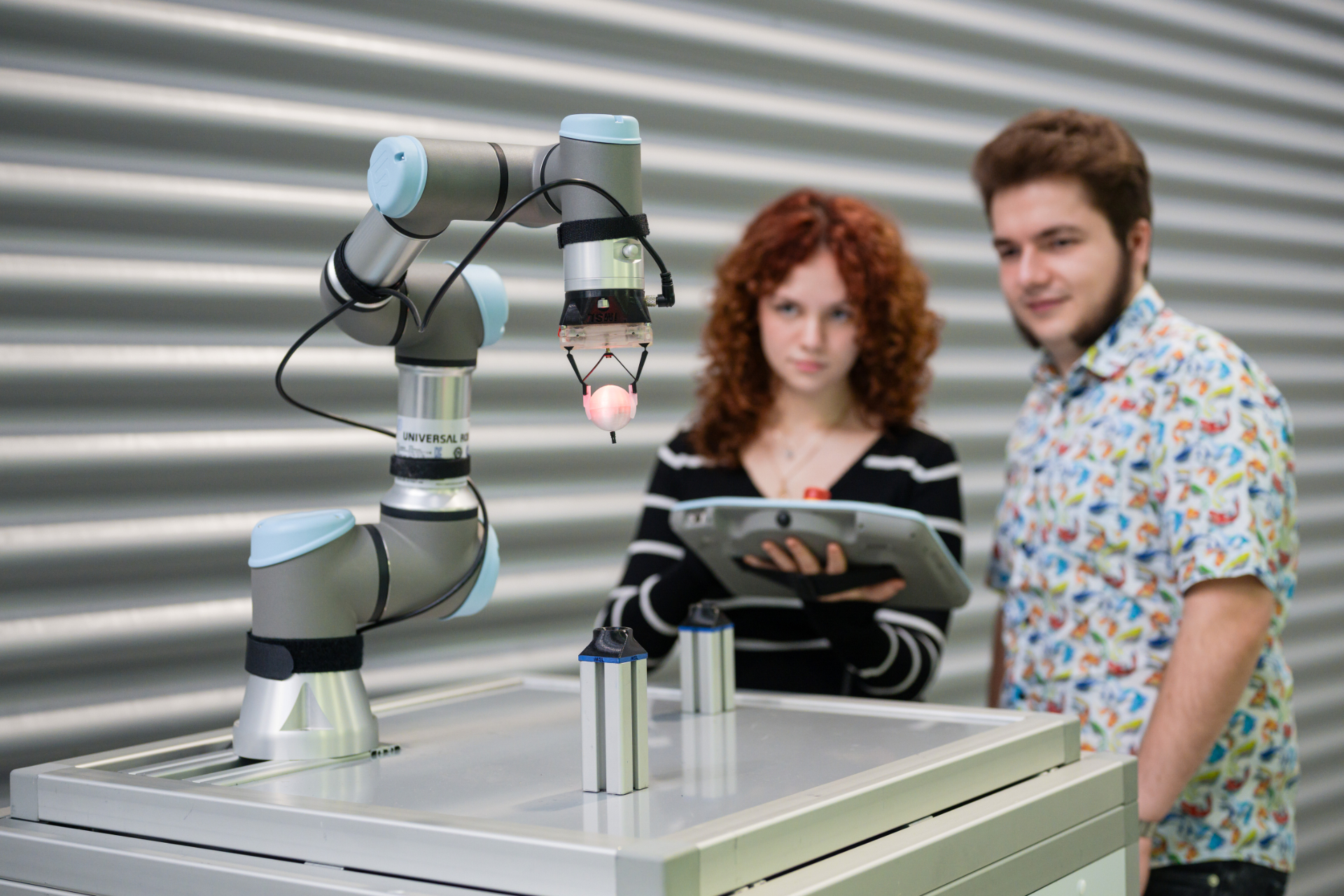
Systems Engineering is a dynamic and interdisciplinary Master's degree programme where you will learn to develop, integrate and optimize complex technical systems.
You will expand your knowledge in engineering, information technology and management while developing the skills required for challenging roles in research and industry.
The specializations Information & Communication Systems and Robotic Systems can be studied completely in English, making the programme ideal for international students. The Master of Science in Systems Engineering is your opportunity to develop your skills in an international environment, preparing you for a global career path.
Learn more about the Master's in Systems Engineering and take a step towards designing the future.
5 reasons to study Systems Engineering at Saarland University
- Optimal student support: Small group sizes, mentoring programmes and individual support during exercise and problem-solving classes
- Your studies, fit to you: With the programme's wide variety of specializations, students can fit their studies to their skills and interests.
- Close ties to research and industry: Work on exciting research and development projects while studying.
- Student job and scholarship opportunities: The department offers a number of paid student jobs and scholarships are available.
- Outstanding career prospects: The demand for engineers is growing and the trend is expected to continue.


5 reasons to choose Saarland University
- Outstanding international ranking: Saarland University was ranked among the top 200 universities worldwide by Time Magazine, coming in at number 176 internationally and number 13 in Germany.
- Healthy campus: Saarland University has been awarded the FISU Healthy Campus Platinum Label, the best category awarded by the organization.
- International environment: Nearly a quarter of our student population is from outside of Germany.
- Quality of life: With affordable housing costs, all the necessities close at hand and a wide variety of cultural and leisure activities, Saarland offers an excellent quality of life.
- Research meets practice: At Saarland University, students benefit from the close ties between research and the private sector, opening doors for innovation and allowing you to benefit from practical experience and exciting career paths.
English-language specializations
'Robotics combines mechanics, electronics and artificial intelligence, creating autonomous systems that change the world. In Robotic Systems, you will learn how to take an active role in designing these systems.' – Professor Gianluca Rizzello
What awaits you (selected):
- Automation Systems
- Industrial Robot Control
- Kinematik, Dynamik und Anwendung in der Robotik
- Machine Dynamics
- Optimization
- Advanced Robotics
- Mensch-Roboter-Kooperation in der industriellen Produktion
- Soft Robotics
German-language specializations
What awaits you (selected)
- Spanende und abtragende Fertigungsverfahren
- Feinbearbeitungstechnologie
- Montage und Inbetriebnahme von Kraftfahrzeugen
- Kinematik, Dynamik und Anwendung in der Robotik
- Mensch-Roboter-Kooperation in der industriellen Produktion
- Industrie 4.0 für Ingenieure
- Sustainable Product Engineering
- Optimization
FAQs
To be admitted to the Master’s in Systems Engineering, you must hold a Bachelor's degree or foreign equivalent in systems engineering or a related subject such as mechanical engineering, electrical and information engineering, microsystems technology, mechatronics or a related engineering field.
Depending on your chosen specialization, you must demonstrate B2 level on the Common European Framework of Reference in either German or English.
An applicant's aptitude for the programme in Systems Engineering is typically demonstrated by them having an overall grade of 2.5 or better on the German academic grading scale or the equivalent. If you do not fulfil these requirements, you can also demonstrate your aptitude by providing satisfactory academic references or through an admission interview.
Good to know: University qualifications obtained outside of Germany will be assessed for equivalence. We specifically welcome applications from graduates from a broad range of engineering fields.
In the Systems Engineering programme, you can focus on the areas that interest you and align with your career goals. The programme's seven specializations allow you to develop and hone your expertise in your subject of choice.
Whether you choose to focus on developing innovative products, intelligent sensor-actuator systems or complex, technical integrated systems, each specialization allows students to develop domain-specific skills, preparing them for challenging tasks in industry, research and development.
The System Engineering programmes specializations make it possible to:
- home in on your specific interests within the field
- get acquainted with cutting-edge technologies
- prepare for your chosen career path
- gain expertise in future-focused fields of technology
The Systems Engineering programme is situated at the interface of several disciplines, meaning you will learn to combine technical expertise with approaches that take entire systems into account in order to take on real-world problems.
In the Systems Engineering Master's programme, you can choose one of the following specializations:
- Information & Communication Systems (can be studied completely in English)
- Robotic Systems (can be studied completely in English)
- Production Systems
- Systems Design
- Sensor-Actuator Systems
- Integrated Systems
- Sustainable Engineering
In the Systems Engineering Master's programme, you will tackle hands-on projects, using your knowledge to solve real-world challenges. The projects will vary in size and depth depending on your chosen specialization. During the projects, you will gain valuable experience in interdisciplinary teams, improve your problem-solving skills and refine the skills required for a future career in industry or academia.
Yes, it is possible to complete a semester abroad and gain international experience while studying your Master's in Systems Engineering. A period abroad during your studies gives you the chance to get familiar with new approaches in the field of systems engineering and gain valuable intercultural and language skills.
Saarland University maintains partnerships with universities across Europe and worldwide, making it possible for you to spend part of your studies at a university abroad and build an international network, both within the field of systems engineering and beyond.
A semester abroad isn't just a personally enriching experience, but also improves your career outlook – your international experience, knowledge of a foreign language and the ability to work in a new cultural context are seen as assets by many employers.
If you are interested in spending a semester abroad, we recommend getting in touch with advisers in the Systems Engineering department as well as the International Office early on. Proper planning helps ensure that as many academic credits as possible from your time abroad can be counted towards your degree here at Saarland University. You can find an overview of universities that are partnered with the Systems Engineering department here.
Tip: It is worth it to begin planning for your semester abroad right from the beginning of your studies, as it allows you to better take advantage of the wide variety of international opportunities available to Systems Engineering students.
Yes, the Systems Engineering programme offers many opportunities to get involved in exciting research projects while still studying. Professors in the Systems Engineering department are involved in a variety of national and international research projects, meaning you will have the opportunity to gain insights into the latest developments in the field.
You can begin gaining research experience and contributing to innovative developments by working as a graduate research assistant or through project-based learning and your Master's thesis. Working closely with researchers in the field, you will have the opportunity to explore current questions in both research and industry, apply theoretical knowledge to real-world challenges, gain important skills for your future career and expand your professional network.
Our department explores a broad range of exciting research areas including:
- Artificial muscles and intelligent soft robotic systems
- Patient monitoring and the simulation of bone fracture healing
- Lasers in materials processing
- Full-scale production of hydrogen technologies
- Smart production systems, industrial robotics and cobots
- Sustainable and intelligent energy systems
- Sustainable product development geared to the circular economy
- Multimodal sensor systems for sustainability and health
- Optimization of technical systems
- Control theory
- Efficient electric motors
- High-speed electronics
- Theory and numerical simulation of electromagnetic fields
A Master's in Systems Engineering makes it possible to pursue exciting careers in a wide range of industries and technology sectors. More than ever, employers need engineers that can bring together knowledge from various disciplines in order to understand complex systems in their entirety and develop innovative solutions to challenges.
The programme's interdisciplinary structure prepares you to tackle challenges at the intersection of technology, computer science, management and innovation. Graduates can apply their interdisciplinary knowledge in a variety of fields and are not limited to one industry.
Systems engineers are in high demand in cutting-edge fields such as:
- Industry 4.0 and smart manufacturing
- Digitalization and automation
- Renewable energy and energy transition
- Transport and autonomous systems
- Medical technology and healthcare
- Embedded systems and connected products
- Aerospace engineering
- Robotics and intelligent systems
Graduates typically work in fields such as:
- Systems engineering and systems architecture
- Research and development
- Product development and innovation management
- Technical product management
- Automation and digitalization
- Quality and process management
- Technical consulting
Whether in innovative start-ups, mid-sized companies or international tech corporations, the skills you develop in the Systems Engineering Master's programme are in high demand across industries. With technical expertise, systems thinking and the ability to work with experts across disciplines, systems engineers have all the skills required to design the technical solutions of tomorrow.
Systems Engineering graduates are in high demand and have solid earning potential. Depending on the branch, region, position and company size, engineers in Germany typically earn a starting salary between €50,000 and €60,000 per year. In high-demand industries such as automotive, aerospace, semiconductors, energy and medical technology, starting salaries are often even higher. [get-in-eng...neering.de], [ingenieurcenter.de]
Salaries are typically much higher for employees with more work experience, specialization and responsibility. Graduates with the skills to develop complex technical systems, coordinate interdisciplinary projects and find innovative solutions in strategic fields such as industry 4.0, digitalization, the energy transition or smart mobility are in particularly high demand. [ingenieurcenter.de], [bruttocheck.de]
Systems Engineering graduates can look forward to long, successful careers in diverse roles in industry, research and development.
Information on applying for admission
You can find all the information you need on admission, application, deadlines and organizing your studies on the webpage dedicated to the
Master's in Systems Engineering
which includes key information on the programme and the application process.
Programme-related questions:
Carine Klap
Building A5 1, Room 0.06
Tel.: +49 681 302-4946
Email: studium-se(at)uni-saarland.de