
 Infos für
 Direkt zu
 Fakultäten


Supply Chain Resilience
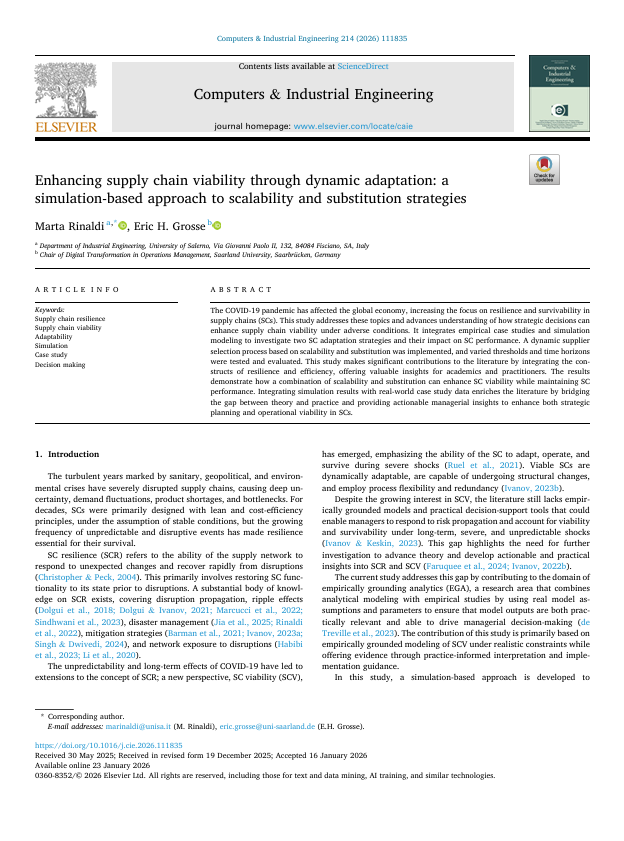
Enhancing supply chain viability through dynamic adaptation: a simulation-based approach to scalability and substitution strategies
Rinaldi & Grosse (2026)
The COVID-19 pandemic has affected the global economy, increasing the focus on resilience and survivability in supply chains (SCs). This study addresses these topics and advances understanding of how strategic decisions can enhance supply chain viability under adverse conditions. It integrates empirical case studies and simulation modeling to investigate two SC adaptation strategies and their impact on SC performance. A dynamic supplier selection process based on scalability and substitution was implemented, and varied thresholds and time horizons were tested and evaluated. This study makes significant contributions to the literature by integrating the con structs of resilience and efficiency, offering valuable insights for academics and practitioners. The results demonstrate how a combination of scalability and substitution can enhance SC viability while maintaining SC performance. Integrating simulation results with real-world case study data enriches the literature by bridging the gap between theory and practice and providing actionable managerial insights to enhance both strategic planning and operational viability in SCs.
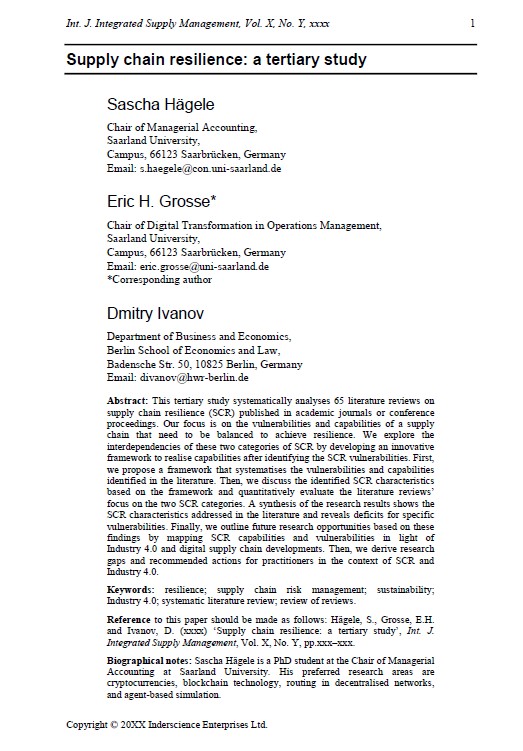
Supply chain resilience: a tertiary study
Hägele, Grosse & Ivanov (2023)
International Journal of Integrated Supply Management
This tertiary study systematically analyzes 65 literature reviews on supply chain resilience (SCR) published in academic journals or conference proceedings. Our focus is on the vulnerabilities and capabilities of a supply chain that need to be balanced to achieve resilience. We explore the interdependencies of these two categories of SCR by developing an innovative framework to realize capabilities after identifying the SCR vulnerabilities. First, we propose a framework that systematizes the vulnerabilities and capabilities identified in the literature. Then, we discuss the identified SCR characteristics based on the framework and quantitatively evaluate the literature reviews’ focus on the two SCR categories. A synthesis of the research results shows the SCR characteristics addressed in the literature and reveals deficits for specific vulnerabilities. Finally, we outline future research opportunities based on these findings by mapping SCR capabilities and vulnerabilities in light of Industry 4.0 and digital supply chain developments. Then, we derive research gaps and recommended actions for practitioners in the context of SCR and Industry 4.0.