
 Infos für
 Direkt zu
 Fakultäten


Warehousing 5.0
This book examines the concept of Warehousing 5.0.
Management has come to recognize that warehouses are not just simple storerooms but central pillars of competitive advantage and business success with high impact on the efficiency of supply chains. However, warehouse managers continue to struggle with improving operational performance and cutting costs, and in the ongoing transition to smart warehouses, constantly new challenges, such as labor shortages and sustainability requirements, arise. The concept of Warehousing 5.0 offers managers guidance in addressing these challenges by harnessing the benefits of automated and digitally supported warehousing processes enabled by Industry 4.0 technologies with a strong focus on human-centricity, environmental sustainability, and resilience and innovation. This book summarizes the most recent research results on Warehousing 5.0 and supports managers in successfully transforming their warehousing processes and management concepts.
Written by experts in the field, this book offers a comprehensive thematic perspective of the concept of Warehousing 5.0, with a focus on practical insights and guidance for managers. Key topics covered in this book include:
- Conceptualization of Warehousing 5.0
- Implementing human-centric management concepts in warehousing
- Managing the various human-technology interactions in warehouses
- Advancing sustainability and decarbonization of warehouses
- Achieving resilience and fostering innovation in warehouses
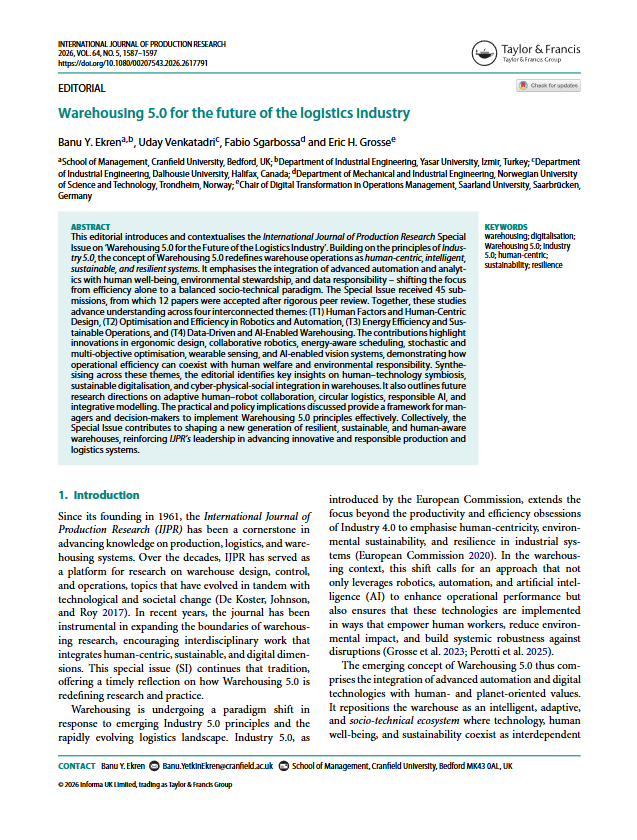
Warehousing 5.0 for the future of the logistics industry
Ekren, Venkatadri, Sgarbossad & Grosse (2026)
This editorial introduces and contextualises the International Journal of Production Research Special Issue on ‘Warehousing 5.0 for the Future of the Logistics Industry’. Building on the principles of Industry 5.0, the concept of Warehousing 5.0 redefines warehouse operations as human-centric, intelligent, sustainable, and resilient systems. It emphasises the integration of advanced automation and analytics with human well-being, environmental stewardship, and data responsibility – shifting the focus from efficiency alone to a balanced socio-technical paradigm. The Special Issue received 45 submissions, from which 12 papers were accepted after rigorous peer review. Together, these studies advance understanding across four interconnected themes: (T1) Human Factors and Human-Centric Design, (T2) Optimisation and Efficiency in Robotics and Automation, (T3) Energy Efficiency and Sustainable Operations, and (T4) Data-Driven and AI-Enabled Warehousing. The contributions highlight innovations in ergonomic design, collaborative robotics, energy-aware scheduling, stochastic and multi-objective optimisation, wearable sensing, and AI-enabled vision systems, demonstrating how operational efficiency can coexist with human welfare and environmental responsibility. Synthesising across these themes, the editorial identifies key insights on human–technology symbiosis, sustainable digitalisation, and cyber-physical-social integration in warehouses. It also outlines future research directions on adaptive human–robot collaboration, circular logistics, responsible AI, and integrative modelling. The practical and policy implications discussed provide a framework for managers and decision-makers to implement Warehousing 5.0 principles effectively. Collectively, the Special Issue contributes to shaping a new generation of resilient, sustainable, and human-aware warehouses, reinforcing IJPR's leadership in advancing innovative and responsible production and logistics systems.
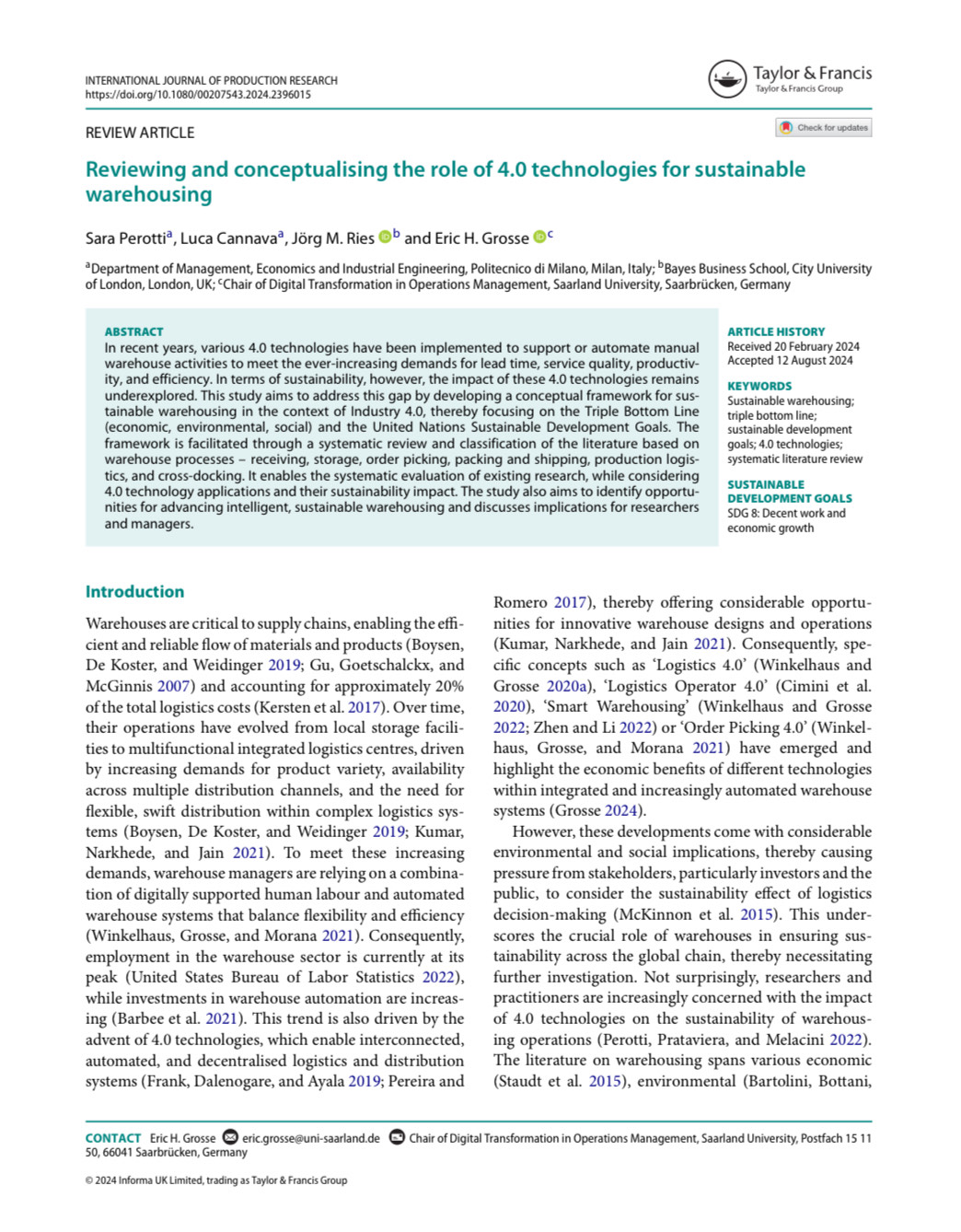
Reviewing and conceptualising the role of 4.0 technologies for sustainable warehousing
Perottia, Cannavaa, Ries & Grosse (2025)
In recent years, various 4.0 technologies have been implemented to support or automate manual warehouse activities to meet the ever-increasing demands for lead time, service quality, productivity, and efficiency. In terms of sustainability, however, the impact of these 4.0 technologies remains underexplored. This study aims to address this gap by developing a conceptual framework for sustainable warehousing in the context of Industry 4.0, thereby focusing on the Triple Bottom Line (economic, environmental, social) and the United Nations Sustainable Development Goals. The framework is facilitated through a systematic review and classification of the literature based on warehouse processes – receiving, storage, order picking, packing and shipping, production logistics, and cross-docking. It enables the systematic evaluation of existing research, while considering 4.0 technology applications and their sustainability impact. The study also aims to identify opportunities for advancing intelligent, sustainable warehousing and discusses implications for researchers and managers.
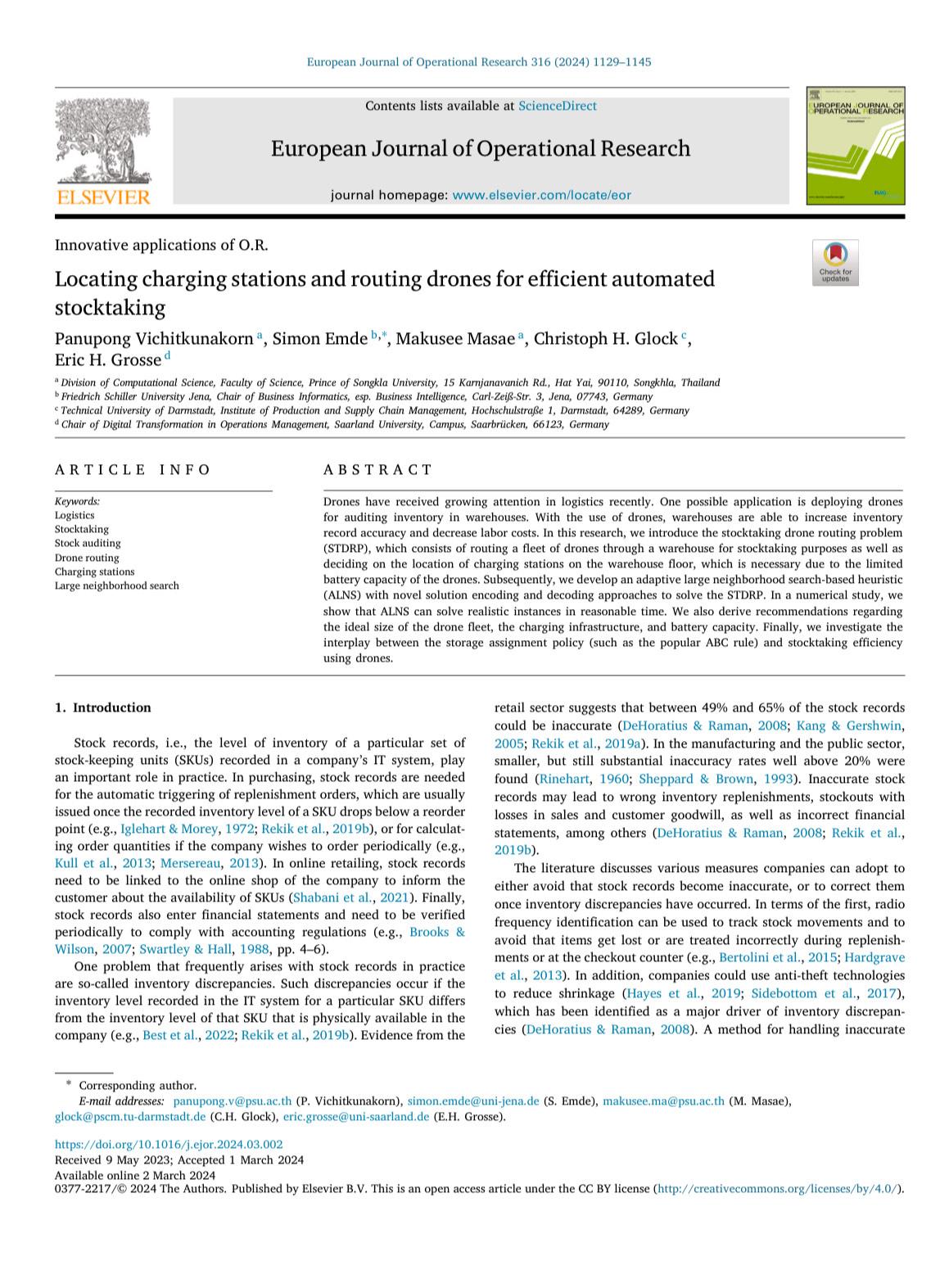
Locating charging stations and routing drones for efficient automated stocktaking
Vichitkunakorn, Emde, Masaea, Glock & Grosse (2024)
Drones have received growing attention in logistics recently. One possible application is deploying drones for auditing inventory in warehouses. With the use of drones, warehouses are able to increase inventory record accuracy and decrease labor costs. In this research, we introduce the stocktaking drone routing problem (STDRP), which consists of routing a fleet of drones through a warehouse for stocktaking purposes as well as deciding on the location of charging stations on the warehouse floor, which is necessary due to the limited battery capacity of the drones. Subsequently, we develop an adaptive large neighborhood search-based heuristic (ALNS) with novel solution encoding and decoding approaches to solve the STDRP. In a numerical study, we show that ALNS can solve realistic instances in reasonable time. We also derive recommendations regarding the ideal size of the drone fleet, the charging infrastructure, and battery capacity. Finally, we investigate the interplay between the storage assignment policy (such as the popular ABC rule) and stocktaking efficiency using drones.