Information for
 Quick links
 Faculties


Seminar summer semester 2026
Frauenchiemsee Seminar Highlights Current Developments in International and European Raw Materials Law
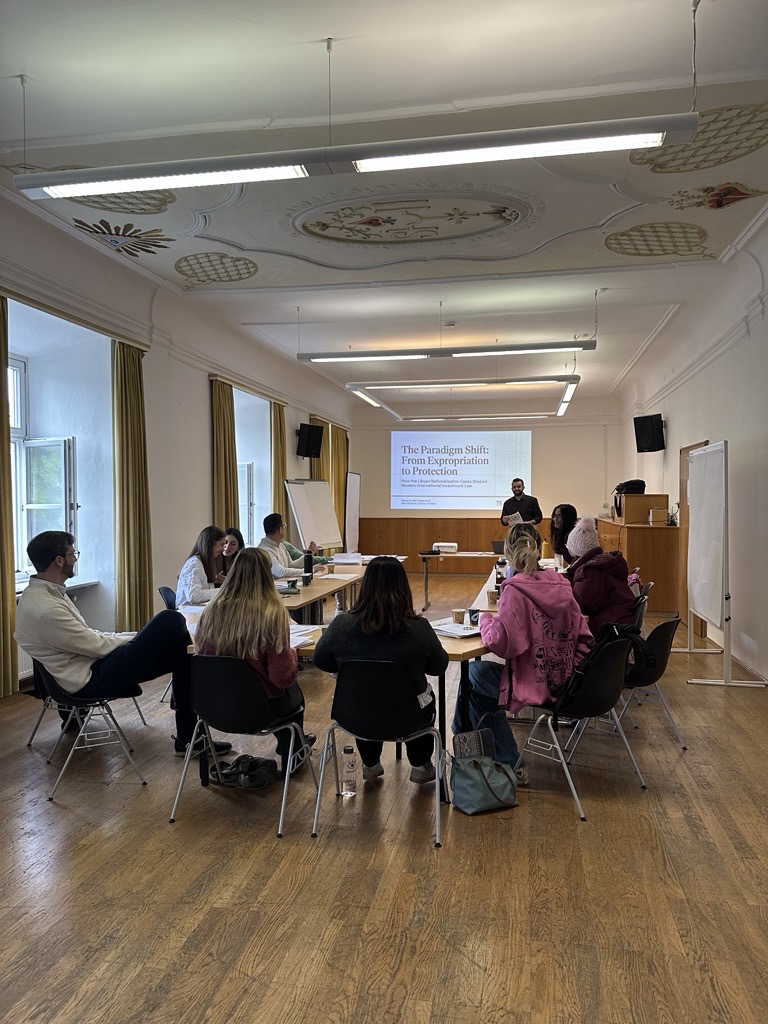
This year’s summer semester seminar was once again held on the island of Frauenchiemsee. Under the title “Raw Materials in International Economic Law”, current challenges of international and European economic law, with a particular focus on raw materials, investment protection and global resource policy, were discussed under the direction of Prof. Bungenberg.
Against the backdrop of Lake Chiemsee, the participants addressed central legal questions of the raw materials sector. One focus was on the principle of permanent sovereignty over natural resources and its current developments. The discussion centered on how states exercise their power of disposal over natural resources today and what limits under international law they are subject to. Questions of sustainable development in the raw materials sector were also examined in greater depth. Using the example of coffee and the International Coffee Agreements, the students analyzed what role international raw materials agreements can play for sustainable supply chains, economic stability and development policy objectives.
Further contributions were devoted to current trade policy conflicts. Thus, China’s quasi-monopolistic position in rare earths was examined from the perspective of WTO law. Likewise, the participants discussed the European Union’s palm oil dispute and the compatibility of deforestation-free supply chain regulations with the requirements of WTO law. Another focus was on investments in the raw materials sector. The students dealt with the core elements of state–investor contracts as well as with questions of investment protection in raw materials projects. Historical perspectives were offered in particular by the analysis of the Libyan expropriation cases, whose significance for modern investment protection law and investor–state dispute settlement was elaborated. At the European level, the EU Critical Raw Materials Act and its international dimension were at the center of attention. The discussion addressed the extent to which this regulatory framework not only serves to secure critical raw materials, but can also be understood as a starting point for an autonomous European raw materials law.
In addition, the seminar turned its attention to new and geopolitically particularly sensitive raw materials spaces. The management of seabed resources within the framework of the United Nations Convention on the Law of the Sea, as well as the different regulatory regimes for raw materials in the polar regions, were addressed.
Alongside the academic program, the students also gained insights into German constitutional history. The seminar program was complemented by a visit to the neighboring island of Herrenchiemsee. In the museum in the former ‚Augustiner-Chorherrenstifts‘, the historic site of the Constitutional Convention of 1948, the participants explored the origins of the Basic Law and the democratic foundations of the post-war period.
The seminar was rounded off by a guided tour of Herrenchiemsee Palace. The palace, built by King Ludwig II and often referred to as the “Bavarian Versailles”, provided an impressive cultural setting for the conclusion of the stay.
The combination of demanding academic discussions, historical reflection and communal exchange once again made the Frauenchiemsee seminar an enriching experience for all participants.