
 Information for
 Quick links
 Faculties


Courses
Europaicum Certificate: Overview Course Catalogue
The courses incorporated into the Europaicum Certificate course catalogue are dealing interdisciplinariliy with European topics and are offered by three faculties: the Faculty of Humanities (P), the Faculty of Law (R) and the Faculty of Human and Business Sciences (HW). The courses held by the FONTE Endowed Professorship can also be recognized for the Europaicum Certificate.
CEUS Courses Europaicum Certificate
Each semester CEUS organizes classes in German and English language dealing with European topics and contexts.
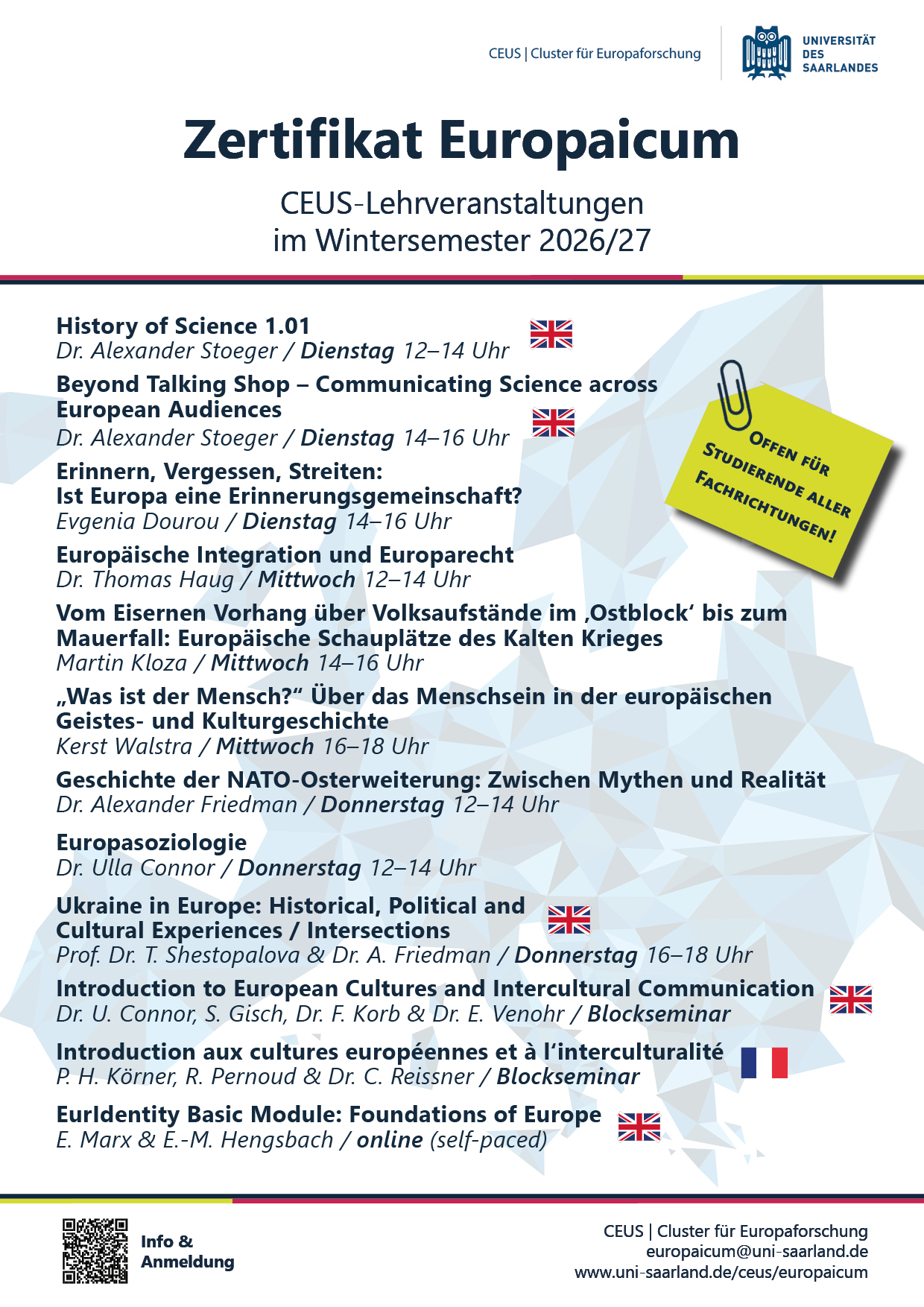
Wintersemester 2026/27
This seminar introduces students to the European history of science and its role in the broader global history through the discussion of influential texts by leading scholars in the field, including James Secord, Lorraine Daston, Steven Shapin, and Kapil Raj. Rather than tracing a chronological history of scientific discoveries, the course explores the concepts, questions, and approaches that have shaped the discipline over the past decades.
Please note: This seminar will be conducted entirely in English. You do not need to be a native speaker or have perfect English to participate successfully. If you are comfortable reading, discussing, and presenting in English, the course offers an excellent opportunity to build confidence in an international academic environment and to prepare for international conferences, Erasmus exchanges, study visits, and other academic or professional experiences abroad.
Course date: Tuesday, 12 am – 2 pm
Lecturer: Dr. Alexander Stoeger
Language: English
Format: Seminar
This seminar explores the theory and practice of science communication through a combination of discussion, analysis, and hands-on exercises. Together, we will examine how knowledge is communicated in lectures, conferences, museums, journalism, social media, and public debates.
Please note: This seminar will meet weekly from October until the end of the year. Instead of regular weekly sessions in January, the course will conclude with a simulated academic conference held over one weekend at the end of January. Depending on the number of participants, the conference will take place on either one or two days, during which all students will deliver their presentations.
Attendance at the January conference is therefore mandatory. My current plan is to hold the conference on 24–25 January (Saturday and Sunday), although the final date will be agreed upon during our first session to accommodate participants as far as possible.
Course date: Tuesday, 2 pm – 4 pm
Lecturer: Dr. Alexander Stoeger
Language: English
Format: Seminar
Das Seminar setzt die Schwerpunkte „Erinnern“, „Vergessen“ und „Streiten“ und sucht in transnationalen Texten der Gegenwartsliteratur sowie in Filmen nach möglichen Antworten auf die brisante Frage: Ist Europa eine Erinnerungsgemeinschaft?
Termin: Dienstag,14–16 Uhr
Dozent: Evgenia Dourou
Sprache: Deutsch
Format: Seminar
Der Kurs "Europäische Integration" bietet eine umfassende Einführung in die rechtlichen, institutionellen und historischen Grundlagen der Europäischen Union und anderer wichtiger europäischer Institutionen. Beginnend mit der Geschichte der europäischen Integration nach dem Zweiten Weltkrieg, untersucht der Kurs die zentralen Meilensteine und Beweggründe, die zur Gründung und Weiterentwicklung der Europäischen Union geführt haben.
Es werden keine juristischen Kenntnisse vorausgesetzt.
Der Raum wird erst nach Anmeldung kurz vor Vorlesunsgbeginn per E-Mail bekannt gegeben.
Bei Fragen wenden Sie sich bitte an europaicum@uni-saarland.de
Termin: Mittwoch, 12 – 14 Uhr
Dozent: Dr. Thomas Haug
Sprache: Deutsch
Format: Seminar
In diesem Kurs werden europäische Schauplätze des kalten Krieges untersucht sowie erfragt, welchen Einfluss außereuropäische Kriege und Krisen hatten. Dabei stellen die beiden Hegemonen, UdSSR und USA, und ihre in Europa verfolgte Politik auf beiden Seiten des ‚eisernen Vorhangs‘ einen wesentlichen Aspekt der Übung dar.
Termin: Mittwoch,14–16 Uhr
Dozent: Martin Kloza
Sprache: Deutsch
Format: Seminar
Sind wir Vernunftwesen? Haben wir eine Seele? Zeichnet uns Moral aus? Sind wir das Ebenbild Gottes? Sind wir das soziale Wesen? Sind wir alle gleich? Besitzen wir Würde? Sind wir vor allem Geist, und der Körper ist nachrangig? Sind wir Menschenaffen? Sind wir das andere Tier? Ist Gesundheit die Norm fürs Menschsein? Sind wir auf dem Weg, Cyborgs zu werden? Ist Selbstoptimierung sinnvoll? Über nichts reflektiert der Mensch so oft, wie über sich selbst.
Nach einer kurzen anthropologischen Einführung zur Stammesgeschichte werden wir das Denken über unser Menschsein von der Antike bis in die Gegenwart beispielhaft beleuchten. Vielleicht sind wir danach schlauer, wer Homo sapiens ist und wer er in Zukunft sein will.
Termin: Mittwoch, 16–18 Uhr
Dozent: Kerst Walstra
Sprache: Deutsch
Format: Seminar
Beschreibung
Termin: Donnerstag, 12–14 Uhr
Dozent: Dr. Alexander Friedman
Sprache: Deutsch
Format: Übung
Im Kurs „Europasoziologie” werden wir uns mit sozialen, kulturellen und politischen Prozessen zum Thema Europa aus soziologischer Perspektive befassen. Das Seminar zielt darauf ab, zentrale Theorien und Konzepte der Europasoziologie zu erarbeiten und deren Anwendung auf aktuelle gesellschaftliche Entwicklungen zu diskutieren.
Termin: Donnerstag, 12–14 Uhr
Dozent: Dr. Ulla Connor
Sprache: Deutsch
Format: Seminar
Course date: Thursday, 4 pm – 6 pm
Lecturer: Prof. Dr. Tetiana Shestopalova & Dr. Alexander Friedman
Language: English
Format: Seminar
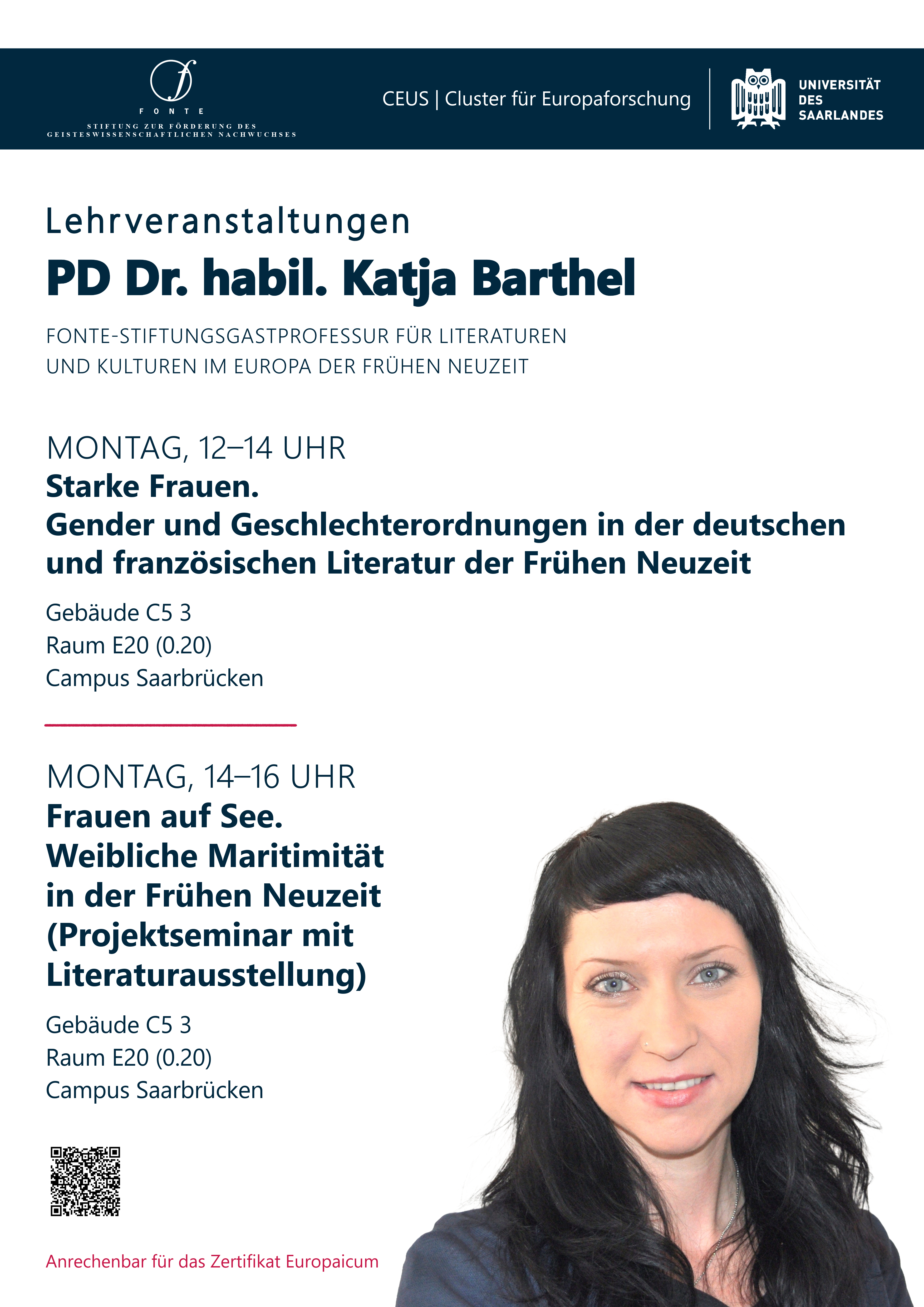
Das Seminar untersucht diese Weiblichkeitskonstruktionen im interkulturellen Transfer zwischen Frankreich und Deutschland. Wie wurden französische Genderkonzepte im deutschsprachigen Raum adaptiert und verändert? Das Seminar hilft Ihnen, Ihre Kenntnisse der deutschsprachigen und französischen Literatur- und Kulturgeschichte zu vertiefen und schärft Ihr analytisches Instrumentarium zur kritischen Einordnung und Dekonstruktion historischer Gender- und Machtverhältnisse.
Termin: Montag, 12–14 Uhr
Dozent: FONTE-StiftungsgastprofessorinPD Dr. Katja Barthel
Sprache: Deutsch
Format: Proseminar / Übung
In diesem interdisziplinären Praxisseminar untersuchen wir anhand historischer Quellen und literarischer Texte des 17. und 18. Jahrhunderts, wie der maritime Raum genderspezifisch und symbolisch aufgeladen wurde und wie Frauenfiguren in der Literatur die Grenzen frühneuzeitlicher Geschlechterordnungen auf die Probe stellten.
Wissenschaft trifft auf Praxis: Im Seminar gestalten wir eine eigene Literaturausstellung zum Thema. Neben der kritischen Quellenkritik und Textanalyse vertiefen Sie so Ihre wissenschaftliche Recherchekompetenz und erproben sich in der literarischen Ausstellungspraxis. Vorkenntnisse (zum Thema und zur musealen Literaturvermittlung) sind nicht erforderlich.
Termin: Montag, 14–16 Uhr
Dozent: FONTE-StiftungsgastprofessorinPD Dr. Katja Barthel
Sprache: Deutsch
Format: Seminar
This class is an introductionary course for incoming international students and Erasmus students. It gives a broad overview about living and studying in Europe as a European citizen. The students gain interdisciplinary knowledge about European culture(s) as well as about intercultural theories and multilingualism in Europe.
Lecturer: Dr. Fabienne Korb, Dr. Elisabeth Venohr, Sarah Gisch, Dr. Ulla Connor
Language: English
Course type: block seminar
Further information on LSF
Registration Winter Semester 2026/27
Dans ce cours, vous acquerrez des connaissances interdisciplinaires sur divers aspects des sociétés et cultures européennes, les théories interculturelles et le multi-linguisme en Europe.
L‘ échange, l‘interaction et le travail en groupe entre les étudiants participants cons-tituent une partie essentielle du cours.
Dates: à annoncer
Enseigneant(e)s: Paula H. Körner, Dr. Christina Reissner, Raphaël Pernoud
Pour plus d'informations, veuillez consulter le descriptif dans le programme des cours LSF
This course is an E-Learning-Module with 6 ECTS. Students will study online by themselves with video content, self study material and reading lists. 12 topics on Europe and the EU are virtually lectured by professors from seven partner universities of the Greater Region: University of Luxembourg, Université de Lorraine, Saarland University, TU Kaiserslautern, Trier University, University of Liège and htw saar.
A previous enrollment via lsf is necessary. You will then get further information regarding the course via E-Mail.
Content and Structure:
Part I European Values and Identities
•Identity Politics and Representation: Group Formation in the 20th and 21st Centuries (Assoc. Prof. Sonja Kmec, University of Luxembourg)
•Sociology of Religious and Philosophical Pluralisms (Prof. Paul Clavier, Université de Lorraine)
•Rule of Law and Fundamental Rights in Europe (Dr. Marie Rota, Université des Lorraine)
•European Economic and Social History (PD Dr. Jens Späth, Universität des Saarlandes)
•History of Public Power in Europe (Prof. Dr. Philippe Poirier, University of Luxembourg)
•Art Trends in Europe (Jun.-Prof. Dr. Jonas Nesselhauf, Universität des Saarlandes)
•European Labor Market (Prof. Dr. Felix Hörisch, Kai Brumm, htw saar)
Part II: European Challenges and Actors
•Actors and Decision-making Processes in Europe (Philipp Mai, RP TU Kaiserslautern)
•The Economic Dimensions of Europe (Prof. Dr. Xenia Matschke & Prof. Dr. Joachim Schild, Universität Trier)
•European Geopolitical Actors and Issues (Dr. Antonios Vlassis, Université de Liège)
•Rights and Duties of European Individuals (Sara Mussara, Université de Liège)
•European Scientific and Environmental Challenges and Issues (Prof. Jean-Jacques Gaumet, Universitè de Lorraine)
More information: https://www.uni-saarland.de/einrichtung/ceus/europaicum/eurid.html
This module will be studied online with no fixed time schedule. The time indicated in lsf is the date für the written examination on campus.
Übersicht Lehrveranstaltungen Wintersemester 2026/27
Archiv
- Introduction to European Cultures and Intercultural Communication
- On the road? Reisen und Mobilität in Literatur über Europa
- Animal Kingdom - Looking at Wildlife to Create Society
- Internationale Beziehungen: Herausforderungen und Chancen zur Förderung von Frieden und Sicherheit
- Klimaschutzrecht in Europa
- Regional Development in the EU and Beyond
- Erinnerungsorte/Lieux de mémoire. Warum alle Auschwitz, Austerlitz und Verdun kennen, aber niemand weiß, wo’s liegt.
- Was ist Rassismus – Zur Geschichte einer europäischen (?) Ideologie
- Ukraine in Europe: Culture and Identity
- Geschichte der Migration in der Bundesrepublik Deutschland, der DDR und im wiedervereinigten Deutschland
- Regional- und Strukturpolitik in Europa - Modul Europäische Integration
- EurIdentity Basic Module: Foundations of Europe
- Introduction into European Cultures and Intercultural Communication
- Menschenrechte in Europa
- Decolonizing Ukraine: Narratives and Literature
- Mensch und Tier in der europäischen Kulturgeschichte
- NS-Volkstumpolitik, Rassenideologie und Völkermord in Frankreich und Polen (1939-1944/45)
- Der Nahostkonflikt (seit 2023) und dessen Rezeption in Deutschland und Europa
- The Elephant in the Museum. 19th-century European metropolitan museums and their heritage
- Communicating Europe. Science, Audiences and the Art of Presentation
- The Power of Memory in Politics and International Relations
- Globale Sicherheit und die Rolle Europas: Normen, Sanktionen und internationales Strafrecht
- EurIdentitx Basic Module: Foundations of Europe
- Medienrecht in Europa
- Grundlagen der europäischen Kulturgeschichte: Epochen – Begriffe – Konzepte
- Understanding European Societies. Sociology of ethnicity, nations and civilisations
- Between Euroscepticism and Euroenthusiasm? Ambivalent narrative constructions of Europe and its borders
- Russische Propaganda in Deutschland und Europa: Ziele - Methoden - Narrative
- (Successful) Transformation of East-Central Europe after the fall of communism. The case of Poland as an example
- Introduction into European Cultures and Intercultural Communication for international students
- EurIdentity Basic Module: Foundations of Europe
- Europa, aber nicht eurozentrisch! Außenperspektiven auf Europa in der deutschsprachigen Gegenwartsliteratur
- Animal Kingdom - Looking at Wildlife to Create Society
- Bridging the Gap – Mastering Science Communication
- Ukraine in Europe: Culture, Borders, Identity
- Verwandlungsmythen: Ovids Metamorphosen und ihre Rezeption in der europäischen Kulturgeschichte
- 30 Jahre Lukaschenko: die Diktatur in Belarus und ihre internationale Rezeption
- Imagining Inclusive Communities in European Culture
- Berliner Luftbrücke, Ungarn 1956, Prager Frühling … – Heiße Herde in Europas Kaltem Krieg
- Europäische Integration und Europarecht
- Was macht den europäischen Staat aus? Staatsformierung und 'Staatsvergleich' in der Frühen Neuzeit
- Der 'europäische Blick'? Die Wahrnehmung der Welt in frühneuzeitlichen Berichten

- EU-Integration: Europäische und nationale Identität(en)
- Superhelden der Antike! Griechische Mythologie und europäische Kultur
- Europavisionen in der Gegenwartsliteratur
- Israelbezogener Antisemitismus in Deutschland und Europa
- Klimaschutzrecht in Europa
- Kulturelle Vielfalt und Mehrsprachigkeit in der Literatur
- Erinnerungsorte in europäischen Gesellschaften
- Women in the History of Science
- Introductory Course into Ukrainian Literature and Culture
- Living in a border region: exploring cross-border inequalities
- Geschichte der Frauenbewegung und des Feminismus im Mittelmeerraum
- Une histoire des échanges culturels et intellectuels entre l’Europe et la Méditerranée du sud (19ème-21ème siècles)
- Gender and Women perspectives on the history of the Middle East and North Africa

- Menschenrechte in Europa
- Superhelden der Antike! Griechische Mythologie und europäische Kultur
- Atomwaffen in Europa nach dem Zweiten Weltkrieg
- Wie erinnert sich Europa? Kollektives Gedächtnis in Literatur und Film
- Erinnerungsorte. Kristallisationspunkte des kollektiven Gedächtnisses in europäischen Gesellschaften?
- Sparking Science & Ethics - 19th century electrical experiments and the ongoing debate on ethical limits in science
- Introductory Course into Ukrainian Literature and Culture
- Bücher, Sprachen und Tulpen. Europäischer Kulturtransfer in der Frühen Neuzeit
- Journale als Medium europäischer Kulturpolitik: Die Konstituierung einer europäischen Kunstgeschichte um 1800
- EU-Westafrika-Politik im Spiegel der deutsch-französischen Zusammenarbeit
- Frankreichs Europapolitik im Vorfeld der Europawahlen
- Eine Vision für Europa: Mediale Bilder verstehen und selbst gestalten

- 60 Jahre Elysée-Vertrag: Akteure und Mechanismen der deutsch-französischen Zusammenarbeit in der Europapolitik
- European Integration II
- Europe – Spatial dimensions of culture and society
- Literatur als Simulation interkulturellen Zusammenlebens
- Medienrecht in Europa
- Mensch und Natur in der europäischen Kulturgeschichte
- Prozesse und Wandel der Public Policy im heutigen Frankreich
- Russlands Krieg gegen die Ukraine und dessen Rezeption in Europa

- EU Enlargement: What are the limits of the EU?
- European Integration I
- Future of Europe: Elaborating on Results of the Conference on the Future of Europe
- Medien im Kalten Krieg – Ost und West im Kampf um die Deutungshoheit
- Rassismus – Zur Geschichte einer europäischen (?) Ideologie
- Völkerrecht
- War in Ukraine: History, Politics and Law

- EU external relations and role of the EU as a global actor: legal, political and historical dimensions
- European Integration II
- Joining or Leaving the EU – Consequences for European Integration
- Kampf um Troja! Homers Ilias und ihre Rezeption
- Klimaschutzrecht in Europa
- Quo Vadis Ukraine? Study of Ukraine’s road to Europe
- Rechtsextremismus und Rechtspopulismus in Europa nach 1945
- Wissenschaftskommunikation am Beispiel der 3. Saarbrücker Europa-Konferenz
- Eros! Griechische Mythologie und europäische Kultur
- Europa als Schlachtfeld? Erinnerungskulturen über Krieg und Kolonialismus
- Europäisches und deutsches Medienrecht
- European Integration II
- Living and working in Border Regions: the many faces of the Greater Region
- Nachbarn am Rhein. Eine Geschichte der französischen und deutschen Gesellschaften im „Zeitalter der Extreme“
- Quo vadis, Europa? Eine Zeitgeschichte Europas nach 1989
- Von den Pocken bis zum Coronavirus. Geschichte der Schutzimpfung in Europa
- Die Balkanstaaten nach den Jugoslawien-Kriegen
- Die (Wieder-)Verzauberung der Welt: Carlo Gozzis Bühnenmärchen und ihre europäische Wirkung
- European Integration I
- Human Resource Management (HRM) in Europe
- Mensch und Tier in der europäischen Kulturgeschichte
- Von Weisheit und Monstren: Die vormoderne Rezeption des Prometheus-Mythos