
 Information for
 Quick links
 Faculties




Italian
Italiano in azione - Italienisch mal anders lernen
Wie wäre es, Italienisch nicht im klassischen Sprachkurs, sondern ganz spielerisch in einem Rollenspiel (RPG) zu lernen? Unsere Rollenspielkurse verbinden Italienischlernen mit einer fiktiven Geschichte, Teamwork und gemeinsamen Spielsituationen. Wie das funktioniert und wie sich die ersten Schritte in einer neuen Sprache anfühlen, erzählt ein Kursteilnehmer:
“Als ich mit dem Rollenspielkurs anfing, hatte ich gar keine Italienisch-Kenntnisse und ich muss sagen, dass sich von Session zu Session, ein besserer Wortschatz und eine bessere Ausdrucksweise bei mir entwickelt hat. Die Sprache „spielerisch“ mit anderen Leuten zu lernen hat in der fiktiven Geschichte, die man spielt, zu lustigen Situationen geführt, womit gewisse italienische Ausdrücke und Wörter besser im Gedächtnis haften geblieben sind. Außerdem hatte man natürlich den Vorteil, dass die Leute, die im Team ein wenig fortgeschrittener in der Sprache sind einem helfen konnten, wenn man in einer Situation nicht weiterkam, zusätzlich zu der Dozentin und den Assistenten natürlich. Der Kurs war sehr gut organisiert und hat auf jeden Fall dazu beigetragen, erste positive und spannende Berührungspunkte mit einer neuen Sprache auf eine nicht so trockene Art und Weise zu haben und einen Grundwortschatz in gewissen Teilen aufzubauen.”
Italian tutoring
Italian tutorials take place both virtually and in person.
For more information, keep reading.

Benvenuti!
Italienisch ist eine der wichtigen Sprachen in Europa und gehört weltweit nach Englisch, Spanisch und Französisch zu den beliebtesten Fremdsprachen.
Italienisch wird von etwa 70 Millionen Muttersprachlern und 5 Millionen Zweitsprachlern gesprochen.
Darüber hinaus existieren auch mehrere italienischsprachige Enklaven in Amerika, vor allem in den USA, Kanada, Argentinien, Brasilien, Venezuela. In Buenos Aires bildete sich zeitweilig Cocoliche, eine Mischsprache mit dem Spanischen, stark heraus.
Die italienische Sprache zeichnet sich durch ihre Ausdruckskraft und Musikalität aus und ist Vermittlerin und Symbol eines kulturellen Erbes, das Europa wesentlich geprägt hat. Italien ist nämlich weltbekannt für seine Kunst und Kultur, für seine historischen Gebäude genauso wie für Design, Film, Theater, Musik, Literatur und die Malerei.
Italienischkenntnisse können in vielen Berufsfeldern angewendet werden. Italien ist für Deutschland einer der wichtigsten Handelspartner. Es ist ein beliebtes Urlaubsland der Deutschen, umgekehrt leben in Deutschland weit über eine halbe Millionen Menschen die eine italienischen Pass oder italinische Wurzeln haben.
Heutzutage lernen viele Menschen Italienisch aus beruflichen und persönlichen Gründen und viele Studenten möchten ein Praktikum oder ein Erasmusjahr in Italien absolvieren.
Blau: Amtssprache
Hellblau: Verkehrssprache
Grüne Quadrate: Italienische Minderheiten.
Die italienische Sprachwelt
Länder mit Italienisch als Amtsprache:
- Italien
- Schweiz
- San Marino
- Vatikanstadt
- Souveräner Malteserorden
Offizieller Status:
- Somalia
Anerkannte Minderheitensprache:
- Slowenien
- Gespanschaft Istrien, Kroatien
Italian: Module structure beginning in winter semester 2024/2025
A1 courses
- Italian A1 Part 1
- 2 hrs/wk
- 3 ECTS credits
- Italian A1 Part 2
- 2 hrs/wk
- 3 ECTS credits
- Italian A1 Part 1+2
- 4 hrs/wk
- 6 ECTS credits
A2 courses
- Italian A2 Part 1
- 2 hrs/wk
- 3 ECTS credits
- Italian A2 Part 2
- 2 hrs/wk
- 3 ECTS credits
- Italian A2 Part 1+2
- 4 hrs/wk
- 6 ECTS credits
B1 courses
(All three courses can be combined as a module)
- Italian B1 Part 1
- 2 hrs/wk
- 3 ECTS credits
- Italian B1 Part 2
- 2 hrs/wk
- 3 ECTS credits
- Italian B1 Part 3 – Oral communication
- 2 hrs/wk
- 3 ECTS credits
B2 courses
(All four courses can be combined as a module)
- Italian B2 Part 1
- 2 hrs/wk
- 3 ECTS credits
- Italian B2 Part 2
- 2 hrs/wk
- 3 ECTS credits
- Italian B2 Part 3
- 2 hrs/wk
- 3 ECTS credits
- Italian B2 – Oral communication
- 2 hrs/wk
- 3 ECTS credits
Italian: Course and module structure beginning in winter semester 2024/2025
UNIcert Basic (A1)
- CEFR: A14
- Italian courses:
- Italian A1 Part 1 (formerly: Elementary Course 1)
- Italienisch A1 Teil 2 (formerly: Elementary Course 2)
- Corsi complementari (complimentary courses) not included in UNIcert3
- Italian A1 – Oral communication (formerly: Elementary Plus Course – Conversation)
- ECTS credits: 3 per course
- Hours per week for UNIcert: 2 per course
UNIcert Basic (A2)
- CEFR: A24
- Italian courses:
- Italian A2 Part 1 (formerly: Intermediate Course 1)
- Italian A2 Part 2 (formerly: Intermediate Course 2)
- Corsi complementari (complimentary courses) not included in UNIcert3
- Italian A2 – Oral communication (formerly: Intermediate Plus Course – Conversation)
- ECTS credits: 3 per course
- Hours per week for UNIcert: 2 per course
UNIcert I1 (14 hours per week)
- CEFR: B14
- Italian courses:
- Italian B1 Part 1 (formerly: Certificate Course 1)
- Italian B1 Part 2 (formerly: Certificate Course 2)
- Italian B1 Part 3 – Oral Communication (formerly: Certificate Course 3 – Oral Strategies)
- Hours per week for UNIcert: 2 per course
UNIcert II2 (8 hours per week)
- CEFR: B24
- Italian courses:
- Italian B2 Part 1 (formerly: Italian Intermedio 1)
- Italian B2 Part 2 (formerly: Italian Intermedio 2)
- Italian B2 Part 3 (formerly: Italian Intermedio 3)
- Italian B2 - Oral Communication
- ECTS credits: 3 per course
- Hours per week for UNIcert: 2 per course
In UNIcert Level I, each course must be taken in order, meaning to enrol in a course, participants must show they have reached the previous course's level either by providing a course certificate or taking a placement test.
1) Cumulative certificate – once you have successfully completed the first six courses, or B1, you can receive the Italian UNIcert Level I certificate. Application form
2) Cumulative certificate – once you have successfully completed the first four courses, or B2, you can receive the Italian UNIcert Level II certificate. Application form
3) Complimentary courses are optional and do not qualify you for the next level.
4) Common European Framework of Reference
To a certain extent, it is possible to have courses from other providers count towards acquiring a certificate. Please contact the Language Centre in good time to enquire if your previous course can be recognized as equivalent to one of the courses below.
Italian: Course and module structure beginning in winter semester 2024/2025
| UNIcert level | Levels and modules | Italian courses | Corsi complementari (complimentary courses) not included in UNIcert34 | |
|---|---|---|---|---|
UNIcert I 1
| UNIcert 8 hrs/wk
| A1 4 | Italian A1 Part 1
| Italian A1 – Oral communication
|
Italian A1 Part 2
| ||||
| A2 4 | Italian A2 Part 1
| Italian A2 – Oral communication
| ||
Italian A2 Part 2
| ||||
| +6 hrs/wk | B1 4 | Italian B1 Part 1
| Italian B1 – Oral communication
| |
Italian B1 Part 2
Italian B1 Part 3 – Oral communication
| ||||
UNIcert II 2
| B2 4
| Italian B2 Part 1
| Italian B2 – Oral communication
| |
Italian B2 Part 2
| ||||
Italian B2 Part 3
| ||||
Italian B2 – Oral communication
| ||||
In UNIcert Level I, each course must be taken in order, meaning to enrol in a course, participants must show they have reached the previous course's level either by providing a course certificate or taking a placement test.
1) Cumulative certificate – once you have successfully completed the first six courses, or B1, you can receive the Italian UNIcert Level I certificate. Application form
2) Cumulative certificate – once you have successfully completed the first four courses, or B2, you can receive the Italian UNIcert Level II certificate. Application form
3) Complimentary courses are optional and do not qualify you for the next level.
4) Common European Framework of Reference
To a certain extent, it is possible to have courses from other providers count towards acquiring a certificate. Please contact the Language Centre in good time to enquire if your previous course can be recognized as equivalent to one of the courses below.
| Italian language modules | |||
|---|---|---|---|
| Module (2 courses) | Courses | hrs/wk | ECTS credits |
| Italian courses A1* | Italian A1 Part 1 | 2 | 3 |
| Italian A1 Part 2 | 2 | 3 | |
| Italian courses A2* | Italian A2 Part 1 | 2 | 3 |
| Italian A1 Part 2 | 2 | 3 | |
Italian courses B1* (All three courses can be combined as a module) | Italian B1 Part 1 | 2 | 3 |
| Italian B1 Part 2 | 2 | 3 | |
| Italian B1 Part 3 | 2 | 3 | |
Italian courses B2* (All four courses can be combined as a module) | Italian B2 Part 1 | 2 | 3 |
| Italian B2 Part 2 | 2 | 3 | |
| Italian B2 Part 1 | 2 | 3 | |
| Italian B2 – Oral communication | 2 | 3 | |
* Common European Framework of Reference
Language Centre placement tests comprise two parts:
- C-test – this part of the test involves filling in blanks in a test and measures general language level (vocabulary, grammar, sentence structure, etc.)
- Listening comprehension with multiple choice questions
During the C-test, participants are provided a text in which all sentences except the first and last are incomplete. In the rest of the sentences, half of the words are missing their second half. For example, if a word contains six letters, three would be missing. If a word contains an odd number of letters, such as seven, the one more than half would be missing – in this case four.
- It co___ look li___ this.
- Not so ha___, ri___?
When taking the test, read the first sentence carefully – it will help you get oriented with the text. Then read a sentence with gaps and begin filling in the blanks.
Normally, all Language Centre placement tests are taken on the computer.
You can find more information on placement tests on our web page on the topic.
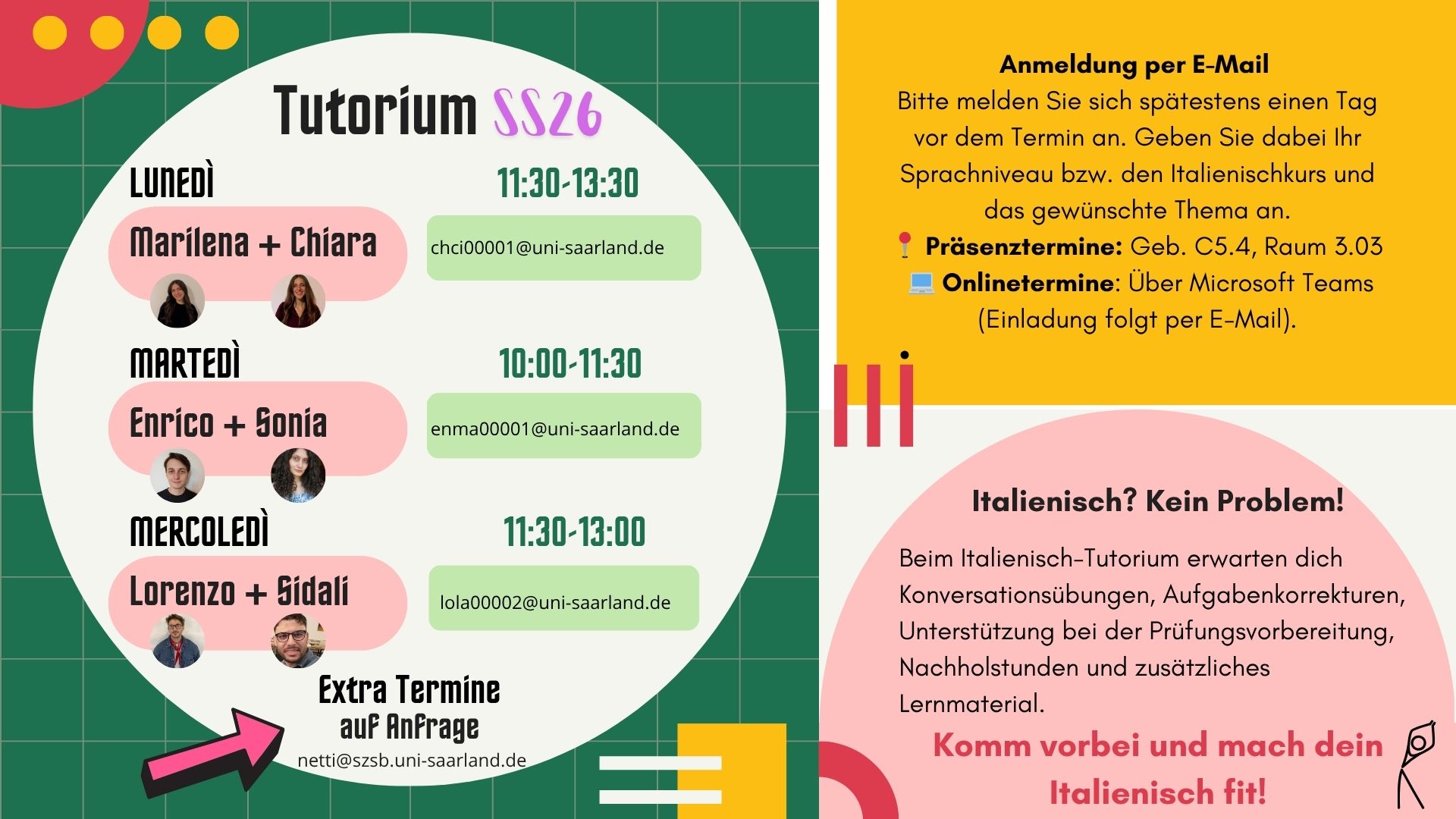
During the 2026 summer semester, tutorials are offered both online and in person and begin on 20 April 2026.
++ Please sign up in advance by email. ++
Please sign up at least one day in advance so we can properly organize our sessions. When signing up, please let us know your current language level or the course you are attending as well as which topic you would like to cover.
In-person: Building C5.4 4, Room 3.03
Online Tutorials take place over Microsoft Teams and participants receive their invitations directly.
Participants should try logging in at least 15 minutes before the start of the session to ensure they have access. If there are any technical troubles, please contact me directly.
I am also available for any other organizational questions.
p.netti(at)szsb.uni-saarland.de
Buon inizio semestre!
Paola Netti
Teaching and programme coordination team
- Paola Netti
- p.netti(at)szsb.uni-saarland.de
- Tel.: +49 681-302 5447
Part-time external teaching staff
- Domenica Caminiti
- Davide Clemente
- Lucia Landro
- Sara Marino
- Maria Marra
- Nicol Parrillo
- Simone Pepe
- Sandra Strohbach
- Dott.ssa Marzia Vacchelli
- Nicoletta Serra
Certificates
Italian courses at the Language Centre follow the UNIcert®-System. UNIcert is a language certificate awarded by over 50 language centres in Germany that allows students to learn languages alongside their studies while also earning an official certificate. The programme was founded and is administrated by AKS (Arbeitskreis der Sprachenzentren Deutschlands), an alliance of language centres in Germany. The AKS has over 70 member institutions across Germany and contributes to maintaining and developing high-quality standards for language courses via the UNIcert programme.
Students who complete language centre courses can receive a certificate attesting to their progress in the language, test scores and the skills they acquired.
The UNIcert Basic certificate can be awarded to participants who complete the courses in the table below, which total 8 hours per week.
Your final grade will be the weighted average of all course grades. Students can apply to have previous courses (such as secondary school courses) counted towards the Basic certificate, but Italian A2 Part 2 needs to have been completed at the Language Centre. Please contact the Language Centre in good time to enquire if your previous course can be recognized as equivalent to one of the courses below.
| Levels and modules | Italian courses | hrs/wk | Teaching hours |
|---|---|---|---|
| A1 | Italian A1 Part 1 | 2 | 30 |
| Italian A1 Part 2 | 2 | 30 | |
| A2 | Italian A2 Part 1 | 2 | 30 |
| Italian A2 Part 2 | 2 | 30 |
The UNIcert I certificate can be awarded to participants who complete all of the required courses. Your final grade will be the weighted average of all course grades. Students can apply to have previous courses (such as secondary school courses) counted towards the UNIcert I certificate, but Italian B1 Part 3 needs to have been completed at the Language Centre. Please contact the Language Centre in good time to enquire if your previous course can be recognized as equivalent to one of the courses below.
| Levels and modules | Italian courses | hrs/wk | Teaching hours |
|---|---|---|---|
| A1 | Italian A1 Part 1 | 2 | 30 |
| Italian A1 Part 2 | 2 | 30 | |
| A2 | Italian A2 Part 1 | 2 | 30 |
| Italian A2 Part 2 | 2 | 30 | |
| B1 | Italian B1 Part 1 | 2 | 30 |
| Italian B1 Part 2 | 2 | 30 | |
| Italian B1 Part 3 | 2 | 30 |
The UNIcert II certificate can be awarded to participants who complete the courses in the table below, which total 8 hours per week.
Students can apply to have previous courses (such as secondary school courses) counted towards the UNIcert II certificate, but Italian B2 Part 2 need to have been completed at the Language Centre. Please contact the Language Centre in good time to enquire if your previous course can be recognized as equivalent to one of the courses below.
Students who have completed all required courses can apply for the certificate at the Language Centre Service Point or directly from the programme coordinator. The grades obtained in each course are averaged to determine the final grade.
| Levels and modules | Italian courses | hrs/wk | Teaching hours |
|---|---|---|---|
| B2 | Italian B2 Part 1 | 2 | 30 |
| Italian B2 Part 2 | 2 | 30 | |
| Italian B2 – Oral communication | 2 | 30 | |
| Italian B2 – Written communication | 2 | 30 |
Links
- Bilingual German-Italian/Italian-German dictionary: it.pons.eu
- Dizionario della Lingua Italiana Hoepli, monolingual: dizionari.hoepli.it
- Monolingual Italian dictionary and thesaurus from the Italian newspaper Corriere della Sera: dizionari.corriere.it
Adesso (magazine for Italian learners in German-speaking regions)
Dizionario italiano multimediale e multilingue di ortografia e di pronunzia:http://www.dizionario.rai.it/
- Italian Cultural Institute in Stuttgart:www.iicstoccarda.esteri.it/IIC_Stoccarda
- Italian Cultural Institute in Cologne: www.iiccolonia.esteri.it/IIC_Colonia
- Italian Cultural Institute in Munich: www.iicmonaco.esteri.it/IIC_Monaco
- Italian Cultural Institute in Berlin: www.iicberlino.esteri.it/IIC_Berlino
- Information from the Italian Ministry of University and Research (MIUR, Ministero dell’Università e della Ricerca) on studying in Italy: www.studieren-in-italien.it
- Italian consulate general in Frankfurt am Main with an office in Saarbrücken (Am Ludwigsplatz 7, 66117 Saarbrücken, Tel: +49 681 668330: www.consfrancoforte.esteri.it/Consolato_Francoforte
- Italian Embassy in Germany: https://ambberlino.esteri.it/de/