Information for
 Quick links
 Faculties


The following text is based on a machine translation.
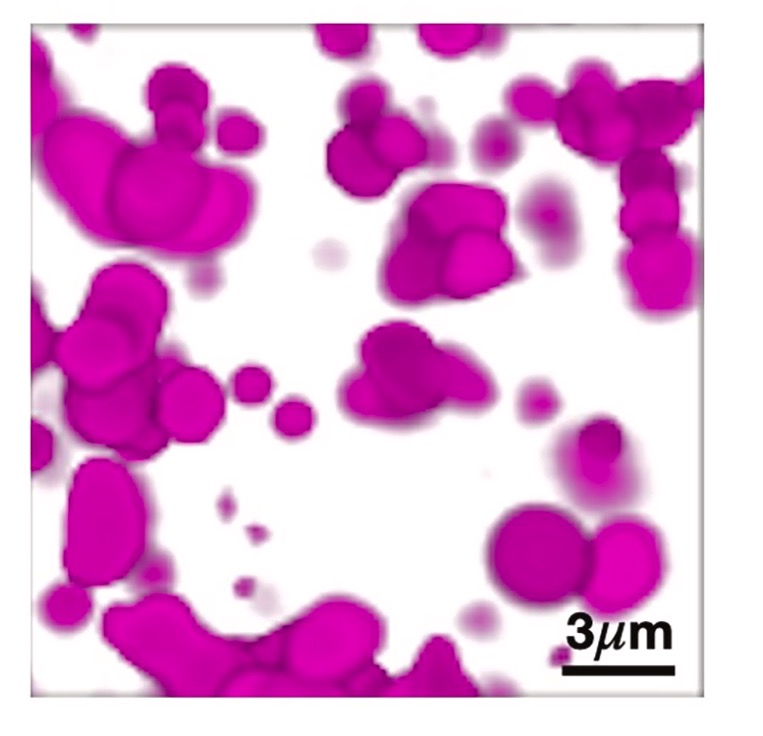
How do living systems organize their internal processes without a central control system? A research team from Saarland University who had moved from the Max Planck Institute for Molecular Cell Biology and Genetics in Dresden, and the University of Augsburg have now described a mechanism that brings us closer to answering this question. In an artificial, cell-free system, the scientists were able to show that so-synthetic biomolecular condensates form and dissolve spontaneously. At the same time, these microscopic compartments actively influence the biochemical processes in their surroundings.
Biomolecular condensates arise through phase separation: in the cell this can bring substances that were previously evenly distributed together, much like oil and water separate from one another after thorough mixing. During this ‘separation’ of the individual components, proteins and RNA molecules spontaneously aggregate to form compartments, without, however, being enclosed by a membrane, as is the case with other cellular compartments. Such membrane-less structures also occur in living cells. It has only become clear over the past decade and a half that many of these structures are not rigid formations, but behave like liquid droplets.
Initially, however, such aggregations of individual compounds and molecules were regarded merely as ‘organizational centers’ within cells – units that imparted spatial structure to the cell’s interior. Scientists now believe, that these condensates play a far more significant role. They could provide clues as to how early chemical systems spatially organized their reactions prior to the emergence of the first cells.
The study now presented also supports the assumption that the function of these compartments extends far beyond mere spatial organization. The team led by Prof. Dr Dora Tang was able to demonstrate that the condensates have a direct effect on the synthesis and degradation of RNA and thereby help to determine dynamics of the compartments.
The research focused on so-called messenger RNA (mRNA), the molecular messenger that carries genetic information. “The experiments show that mRNA is degraded significantly more slowly within the condensates than outside them. The droplets thus create a kind of protected microenvironment in which the molecules are preserved for longer. This extends the lifespan of the mRNA, and the concentration of genetic material in the overall system increases,” says the physical chemist, who specializes in researching such compartments, summarizing the key findings of the study now presented. According to the scientists, the condensates are therefore not only organizational structures but also a kind of ‘safe haven’ for sensitive biomolecules.
“The feedback mechanism observed is particularly remarkable: the condensates are only formed as a result of mRNA production. Once they have formed, they change the speed at which the mRNA can be produced and destroyed. The change in balance between production and degradation protects this mRNA from degradation and thereby indirectly promote the conditions that enable their own existence,” Dora Tang goes on to explain. In this self-regulating mechanism, compartmentalization – that is, the aggregation of individual compounds into ‘condensates’ – and the biochemical reactions leading to the formation of mRNA are inextricably linked. The droplets therefore do not behave like passive containers, but rather as active participants in the molecular process.
Theoretical models also suggest that such condensates can cushion fluctuations in biological systems. “When the availability of resources for RNA production was periodically altered, the concentrations of genetic messengers remained more stable in the presence of condensates than in comparable systems without compartment formation,” said Dora Tang. The compartments acted, in a sense, as ‘molecular shock absorbers’, reducing sharp fluctuations and thus ensuring more robust conditions. The compartments can therefore help to keep important molecules available for longer and cushion fluctuations.
The findings provide new insights into the fundamental principles of biological self-organization. They could help to improve our understanding of the role played by membrane-less compartments in living cells and of how simple chemical systems develop properties reminiscent of living organisms. Furthermore, the scientists see potential applications in synthetic biology, where artificial, life-like systems are specifically engineered from chemical parts.
Original publication:
Archishman Ghosh, Advait Thatte, Surased Suraritdechachai, Roman Rattunde, Christoph A. Weber, T.-Y. Dora Tang, Transcription-driven phase separation of synthetic condensates enables self-organizing compartments and protective microenvironments, Cell Reports Physical Science, Volume 7, Issue 8, 2026, 103481, ISSN 2666-3864, https://doi.org/10.1016/j.xcrp.2026.103481
Further information:
Prof. Dr Tsing-Young Dora Tang
Email: dora.tang(at)uni-saarland.de