Information for
 Quick links
 Faculties


The following text has been machine translated from the German with no human editing.
Large language models (LLMs) – the technology behind tools such as ChatGPT and Claude, which millions of people use every day – only demonstrate their full potential after extensive fine-tuning. This step, known in the field as fine-tuning or post-training, specialises a model for new subject areas, languages or tasks and ensures that it is safer and better tailored to human requirements. Yet although almost every practical application relies on this fine-tuning, surprisingly little is known so far about when, why and how it actually works. This is precisely where Marius Mosbach's research comes in.
His aim is to transform the adaptation of language models from a collection of empirical recipes into a well-founded science, and to use this understanding to develop more reliable and adaptable AI systems. His work is divided into three areas: Firstly, he focuses on the interpretability of models – that is, the question of how language models work internally and how adaptation changes them. However, Marius Mosbach is also interested in the topic of generalisation – that is, the question of when and why models function reliably even outside their training data. He is also exploring the field of continuous learning, in which systems continue to learn dynamically even after training has been completed, can update outdated knowledge and improve whilst in use. A particular priority for him is to make research into the interpretability of AI systems practically applicable.
Marius Mosbach has made a name for himself in academic circles through, amongst other things, LLM2Vec, a method that enables large language models to be transformed into powerful text encoders. Furthermore, his ground-breaking work on the stability of fine-tuning language models such as 'Bert' has attracted widespread attention.
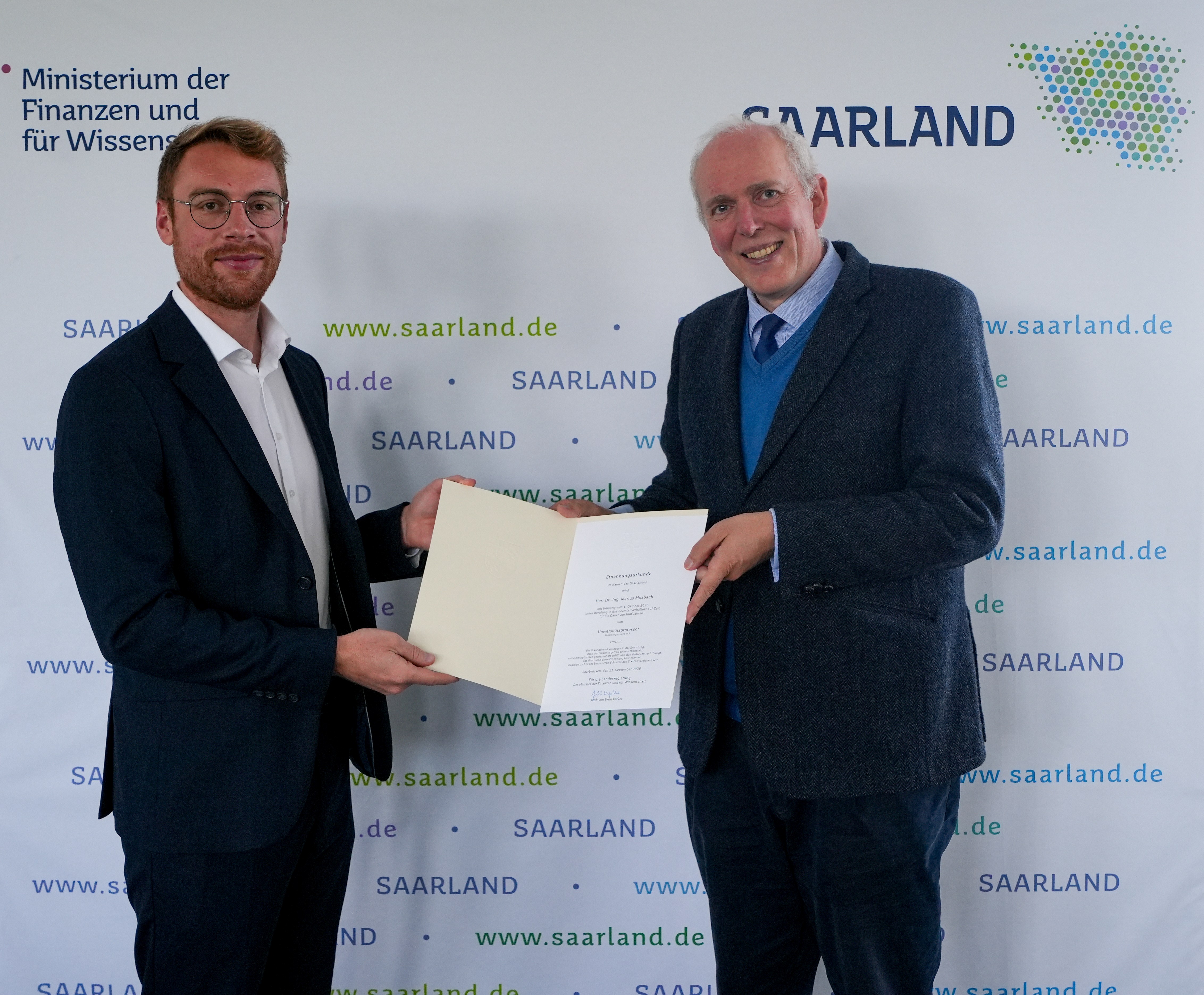
At Saarland University, Marius Mosbach is establishing a new research group within the Department of Language Science and Technology at the Saarland Informatics Campus. At the same time, he will serve as Scientific Director at the German Research Center for Artificial Intelligence (DFKI), thereby maintaining close links with the international research community and AI research at the centre.
Marius Mosbach has received numerous awards for his work, together with his co-authors, including a Best Paper Award at COLING 2022, the Best Theme Paper Award at ACL 2023 and the Most Interesting Paper Award at the BabyLM Challenge 2023. Marius Mosbach will take up his post at Saarland University on 1 October 2026.
Short biography
Marius Mosbach studied Computer Science at Saarland University, where he also completed his Ph.D. at the Faculty of Mathematics and Computer Science. He subsequently conducted postdoctoral research at Mila – Quebec AI Institute and at McGill University in Montréal (Canada). Marius Mosbach will take up his post as a professor at Saarland University and as Scientific Director at the German Research Center for Artificial Intelligence (DFKI) on 1 October.