Information for
 Quick links
 Faculties


Meiers studied and completed his doctoral degree in Saarbrücken before conducting research at Harvard. He is now returning to campus thanks to the EU’s prestigious Marie Skłodowska-Curie Postdoctoral Fellowship, which supports outstanding young researchers.
The following text has been machine translated from the German with no human editing.
To make medicines more effective or to develop new active ingredients, Professor Tanja Gulder’s Organic Chemistry research group at Saarland University is modifying the molecular structure of drugs. The researchers specialise in ‘tuning’ these tiny building blocks of substances: They enhance them using innovative, sustainable methods that are environmentally friendly and conserve resources. To do this, Gulder and her team draw inspiration from the most experienced and imaginative chemist of all: nature. Following her example and using her tricks – which have matured over billions of years of persistent evolution – they are working to improve active ingredient molecules.
“Nature can help us achieve what we are not yet capable of today. In our research, we are getting to the bottom of the question of how nature creates medicinal substances in its ‘green pharmacy’. In doing so, we want to find out exactly how these natural substances work and what we can learn from them,” explains Tanja Gulder, who is involved in, amongst other things, two collaborative research centres and two Research Training Groups funded by the German Research Foundation (DFG). “We are working to understand nature’s methods and to work out which molecules it produces, for what purpose, and how it does so. The aim is to transfer its Chemistry to the test tube in order to develop new active substances or further refine existing ones,” says the chemist. In this way, she and her team are equipping active substances with new, tailor-made properties from the inside out.
One such well-known method is to incorporate halogens such as fluorine, chlorine, bromine or iodine into organic compounds. Nature provides a model for such halogen compounds: certain biocatalysts, also known as halogenases, synthesise natural substances in the most ingenious ways, substances which contain at least one halogen atom in their molecular structure. Products ‘halogenated’ in this way – such as antibiotics or cancer drugs – often exhibit stronger biological activity. Furthermore, these substances become ‘more reactive’, meaning they enter into chemical reactions with other substances or their environment more quickly and easily.
Joscha Meiers is conducting research in this field. A pharmacist and chemical biologist with a doctoral degree, he aims to produce such ‘enhanced’ molecules using more environmentally friendly methods than have previously been possible, with a view to improving existing drugs or developing new ones in the future. “Many synthesis steps in the production of medicines are based on organic halogen compounds. They serve, for example, as highly reactive building blocks for constructing complex active ingredients,” explains Joscha Meiers. “Around a third of authorised medicines today contain at least one such incorporated halogen in their molecular structures; in the case of pesticides, this figure is even significantly higher,” adds the pharmacist.
“So far, however, it has been difficult to incorporate halogen atoms into organic compounds as efficiently as possible. Only a small proportion of the reagents used ultimately ends up in the molecule; the majority ends up as waste,” explains Meiers. “Current methods for producing such halogen compounds are also very energy-intensive. They require high pressure, intense heat and solvents that are difficult to recycle – so, overall, the processes are not very environmentally friendly,” says the researcher.
Tanja Gulder’s team specialises in new methods for incorporating halogen atoms into organic molecules in a ‘mild’, environmentally friendly and efficient manner. This is why Joscha Meiers is joining Saarland University: the researcher is now working in Tanja Gulder’s research group to produce such compounds in a more manner. He is developing novel biocatalytic methods to produce these compounds under very energy-efficient conditions at room temperature in water.
He is supported in this work by a Marie Skłodowska-Curie Postdoctoral Fellowship: the European Commission awarded this to Joscha Meiers as part of the EU’s ‘Horizon Europe’ research framework programme in the highly competitive 2026 round. This prestigious research fellowship supports postdocs and promotes excellence in research.
About the researcher
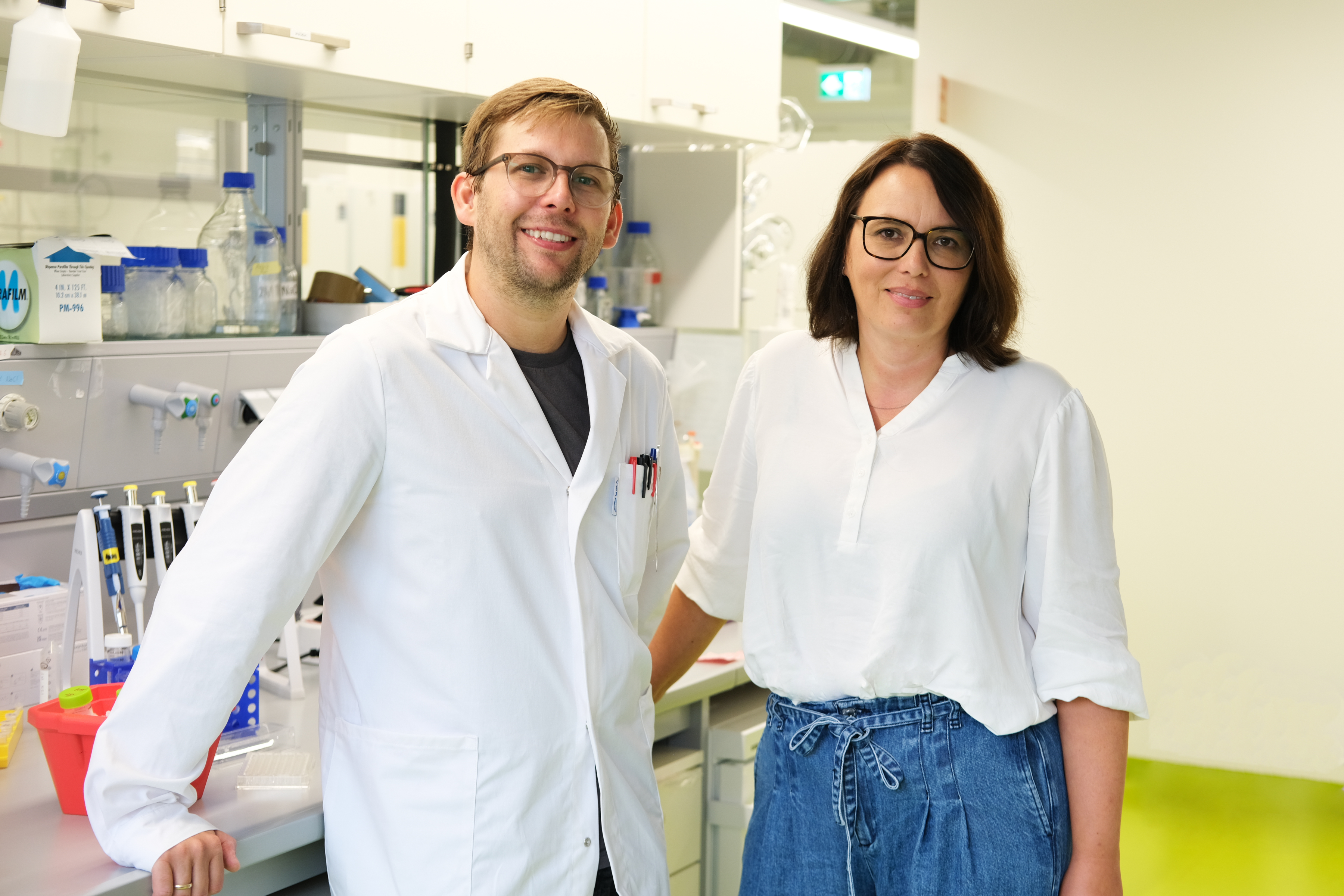
Joscha Meiers, a pharmacist and chemical biologist with a doctoral degree who has been conducting research at Harvard in the US since May 2023, knows the Saarbrücken campus very well: he studied Pharmaceutical Science at Saarland University. As early as his Master’s thesis in Professor Christian Ducho’s laboratory, he developed a method to determine how much of an antibiotic enters the interior of a bacterial cell. He is a postdoc in Professor Alexander Titz’s group on the chemical biology of carbohydrates at the Helmholtz Institute for Pharmaceutical Research Saarland on the campus, focusing on the chemical synthesis and microbiological analysis of novel combination drugs against antibiotic-resistant bacteria in biofilms. Since 2023, Meiers has been conducting research at Harvard University in Professor Emily Balskus’s group in the Department of Chemistry and Chemical Biology. There, he has been working on new antimicrobial molecules derived from the human gut microbiome and novel antibiotic strategies.
For enquiries:
Dr Joscha Meiers: Email: joscha.meiers@uni-saarland.de
Prof. Dr Tanja Gulder: Email: tanja.gulder@uni-saarland.de
Press photos can be found on this news website (at the very bottom of the page): https://www.uni-saarland.de/aktuell/msca-51064.html
You may use the press photos free of charge in connection with this press release and reporting on Saarland University, provided you credit the photographer.