Information for
 Quick links
 Faculties


With funding of around €2.5 million, the project will generate new data that will be used to assess the condition of Saarland's water bodies. The main focus of the project will be on the implementation of the Water Framework Directive in Saarland and the new requirements arising from the EU's Urban Wastewater Treatment Directive.
The following text has been machine translated from the German with no human editing.
Pollutants from households, agriculture and industry are affecting many European water bodies, and their natural structures have also been destroyed in many places. In addition, high temperatures, prolonged dry spells and heavy rainfall events during hot summers are exacerbating the pressure on water bodies. To counteract this, the European Union adopted the Water Framework Directive in 2000 – with the aim of bringing all water bodies across Europe to a good chemical and ecological status by 2027 at the latest.
“This target cannot be met by next year. That is why the EU Member States are currently drawing up a fourth management plan to further advance the implementation of the EU Water Framework Directive,” explains Angelika Meyer. A geographer with a PhD, she coordinates the ‘Water Monitoring’ working group at Saarland University, which has been monitoring water quality in Saarland’s watercourses on behalf of the state for many years. The aim is to identify sources of pollution more accurately and thus lay the foundations for effective and cost-efficient measures to protect water bodies.
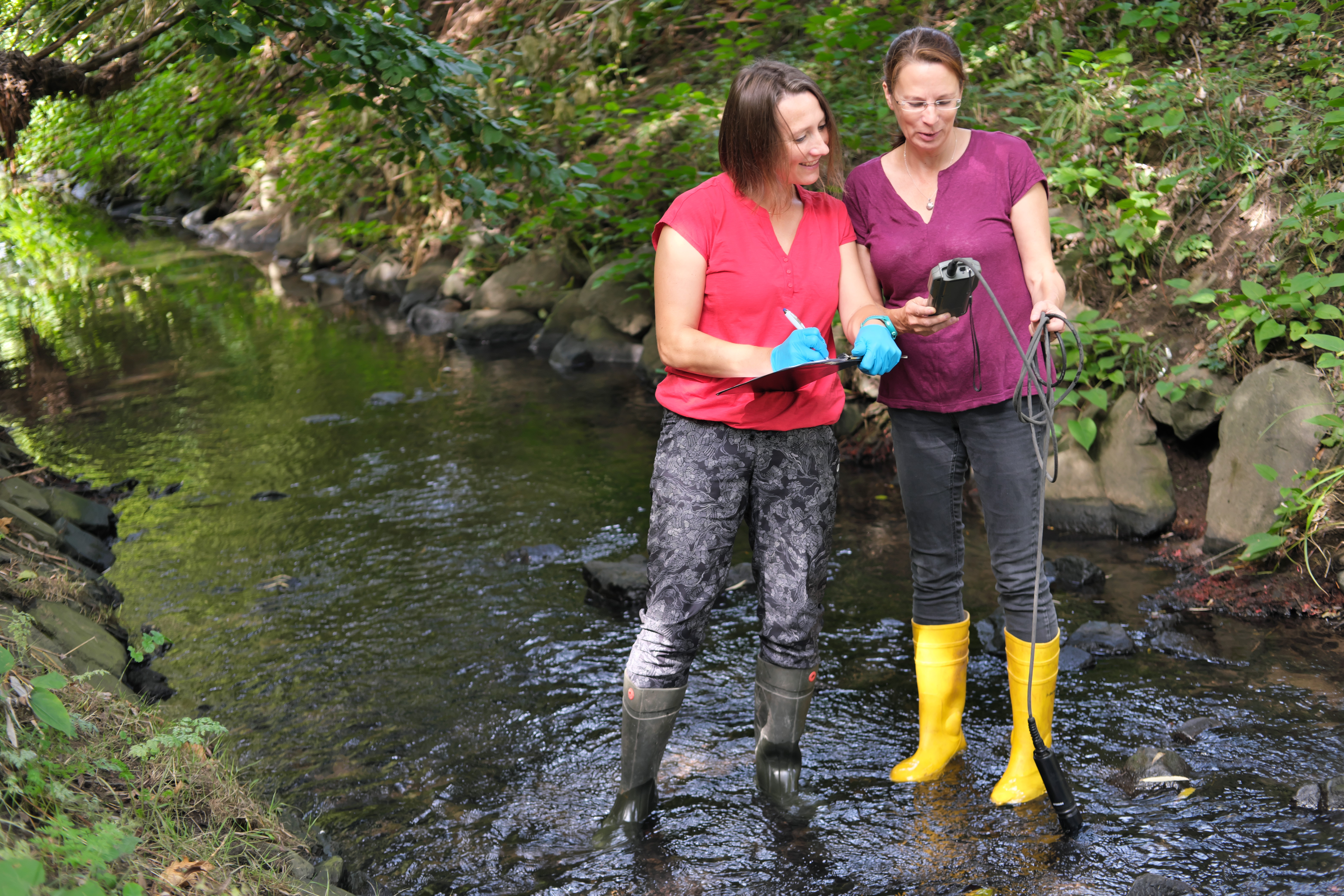
The measurements are carried out, amongst other things, using mobile monitoring stations, which take samples at selected water body locations for up to a year at a time: river water is continuously fed into the station, where probes and analysers measure key water parameters such as oxygen content, water temperature, pH, conductivity, chloride, nitrate, ammonium, phosphorus and organic carbon. The readings are transmitted online every five minutes, enabling real-time monitoring of the water body.
New collaborative project responds to stricter EU requirements
In the new five-year collaborative project, Angelika Meyer’s team will intensify its research into assessing the condition of Saarland’s water bodies. In line with the requirements of the fourth management plan under the EU Water Framework Directive, the scientists will, amongst other things, begin including trace substances in their water analyses. The plan also provides for greater consideration to be given to climate-related stress factors such as prolonged periods of low water and higher water temperatures. “To this end, we will in future use more flexible individual probes that transmit key parameters such as oxygen content and temperature in real time. This will help us to quickly identify vulnerable river sections and understand the triggers that lead to particularly critical situations.”
Another key focus of the water monitoring project is to adapt the measurements to the new requirements of the EU Urban Waste Water Treatment Directive; this obliges operators of large sewage treatment works, for example, to introduce a fourth treatment stage to remove micropollutants such as pharmaceutical residues or PFAS. In addition, the Urban Waste Water Treatment Directive addresses the problem of storm water overflow structures, which lead to significant pollutant discharge into water bodies during heavy rainfall. “To find out how much waste water enters a vulnerable stretch of stream and how often this happens, we will be making greater use of our large monitoring stations there for real-time monitoring,” explains the project coordinator.
Water pollution is particularly high in the Saarland: “Our federal state is densely populated, whilst at the same time agriculture and industry characterise many regions. If pollutants from sewage treatment works or other sources enter the mostly small watercourses, this is particularly problematic during periods of extreme drought, such as this summer.”
Continuous sampling reveals pollution patterns
Due to stricter EU requirements, researchers in Saarbrücken will, in future, increasingly use specialised automatic samplers alongside the established measurements carried out using mobile monitoring stations: small, self-powered units that automatically fill bottles with water samples. These are then analysed in the laboratory for inorganic and, in future, also organic micropollutants, including so-called PFAS and pharmaceutical residues. “As water bodies are subject to significant fluctuations, we must – in order to identify specific pollution patterns – carry out continuous sampling even for trace substances,” explains Professor Ralf Kautenburger, who is the scientific project lead for the water monitoring project. In this way, links can be established with weather events such as rainfall, or with groundwater levels and data from sewage treatment works. “The continuous measurements show when specific pollutants enter the water bodies, and we can deduce from this which substances are being introduced from agriculture, sewage treatment works or canals. This knowledge is essential for planning the right measures to improve water quality in the respective catchment area,” says Kautenburger.
Background:
The ‘Water Monitoring’ working group at Saarland University is part of Professor Guido Kickelbick’s Chair of Inorganic Solid-State Chemistry and forms part of the Environmental Analysis Unit (https://www.uni-saarland.de/lehrstuhl/kickelbick/arbeitsstelle-umweltanalytik.html).
The new 4th Management Plan under the Water Framework Directive (WFD) is currently being prepared; it will be implemented from 2028 to 2033. To this end, a comprehensive reassessment of water bodies is currently underway, taking into account the findings from the last management cycles. https://www.umweltbundesamt.de/wasserrahmenrichtlinie
The EU Urban Waste Water Treatment Directive (Directive 2024/3019, KARL) came into force on 1 January 2025 and must be transposed into national law by 31 July 2027. https://www.umweltbundesamt.de/themen/wasser/abwasser/faq-zur-kommunalabwasserrichtlinie-karl
For further information, please contact:
Dr Angelika Meyer
Project Co-ordinator, Water Monitoring
Saarland University
Institute of Inorganic Solid-State Chemistry
www.gewaesser-monitoring.de
www.uni-saarland.de/lehrstuhl/kickelbick/arbeitsstelle-umweltanalytik.html
Press photos available for download