Information for
 Quick links
 Faculties


The new institute was established with the support of a research grant from the charitable Klaus Faber Foundation in Saarbrücken.
The following text has been machine translated from the German with no human editing.
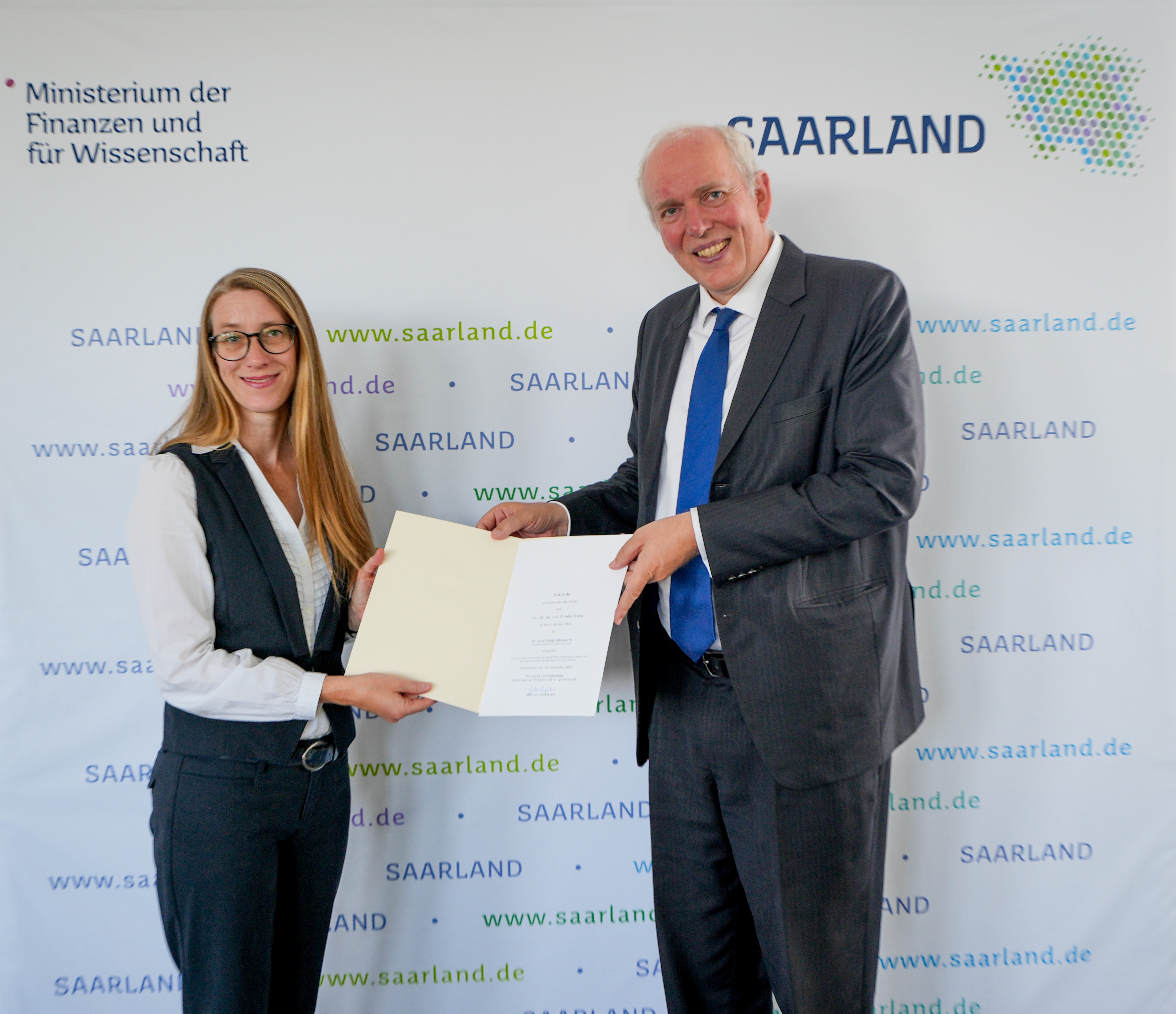
Anneli Peters, who has a doctoral degree in biochemistry, is moving from Ludwig Maximilian University of Munich to Saarland University. There, she most recently led a Heisenberg research group at the Institute of Clinical Neuroimmunology, having previously been funded by the German Research Foundation (DFG) as an Emmy Noether group leader. Other stages of her scientific career include the Max Planck Institute for Neurobiology in Munich and several years of research at Harvard Medical School in Boston (USA).
Her research focuses on understanding the adaptive immune response in inflammatory autoimmune diseases of the central nervous system, particularly multiple sclerosis (MS). A key area of focus is the interaction between T and B cells, which play a decisive role in the development and maintenance of autoimmune inflammatory processes. Her work has demonstrated, among other things, that these interactions take place not only in secondary lymphoid organs in the periphery, but also directly within the central nervous system in so-called ectopic lymphoid follicles. These structures form beneath the meninges and are suspected of promoting smouldering inflammatory processes in the brain over long periods of time.
Furthermore, Anneli Peters is investigating the role of the gut microbiota as a trigger and modulator of neuroimmunological diseases. Using innovative experimental strategies, she has demonstrated that the gut microbiota of people with MS contains pathogenic species capable of activating autoreactive immune cells in the gut, leading to their subsequent migration into the central nervous system. The aim is now to gain a better understanding of the cellular and molecular mechanisms underlying these pathogenic interactions between the gut microbiota and the immune system and to derive new therapeutic approaches from this in the long term.
Methodologically, her research group combines in vivo models with modern immunological and molecular biological techniques as well as high-resolution imaging to analyse disease-relevant processes in both the peripheral immune system and the brain.
With the Klaus Faber Institute for Neuroimmunology, Saarland University is establishing a new international centre for basic and translational research. The aim is to systematically decipher neuroimmunological mechanisms and develop new approaches for the diagnosis and treatment of neuroimmunological diseases – in particular multiple sclerosis.
'I am very much looking forward to establishing the new institute and, together with my team and in collaboration with the highly qualified experts at the site, driving forward innovative research in neuroimmunology. Of particular importance to me is the long-term benefit of our basic research for those affected," says the new professor and head of the institute. Saarland University is gaining an internationally renowned scientist in Anneli Peters, who will further raise the university's profile in the field of biomedical research. She will take up her professorship on 1 October.