Information for
 Quick links
 Faculties


The following text has been machine translated from the German with no human editing.
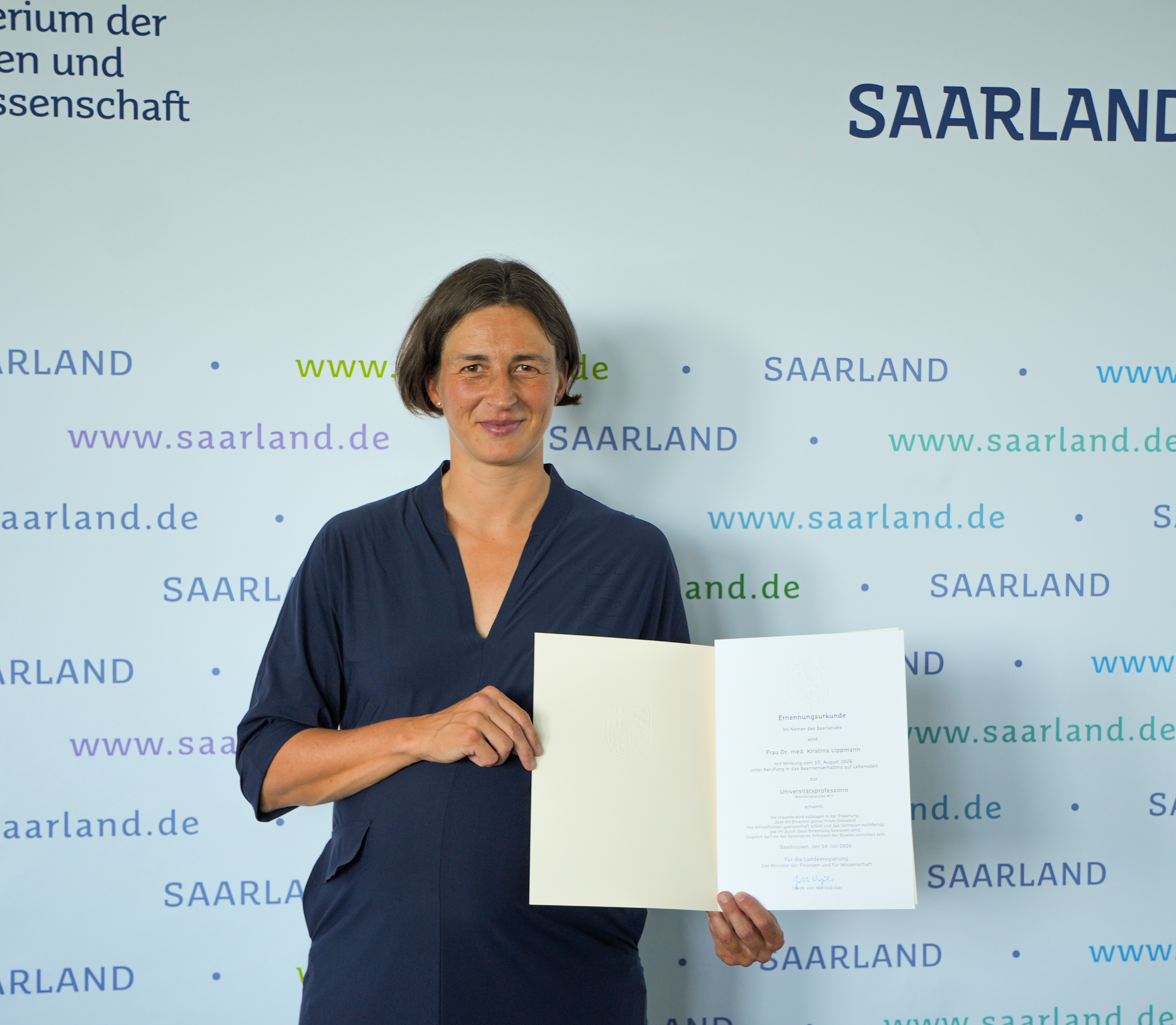
Kristina Lippmann is moving from Leipzig University to Saarland University. In Leipzig, she worked as a qualified specialist in physiology and as a research group leader at the Carl-Ludwig Institute of Physiology. She also contributed as a principal investigator to the establishment of the Research Training Group 3102 'NeuroTune'. Professor Lippmann's scientific interests range from the study of neurotransmitter release at synapses to the influence of cellular changes on neuronal network dynamics. For synaptic structure-function analyses, she combines super-resolution light and (cryogenic) electron microscopy with functional electrophysiology.
A particularly innovative aspect of her research is the so-called 'zap-and-freeze' method: by freezing brain tissue milliseconds after stimulation, the processes occurring at the moment of neurotransmitter release can be captured and visualized in three dimensions using electron tomography with nanometer resolution. Through this approach, Kristina Lippmann aims to gain a better understanding of protein dynamics at the release sites during synaptic activity and plasticity, and ultimately in the context of disease. Furthermore, she is investigating the influence of cellular changes –associated with disease – on neuronal network dynamics, which are essential for learning and memory processes.
Kristina Lippmann aims to further develop the long-established and prestigious physiology research at Saarland University and to collaborate with clinical partners at Saarland University Hospital in both research and teaching. In addition to studies using mouse models, she intends to translate her two main areas of research to humans in collaboration with clinical partners, in order to contribute to our understanding of altered information processing in diseases.
In her teaching at the Faculty of Medicine at Saarland University, Kristina Lippmann aims to teach students not only the fundamentals of physiology but also pathophysiology and research. Beyond the faculty, Kristina Lippmann is interested in fostering links with basic researchers and computer science researchers in the Saarland and wishes to expand DFG-funded research networks in the region. Furthermore, Professor Lippmann cooperates closely with the Universities of Würzburg, Heidelberg and the Charité in Berlin, as well as with the European Molecular Biology Laboratory (EMBL) in Heidelberg. Internationally, she collaborates with researchers at Johns Hopkins, Stanford and Harvard Universities. Kristina Lippmann will take up her post at Saarland University on 15 August 2026.
Short biography
Kristina Lippmann has gained a wide range of international experience throughout her career to date. She was born in Freiberg, Saxony, studied medicine in Leipzig and subsequently completed her medical doctoral thesis at the Charité – Universitätsmedizin Berlin in collaboration with Ben-Gurion University of the Negev in Israel. Research stays at the University of California, San Francisco, Johns Hopkins University in Baltimore, and Stanford University have shaped her scientific development. Prestigious research fellowships and awards – including Grass and Whitman Fellowships at the Marine Biological Laboratory in Woods Hole, Massachusetts – as well as the German-Israeli Bernard Katz Prize underscore her international standing.