Information for
 Quick links
 Faculties


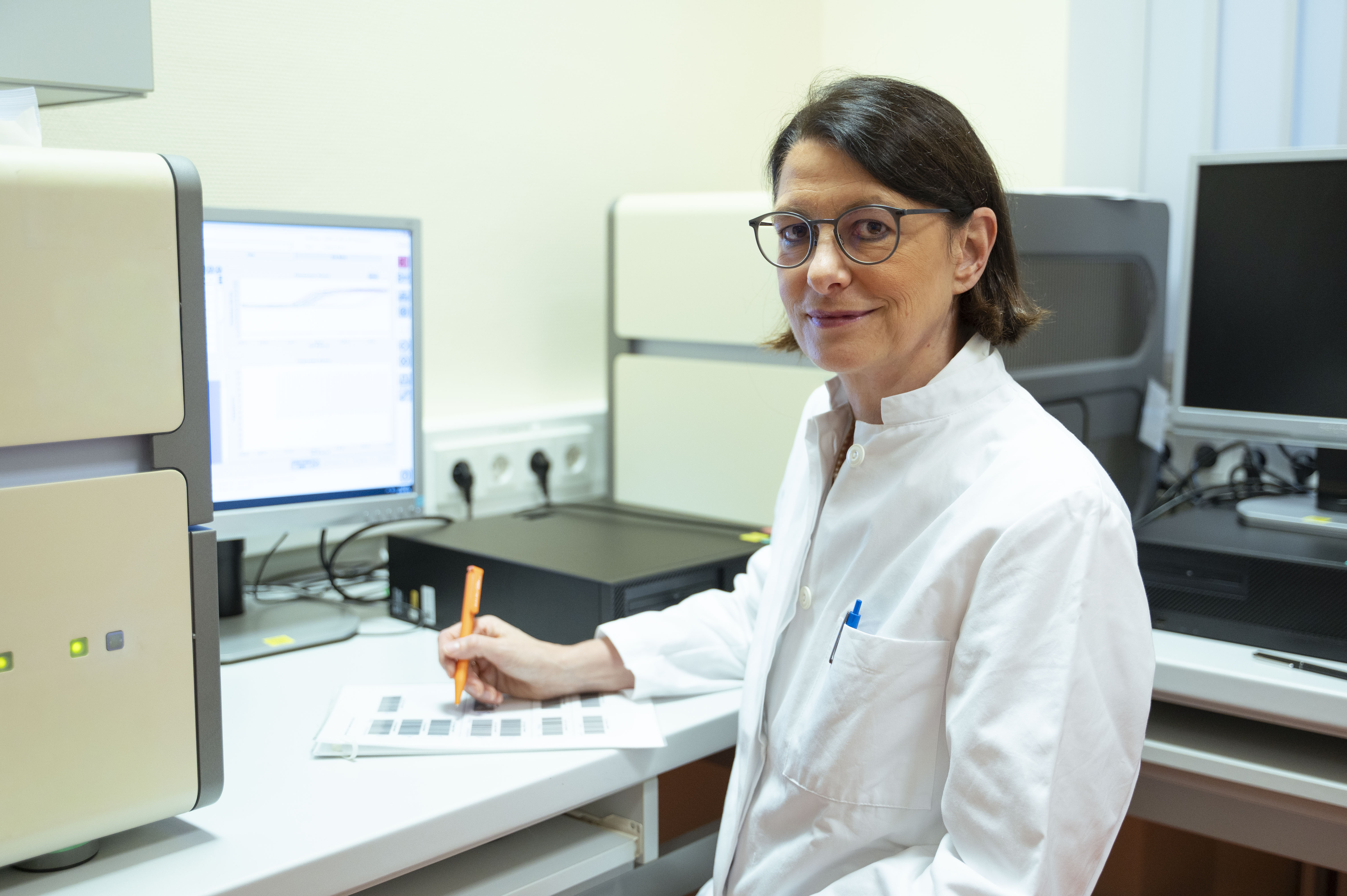
The PRÄZIS project, coordinated by Professor Sigrun Smola at the Institute of Virology at Saarland University, piloted the screening appointments in Saarland, demonstrating their positive impact on HPV vaccination rates and establishing the empirical basis for the new programme.
The following text has been machine translated from the German with no human editing.
Germany has been lagging behind for years when it comes to protection against cervical cancer. Every year, around 4,300 people are still diagnosed with cervical cancer and around 1,400 die from it (Centre for Cancer Registry Data, as of 2023). One measure that can change this is the HPV vaccination: according to the latest analysis by the Robert Koch Institute, in 2024 only 55 per cent of 15-year-olds were fully vaccinated. The World Health Organization is aiming for a 90 per cent vaccination rate to eliminate cervical cancer.
Large-scale registry studies from countries with well-implemented vaccination programmes demonstrate that this target is achievable. Data from Sweden, Denmark and England show that HPV vaccination can reduce the risk of developing invasive cervical cancer by up to 87 per cent. 'These studies reflect a consistent pattern: it is not only crucial that people are vaccinated, but also that they are vaccinated as early as possible. Australia, which adopted a school-based programme with high vaccination rates at an early stage, has a strong chance of becoming the first country to eliminate the disease,' explains Sigrun Smola, Professor of Virology at Saarland University.
'PRÄZIS': The Saarland data set
The 'PRÄZIS' project (Prevention of Cervical Cancer and its Precursors in Women in Saarland) was the first in Germany to demonstrate, based on data, that screening at the ages of 9 and 10 is the key to achieving higher vaccination rates. Saarland served as the model region. 'The key finding of this study was that there is a statistically significant correlation between participation in the screening programme for 9- to 10-year-olds and HPV vaccination at this age,' explains Dr. Anna Sternjakob, who conducted the study at the Institute of Virology. The consortium therefore recommended that screening for 9- to 10-year-olds, including HPV vaccination for all children, be made mandatory and funded, and that an organized invitation scheme be put in place, as is standard practice for screening younger children.
The Innovation Committee of the Joint Federal Committee (G-BA) subsequently decided in September 2021 to forward these findings to the Conference of State Health Ministers and also to the G-BA's Sub-Committee on Methodology Assessment, with a request that they be taken into account in the further development of cervical cancer prevention. Now, at long last, on 1 August 2026, the Joint Federal Committee approved the 'new U10'. Sigrun Smola and her team feel their preliminary scientific work has been validated: 'Our data have shown that the screening examination at the age of nine to ten is an excellent starting point for HPV vaccination within the German healthcare system. The fact that this appointment will be available to all children in future and that the HPV vaccination is explicitly mentioned there is a major step forward for cancer prevention in Germany.'
Researchers will only be able to measure to what extent the new U10 check-up actually boosts HPV vaccination rates in a few years' time: the Paediatric Guidelines provide for an Evaluation five years after its introduction to assess quality and the achievement of objectives.
Collaborating partners in the scientific 'PRÄZIS' study
The PRÄZIS project was launched back in April 2017; the Innovation Fund of the Joint Federal Committee funded it and Professor Sigrun Smola at Saarland University coordinated it. Her team, led by Dr. Anna Sternjakob, analysed pseudonymized routine data from AOK Rheinland-Pfalz/Saarland, IKK Südwest and the Saarland Association of Statutory Health Insurance Physicians, which the team linked together in a joint study database. Also involved in the study were Stefan Wagenpfeil, Professor of Medical Biometrics, Epidemiology and Computer Science; Thorsten Lehr, Professor of Clinical Pharmaceutical Science at Saarland University; and Thomas Lamberty and Bernd Holleczek from the Saarland Ministry of Health.
The new U10 screening programme and the HPV vaccination
The Joint Federal Committee has now approved the U10 screening, which targets children aged 9 to 10. This is precisely the age at which the Standing Committee on Vaccination recommends the HPV vaccination for all children, a recommendation that has applied to boys since 2018. This is because human papillomaviruses do not only cause cervical cancer: they can also trigger cancers of the vulva, vagina, penis and anus, as well as a growing proportion of oral and oropharyngeal cancers, which affect men more frequently than women. In this age group, two doses of the vaccine are sufficient instead of three. Until now, there had been no regular screening appointment for all children to receive this. Although a screening appointment for 9- to 10-year-olds already existed, not all health insurance providers had previously funded it. With the new U10, this appointment will now become a standard service for all children with statutory health insurance. In addition, the J1 will in future be documented in the 'Gelbes Heft' (yellow booklet) and is also intended to raise awareness of the HPV vaccination.
Press photos for download, for royalty-free use in connection with this press release, can be found at the very bottom of the following webpage.
Further information:
Decision of the Joint Federal Committee on the U10 screening:
https://www.g-ba.de/presse/pressemitteilungen-meldungen/1350/
Original publication from 2022:
Sternjakob-Marthaler A, Berkó-Göttel B, Rissland J, Schöpe J, Taurian E, Müller H, Weber G, Lohse S, Lamberty T, Holleczek B, Stoffel H, Hauptmann G, Giesen M, Firk C, Schanzenbach A, Brandt F, Hohmann H, Werthner Q, Selzer D, Lehr T, Wagenpfeil S, Smola S.: Human papillomavirus vaccination of girls in the German model region of Saarland: An analysis based on insurance data and the identification of starting points for improving vaccination rates. PLoS One. 2022;17(9): e0273332. DOI: 10.1371/journal.pone.0273332 | pubmed.ncbi.nlm.nih.gov/36054196/
Decision of the Innovation Committee (G-BA) on the 'PRÄZIS' project from 2021: https://innovationsfonds.g-ba.de/downloads/beschluss-dokumente/99/2021-09-23_PRAEZIS.pdf
Questions answered by:
Prof. Dr. Sigrun Smola
Institute of Virology, Saarland University
Tel.: +49-6841-16-23931 Email: sigrun.smola(at)uks.eu