Information for
 Quick links
 Faculties


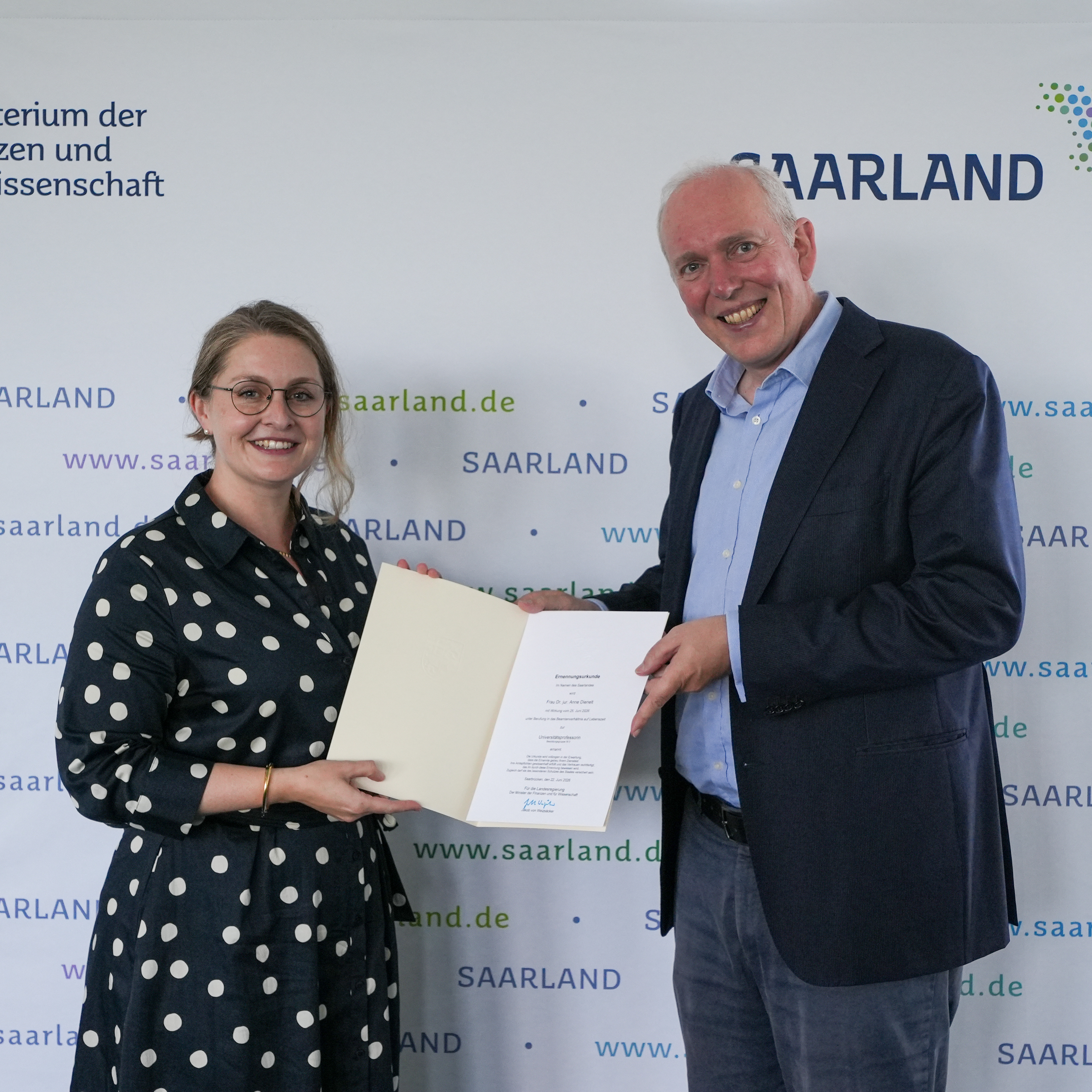
In her new role, Professor Dienelt will strengthen the university’s core research areas in sustainability and interdisciplinary European studies.
The following text has been machine translated from the German with no human editing.
Reliability, predictability, stability – these are the expectations that citizens place on state legal systems. And yet, today, states and international institutions are coming up against limits that existing law did not foresee. “When Pacific island states ask whether they can continue to exist as states even if their territory sinks into the sea, centuries-old legal concepts are no longer sufficient. And when international promises of protection – for climate refugees, for example – come to nothing because of a lack of jurisdiction and clear categories, it becomes apparent just how far the legal toolkit lags behind the challenges,” says Anne Dienelt, the new Professor of Public Law and International Law specialising in sustainability and resilience research at Saarland University.
The legal scholar is exploring the question of whether and how states and international institutions can apply and further develop the law in such a way that they learn from these crises. “And to do so without compromising the principles that define the rule of law: the subordination of power to the law, the protection of fundamental and human rights, and democratic legitimacy,” explains Anne Dienelt, who is moving to the Saarbrücken campus from the Institute for International Affairs at the University of Hamburg. Here, she will also strengthen the focus on sustainability and Europe and, thanks to her expertise in European studies and her collaborations with France, will be closely involved in the work of the university’s Cluster for European Research (CEUS).
Her research focuses on the impacts of climate change. “Climate change is a central issue in sustainability law and, at the same time, the toughest stress test for the evolving rule of law: the question is whether states and international institutions can use the law in such a way that they not only react but also act proactively,” explains the legal scholar.
Two key areas of research on sustainability and resilience
Against this backdrop, her work focuses on sustainability law at the interface between science and society. On the one hand, she explores how state and international actors translate scientific climate findings into law, how scientific evidence forms the basis for legislation, international treaties and court rulings, and what processes of transformation and loss occur in the process. On the other hand, she explores the role that citizen science can play in legal processes: “Citizens are increasingly collecting data themselves, for example to measure local climate changes or the state of ecosystems. This raises the question of what legitimacy this knowledge has in court and in legislation, and how it alters the relationship between civil society and those who apply the law,” explains Dienelt.
She also examines the topic of climate litigation. “Civil society actors, associations and affected states are bringing such strategic climate lawsuits to compel states and companies to fulfil their duty of care. My research pays particular attention to the European legal sphere: with the Green Deal and the associated legislative package, the European Union has created a legal framework for climate-related law; at the same time, the European Court of Human Rights is further developing states’ duty to protect through its climate case law,” says Dienelt.
In a second major area of focus, the new professor is investigating how states and international institutions can use the law to strengthen resilient and adaptive structures. In this context, she is examining which legal structures and instruments enable the state to learn from crises, adapt and act proactively. “The law can create conditions for the state and society that facilitate and structure learning: through evaluation obligations, adaptive regulatory approaches, institutionalised monitoring or enforceable duties of care. The example of climate change highlights where existing instruments are failing and where legislators, courts and international institutions need to take reformative action,” explains the legal scholar.
Innovative teaching and science communication
Alongside her research, Anne Dienelt places particular emphasis on practice-oriented teaching and dialogue between academia and the public. Her teaching project on the Russia–Ukraine conflict, which closely links law and science communication, attracted particular attention: to mark the second anniversary of Russia’s war of aggression against Ukraine, Dienelt, together with 14 law students from different years, published a multimedia digital exhibition on issues of international law relating to the war. Regular seminar papers were transformed into short, accessible summaries, complemented by illustrations by the artist Marlin Beringer. The project was funded by the Claussen-Simon Fund for Higher Education and is available at https://ruk.uhh.de/de.html. At Saarland University, Anne Dienelt aims to develop practice-oriented teaching formats with students in Saarbrücken that combine analysis of law with public impact and involve students in dialogue with society and professional practice at an early stage.
Career
Anne Dienelt studied Law at Tübingen, Aix-en-Provence and Göttingen, and was awarded her doctoral degree in Göttingen with a dissertation on environmental protection in armed conflict. Her [doctoral] dissertation, *Armed Conflicts and the Environment — Complementing the Laws of Armed Conflict with International Environmental Law and Human Rights Law*, was published as a book by Springer in 2022. As part of her research projects, she undertook research stays at New York University School of Law, the University of Paris I Panthéon-Sorbonne, Lund University in Sweden, and at the United Nations International Law Commission in Geneva.
Most recently, she held a temporary position as Academic Councillor at the Institute for International Affairs within the Faculty of Law at the University of Hamburg, where she is conducting research as part of her habilitation project entitled “Resilience, State & Law – The Learning Rule of Law”. Dienelt was also an associate Young Academy Fellow at the Academy of Sciences in Hamburg, where she continues to lead the interdisciplinary project group “Resilience and Diversity in Complex Systems” as its spokesperson.
For further information, please contact:
Prof. Dr Anne Dienelt, maîtrise en droit (Aix-en-Provence): Email: dieneltanne@gmail.com
Press photos available for download: Press photos can be found on this news website: https://www.uni-saarland.de/universitaet/aktuell/news.html
You may use the press photos free of charge in connection with this press release and reporting on Saarland University, provided you credit the photographer (Sebastian V. Giemsa).