Information for
 Quick links
 Faculties


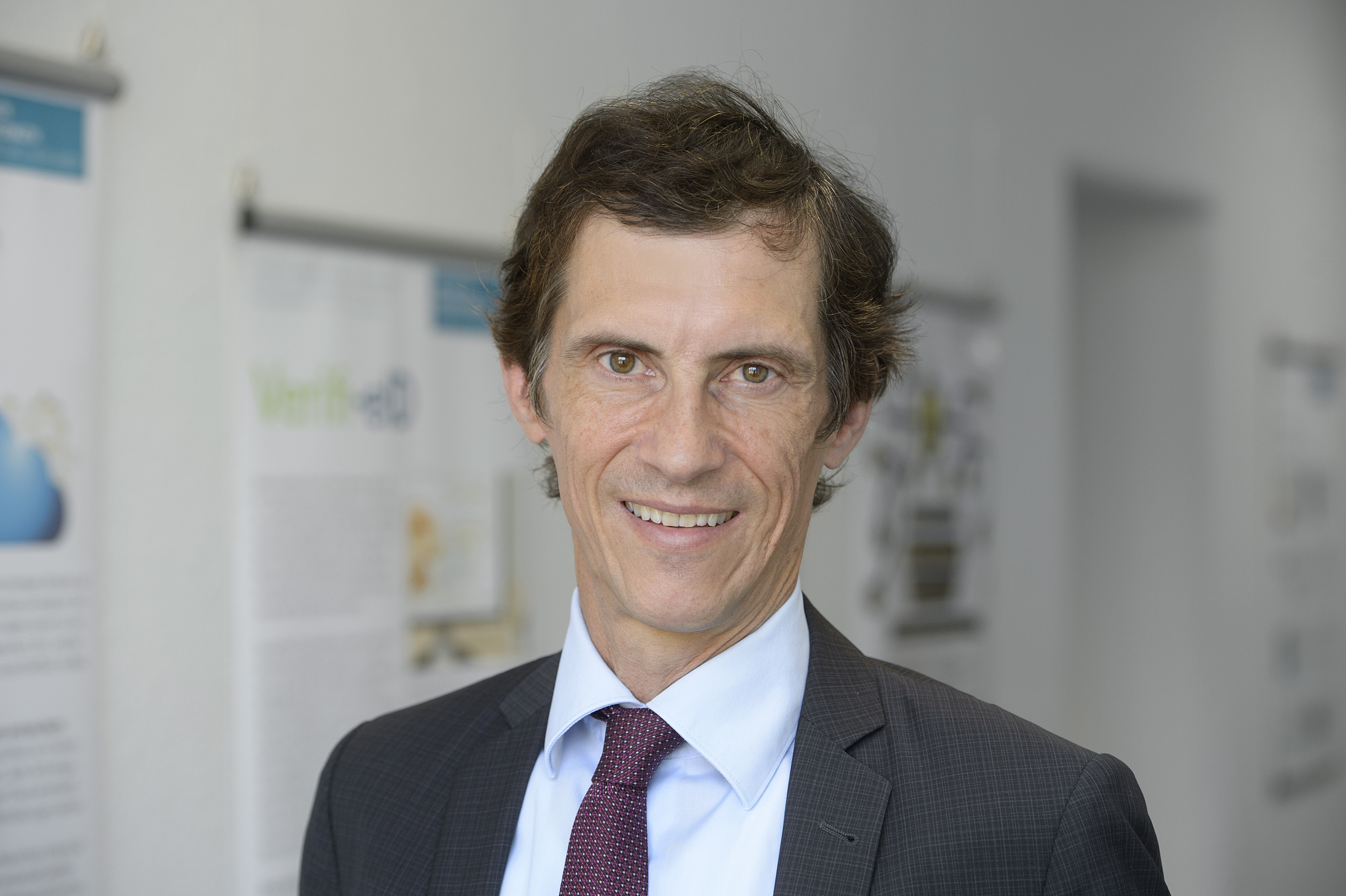
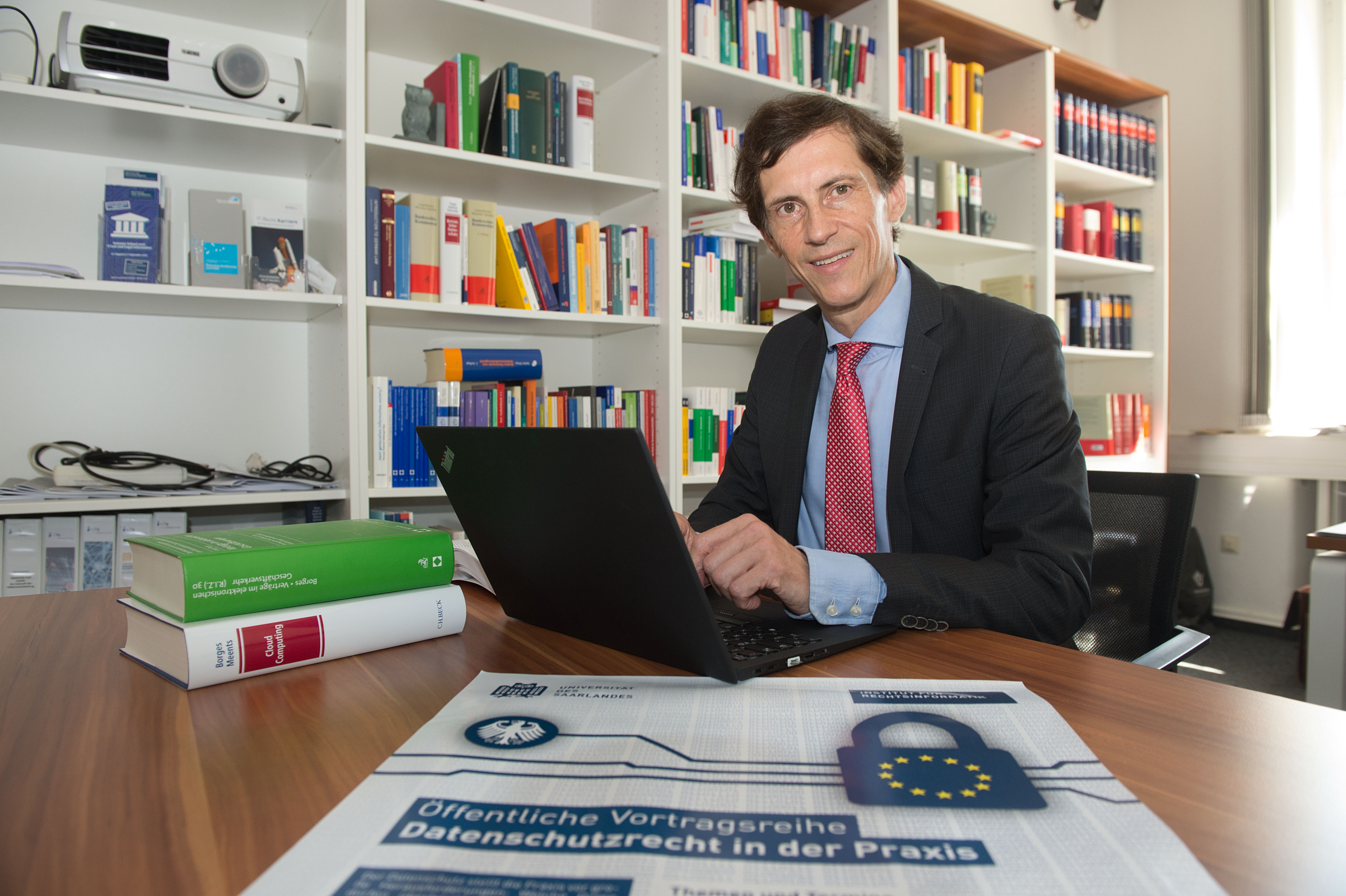
Saarland University Professor Georg Borges estimates that AI could take over as much as 70 to 80 per cent of the effort involved in otherwise time-consuming tasks such as searching for evidence. He and his team have developed tools for specific use cases, which they have bundled along with instructions in the free and openly available 'Legal work with AI' toolbox, which covers everything from brainstorming and research to text review.
The following text has been machine translated from the German with no human editing.
In legal work, there are numerous tasks that take up a great deal of time. One example is searching for supporting documents. “Research traditionally accounts for a significant proportion of working hours when dealing with legal texts,” explains Professor Georg Borges, Executive Director of the Institute for Legal Informatics. Borges and his team have developed an automated search tool for supporting documents. “In our experience, this can save 70 to 80 per cent of working time. Using the latest AI models, we have achieved a real breakthrough here,” says the legal informatics expert, citing an example: “I was able to automatically insert 200 individual references into my latest essay in an hour; checking them took three days.”
The Saarbrücken Law Toolbox currently contains a dozen such applications for drafting legal texts for research and study. “For future lawyers, the professional use of AI tools is a key skill,” says Borges. The toolbox makes it easier to use them.
“The tools we have developed address tasks that characterise everyday legal work. In academic writing, for example, AI helps to organise thoughts, improve outlines and refine drafts. As a critical interlocutor, it can also help to scrutinise arguments and identify potential weaknesses in a legal argument,” explains the legal informatics expert.
The toolbox also contains useful tools for the field of study and teaching: “Here, the use cases range from digital index cards to transcribing lectures and interviews. This also includes creating presentation slides based on model legal solutions and condensing lengthy sets of slides,” says Georg Borges. AI-supported literature searches are also particularly interesting in this context. “Anyone writing an essay, a [doctoral] dissertation or a term paper needs sources to substantiate individual statements. Finding a suitable passage can be time-consuming, particularly when dealing with specialised topics,” says Borges. AI should not merely suggest literature on the same topic, but should identify specific sources. References to opposing views are also valuable for critically reviewing one’s own argumentation.
“The AI services can be linked to users’ own collections of specialist literature. This allows researchers to build on materials they have already compiled for their work,” explains the lawyer. This offers the opportunity to significantly simplify time-consuming search work and create more scope for engaging with the subject matter. Borges and his team have developed further AI tools for analysing formal textual errors, verifying references and checking bibliographies for potentially fabricated sources.
Borges emphasises that, in all of this, it is important that humans always remain in control of the process and understand their role in this regard: “Responsibility for the use of AI always lies with humans: there must always be a professional assessment to determine, for example, whether the supporting documents are reliable and whether the original source actually supports a particular claim,” says Georg Borges.
The free and openly available toolbox will be presented interactively at the Institute for Legal Informatics’ stand during the EDV-Gerichtstag from 23 to 25 September 2026 in Building B4 1 at Saarland University.
Further information can be found on the Institute for Legal Informatics’ website: https://www.rechtsinformatik.saarland
The press release on the EDV-Gerichtstag itself can be found at the following web link:https://www.uni-saarland.de/aktuell/edvgt-2026-50529.html
About the Institute for Legal Informatics
The Institute for Legal Informatics at Saarland University is one of Germany’s leading research institutions in its field. It conducts research and teaches on the legal and technical issues of the digital world. Topics include IT security, data protection, electronic court proceedings, digital administration, smart energy systems and issues relating to autonomous systems. Furthermore, the Institute is committed to training the next generation of researchers. This includes specialised degree programmes, certificate programmes and a Master’s degree programme in the field of information technology and law.
For further information, please contact:
Prof. Dr Georg Borges, Institute for Legal Informatics, Saarland University
Tel.: +49 (0)681 302-3105
Email:georg.borges(at)uni-saarland.de
Press photos available for download:
Press photos can be found on this news website: https://www.uni-saarland.de/aktuell/toolbox-legal-work-with-ai-50598.html
You may use the press photos free of charge in connection with this press release and reporting on Saarland University, provided you credit the photographer.