 Information for
 Quick links
 Faculties


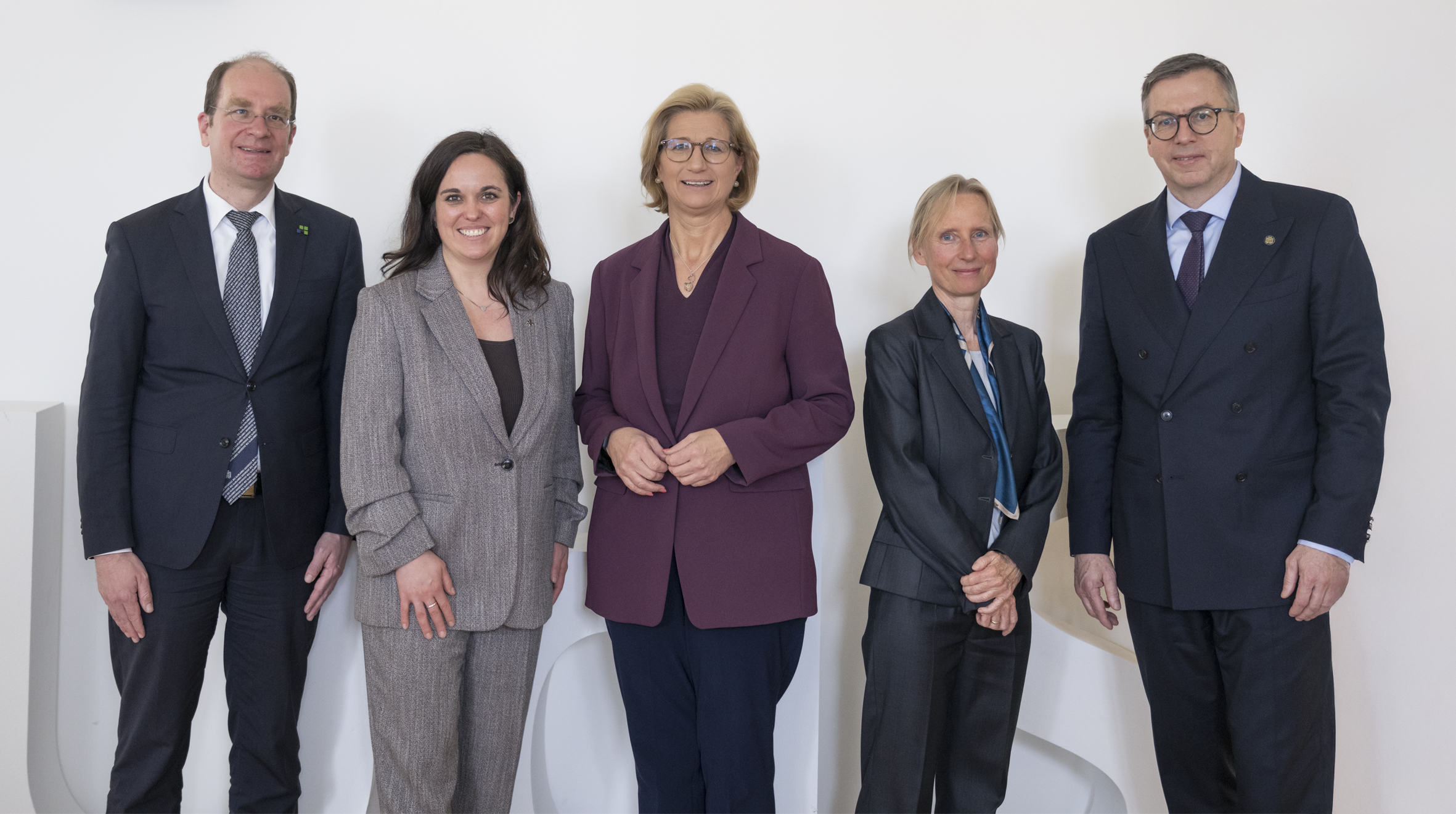
The visit took place in connection with International Francophonie Day, which this year was held worldwide on 20 March. During the visit, which lasted just over an hour, a moderated roundtable discussion brought together various members of the Saarland University community with connections to Quebec. The conversation focused on the Francophone world ('la Francophonie') and on the existing cooperative ties between Saarland University and the province of Quebec; it also explored opportunities to further strengthen the already excellent bilateral relations.
'As a university founded under the patronage of the French government, Saarland University naturally has many close links to the French-speaking world, covering study programmes, academic teaching and research as well as life on campus. I am therefore particularly pleased that Delegate General Geneviève Rolland, accompanied by Minister-President Anke Rehlinger, has honoured our university with her visit today, enabling us to show her first-hand that Francophonie is part of everyday life at Saarland University. I look forward to deepening our ties with Canada – and especially with the province of Quebec – in the years ahead,' said University President Ludger Santen.
With its unique 'trilingual campus', Saarland University has designated French as a defining feature of the university's academic profile and a core part of its international strategy. The Centre for Francophone Studies in Germany (Cellule Francophone) – the national representative office of the Agence Universitaire de la Francophonie (AUF; Association of Francophone Universities) – has been based at Saarland University in Saarbrücken since 2025. With the Centre for Franco-German Relations, the Center for Canadian and Quebec Studies (Centre d'Études Canadiennes et Québécoises), and numerous partner universities in Quebec, including the Université de Montréal and Université Laval, Saarland University already has a vibrant network within the Francophone world – a network that is set to grow further in the future.
'Here in Saarland, French is much more than the language of our neighbours – it is part of Saarland's identity and is woven into everyday life. With the introduction of our 'France Strategy Plus', we are now deliberately widening our perspective to embrace the entire Francophonie. This makes it all the more important that the Cellule francophone translates Saarland University's observer status within the international Francophone community into tangible and vibrant academic collaboration. Today's visit by the Delegate General from Quebec is a clear signal of this cooperative vision and of a strong cultural and academic partnership between Saarland, Quebec and Canada,' said Minister-President Rehlinger.
During her time on campus, Geneviève Rolland (biographical details) was also introduced to a number of the university's academic strengths, for example in the fields of quantum information, pharmaceutical research and law. The meeting was also attended by Canadian students enrolled at Saarland University and by Saarland University students who have spent a semester abroad in Quebec.
'Quebec plays a central role in Canada's research and innovation landscape. Three of Canada's top seven research-intensive universities are based in Quebec, and around a third of the jobs in these areas are located there. Quebec is therefore an ideal partner for European universities – and for Saarland University in particular – not least because Quebec's universities, like Saarland University, all have access to the programmes offered by the Agence Universitaire de la Francophonie (AUF). We share the conviction that scientific and academic cooperation offers one of the most effective means of addressing the challenges of our time,' said Geneviève Rolland.


