Information for
 Quick links
 Faculties


The conference is being organized jointly by Saarland University and the Helmholtz Institute for Pharmaceutical Research Saarland (HIPS) in Saarbrücken.
The following text has been machine translated from the German with no human editing.
The conference combines the 14th edition of the biennial Saarbrücken conference ‘BioBarriers’ with the 30th annual meeting of the ‘CRS DeChAt Local Chapter’ – a regional group (comprising Germany, Switzerland and Austria) of the ‘Controlled Release Society’ (CRS), which is the most important international scientific society in the field of drug delivery. The third component of the conference, a career day, is dedicated to career planning and counselling for young pharmaceutical scientists.
The conference will focus on biological barriers in the human body, such as the skin, lungs and gastrointestinal tract. On the one hand, these barriers serve to keep pathogens and other harmful particles out of the body; but they must also allow useful substances such as medicines to pass through. This transport of drugs to their site of action (‘drug delivery’) is one of the main areas of research of Professor Claus-Michael Lehr, who founded the Saarbrücken conference ‘BioBarriers’ around 30 years ago.
Together with his team, Lehr develops models of biological barriers based on human cells and tissues. Apart from the ethical advantage of being able to replace or at least reduce animal testing in the long term, he is convinced that this will enable him to predict better and faster whether and how a new drug will work in patients. ‘This time, the focus is on miniaturised test systems, known as “on-the-chip methods”,’ explains the professor of biopharmacy and pharmaceutical technology. Biological barriers are replicated as microphysiological systems outside the body – and, in particular, more complex models are developed to simulate the situation of certain diseases. ‘For example, we can now replicate the lungs of a cystic fibrosis patient by printing bacterial biofilms onto living lung cells using 3D printing, thereby simulating the disease,’ explains Lehr. Only by testing on diseased systems can it be demonstrated that drugs are not only safe but also effective.
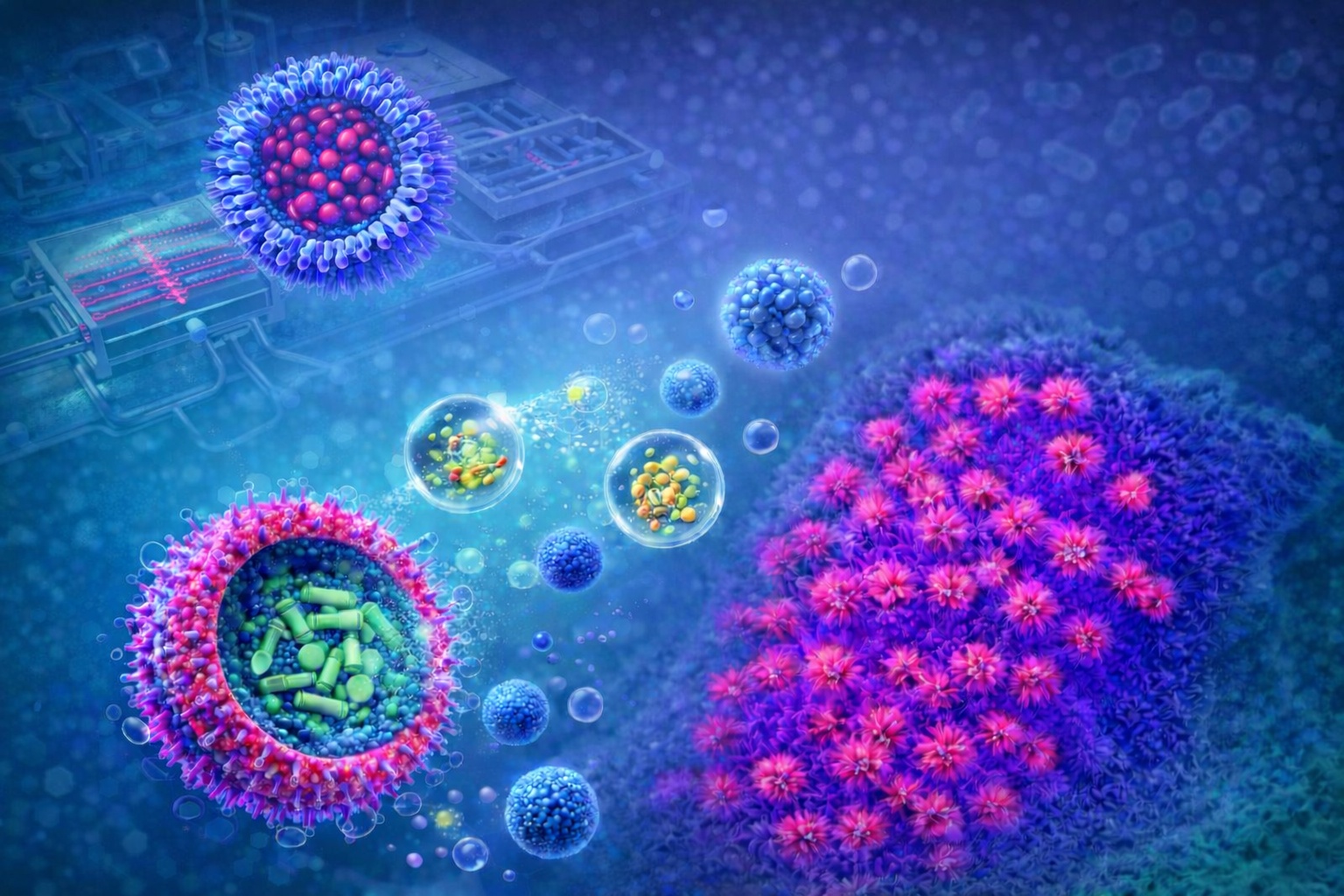
Under the heading ‘Advanced Drug Delivery Technologies,’ scientists will discuss modern drug forms; in addition to small molecules, the focus will be on nucleotides such as mRNA (messenger RNA). Vaccination using messenger RNA proved to be groundbreaking in the COVID pandemic and also plays a role in cancer research. The cells receive the genetic information, i.e. the ‘blueprint’ of the antigen in question (e.g. a virus protein), and can thus produce it themselves. ‘However, special carrier systems, such as nanoparticles, are essential for transporting these large and extremely sensitive molecules into the body and ultimately into specific cellular compartments,’ explains Claus-Michael Lehr. He and his team are conducting their own research into novel variants of the lipid nanoparticles commonly used to date – so-called ‘lipid-polymer hybrid nanoparticles’, which he simplifies as ‘small plastic beads with an outer lipid layer’.
The career day aims to highlight career prospects for young pharmaceutical scientists, which is a particular concern of Claus-Michael Lehr. Alumni of the former GALENOS network – an international doctoral school in the field of drug research led by Lehr, at which around 40 young researchers from twelve European partner universities completed their doctorates between 2004 and 2008 – are also travelling from all over the world to attend. Doctoral students in his current graduate programme ‘TALENTS’ will be among those who can benefit from their experiences. At the conference, they will receive useful information and tips on possible career paths after completing their doctorates in a broad-based programme of workshops, lectures and experience reports – from academic careers to careers in industry to founding their own start-ups.
More than 200 participants from various disciplines are expected to attend the conference, including 20 international guest speakers. Scientists from Saarbrücken will also present their latest research findings: for example, Professor of Medical Chemistry Anna Hirsch will report on her research at the Helmholtz Institute for Pharmaceutical Research Saarland (HIPS); Professor of Bioinformatics Andreas Keller will present Clinical Bioinformatics and the PharmaScienceHub, and Professor of New Materials Wilfrid Weber will explain his work at the Leibniz Institute for New Materials (INM).
Conference: ‘CRS (Controlled Release) meets BioBarriers’
3 to 6 March 2026
Saarland University, Saarbrücken Campus,
Buildings E2 2 (Günter Hotz Lecture Hall) and E2 5
Opening: Tuesday, 3 March, at 12:45 p.m. by University President Ludger Santen and Minister of Science Jakob von Weizsäcker.
Further information about the conference: www.helmholtz-hips.de/de/konferenzen/biobarriers-2026/
Contact for enquiries:
Prof. Dr Claus-Michael Lehr
Helmholtz Institute for Pharmaceutical Research Saarland (HIPS)
Head of the Drug Transport Department
Tel.: 0681 98806-1000
Email: claus-michael.lehr@helmholtz-hips.de
https://www.helmholtz-hips.de/de/forschung/teams/team/wirkstofftransport-ueber-biologische-barrieren/
AI-generated image for download for use in connection with this press release