Information for
 Quick links
 Faculties


Forschungszentrum Jülich will cooperate closely with the new Center for Quantum Technologies.
The following text has been machine translated from the German with no human editing.
The Centre for Quantum Technologies aims to combine fundamental research with practical applications. On the one hand, it will focus on quantum engineering and quantum optics. The aim here is to develop a quantum internet, as well as quantum networks and interfaces. In addition, the scientists will focus on a second area: quantum information theory, quantum algorithms, quantum computing and quantum computing software.
The centre is fundamentally interdisciplinary and takes a broad view of quantum technologies. To this end, it bridges the gap between physics, mathematics, computer science and engineering. The existing expertise of professors from these four disciplines at Saarland University will be expanded through new appointments. These can build on the long-standing research work at Saarland University in the fields of quantum optics and experimental and theoretical physics. These research groups are already playing a key role in the development of quantum networks and a future 'quantum internet'.
In the field of quantum engineering, the aim is to integrate fundamental research in physics with application-oriented research in systems engineering, thereby translating research findings into relevant applications. To this end, plans are in place to fill two further professorships in experimental quantum physics and eight professorships in systems engineering. The University of Saarland also has a renowned partner in the Research Centre Jülich: the Helmholtz Centre will open a branch on the Saarbrücken university campus in the field of quantum engineering, fill joint professorships and contribute its internationally recognized infrastructure.
Once fully established, the Centre for Quantum Technologies will cover the entire value chain from basic research to application in the field of quantum engineering. It will thus be one of the few locations where quantum physics and engineering are united under one roof as equal partners. Important contributions to the development of technologies for quantum networks and quantum computer hardware are expected here in the future.
In the second research focus on quantum computing, Frank Wilhelm-Mauch, as a professor at Saarland University, conducts research in collaboration with Forschungszentrum Jülich (the 'Jülich model'). He coordinates large integrated consortia and bridges the crucial interface between quantum software and hardware. The field of Theoretical Quantum Technology and Quantum Information is already represented at Saarland University by four professorships in Physics, Computer Science and Mathematics. These are to be reinforced by two professorships in Quantum Information within the Department of Computer Science and a further one in this field within the Department of Mathematics. Together with a planned professorship in Quantum Communication within the Systems Engineering department, the new centre will thus cover the interdisciplinary field of quantum information with an unusually broad scope. In addition, the University will establish a joint professorship with the German Research Centre for Artificial Intelligence (DFKI) in the field of Quantum Artificial Intelligence – here too, Saarland is playing a pioneering role.
The Centre for Quantum Technologies is already making an important contribution – in close cooperation with the internationally renowned Department of Computer Science at Saarland University – to closing the gap in research in the field of quantum software and quantum algorithms. Software for quantum computing and industrial applications will also be developed here in future, e.g. through hybrid algorithms that combine methods of classical high-performance computing with those of quantum computing.
'The aim is to create a globally visible hub for quantum technologies on the campus of Saarland University, distinguished by both excellent basic research and application-oriented development,' says University President Ludger Santen. Technical developments, patents and, ultimately, start-ups are to be driven forward, particularly in the field of quantum engineering. There is also significant potential for start-ups in the software sector. For the practical application of quantum computers, new algorithms are needed to solve certain problems more efficiently than on classical computers, according to Santen. 'To train specialists in these fields, Saarland University will, from the winter semester onwards, supplement its B.Sc. and M.Sc. degree programmes in Quantum Engineering – which have been on offer since 2019 – with an M.Sc. programme in Quantum Information. This programme does not necessarily require a background in physics, but is also open to interested students from computer science and mathematics degree programmes,' adds the University President.
Minister for Science Jakob von Weizsäcker also highlights the economic significance of the new centre for the Saarland: 'What began 100 years ago with quantum mechanics as a revolution in theoretical physics is now a key technology with enormous economic potential. The new Centre for Quantum Technologies builds on existing strengths at our university and, together with Forschungszentrum Jülich, creates the critical mass needed for international visibility and competitiveness. With the support of the Saarland Transformation Fund, we are succeeding in establishing a technological beacon here, with corresponding knock-on effects for value creation and jobs.'
Astrid Lambrecht, Chair of the Executive Board of Forschungszentrum Jülich, said at the kick-off event in Saarbrücken: 'Innovative quantum technologies emerge in interconnected ecosystems – driven by our talent and a close integration of university and non-university research. With the support of the state, the new Centre for Quantum Computing at Saarland University is creating optimal conditions for this and specifically strengthening scientific excellence. The cooperation with Forschungszentrum Jülich provides young scientists with access to a high-performance infrastructure linked to concrete applications. In this way, we aim to actively contribute to further strengthening the scientific quantum computing community in Germany."
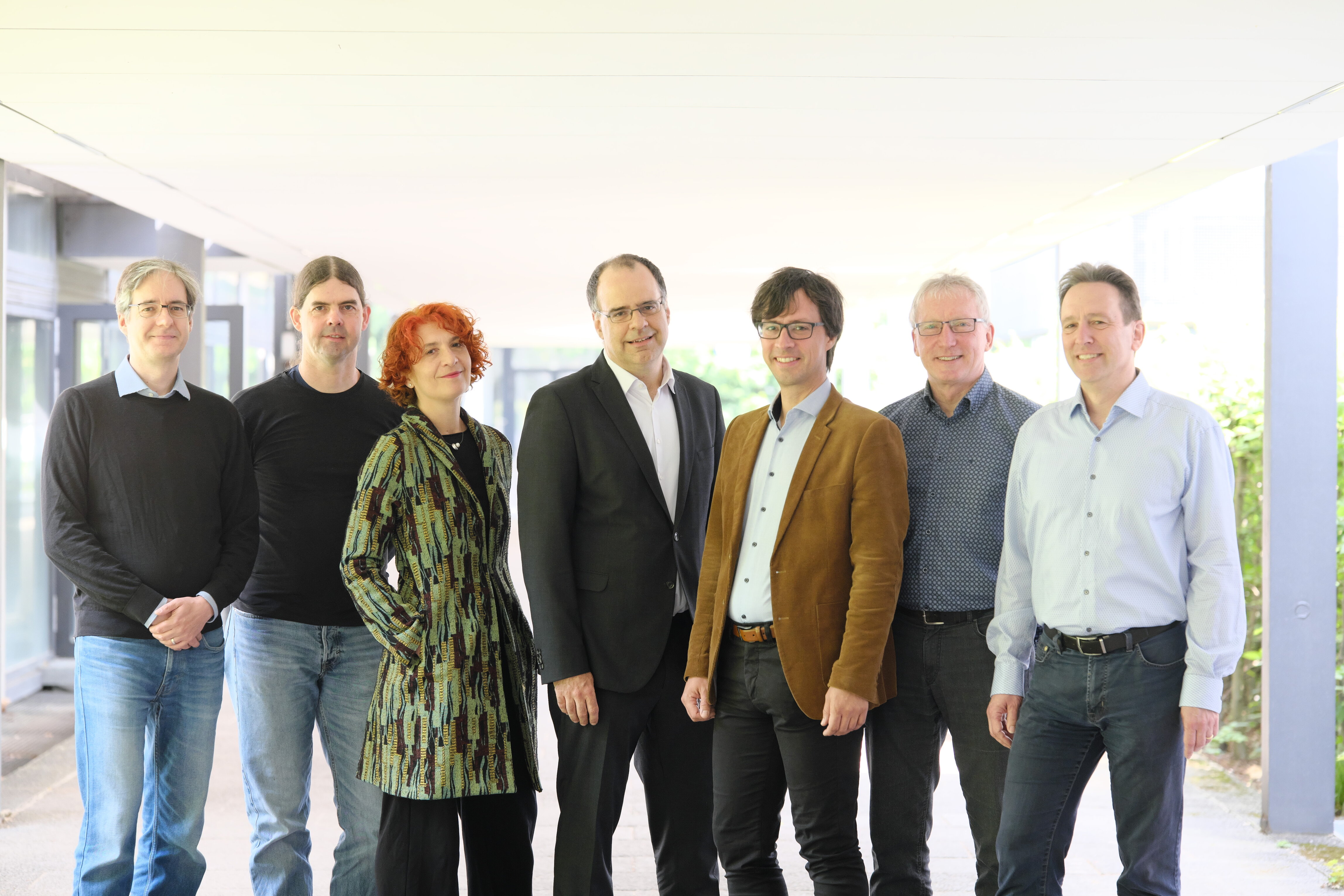
At today's kick-off event for the Centre for Quantum Technologies, starting at 4 p.m. in the Innovation Centre at Saarland University, Professor of Mathematics Moritz Weber will provide insights into past and planned activities on behalf of the QuTe management team. Following this, Jakob von Weizsäcker, Minister for Finance and Science, Ludger Santen, President of the University, and Astrid Lambrecht, Chair of the Executive Board of Forschungszentrum Jülich, will highlight the significance of the new centre from the perspectives of the state, the university and research. German-Austrian experimental physicist Rainer Blatt will deliver the keynote address. Dorothee Bär, Federal Minister for Research, Technology and Space, will send a video message. The founding board of the new Centre for Quantum Technologies at Saarland University comprises Christoph Becher (Physics), Markus Bläser (Computer Science), Jürgen Eschner (Physics), Giovanna Morigi (Physics), Peter Orth (Physics), Moritz Weber (Mathematics) as Executive Director and Frank Wilhelm-Mauch (Physics).
Further information:
https://www.uni-saarland.de/forschen/quantentechnologien.html
For further information, please contact:
Prof. Dr. Moritz Weber
Tel.: +49-681-302-2556
Email: weber(at)math.uni-sb.de