 Information for
 Quick links
 Faculties


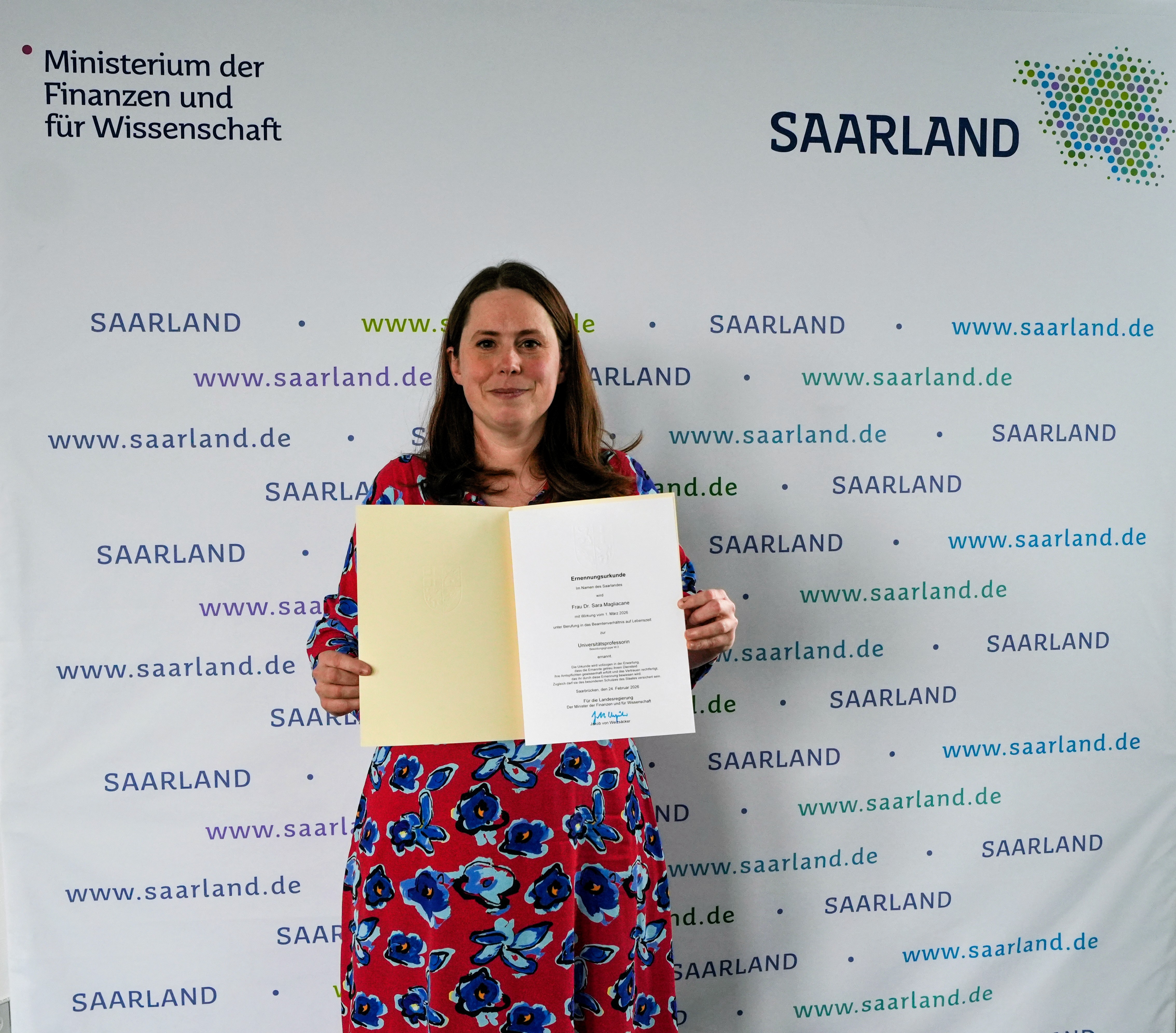
People increasingly use artificial intelligence today in important decisions that have a major impact on people's lives – from improving medical diagnosis and increasing efficiency in research to supporting data-based decision-making in business and administration. However, AI cannot 'understand' like a human being why something happens or how damage could be avoided by acting differently, for example when driving an autonomous vehicle or in robotics. 'Many real-world systems today are based on AI, but their actions are difficult to interpret because we often don't know exactly what the neural networks are calculating in the background. This means that IT systems are not particularly reliable and are difficult to manage when they have to comply with safety regulations, for example," says Sara Magliacane.
The computer scientist therefore wants to research at Saarland University how ideas of causality can be used to make complex AI models safer and more reliable. Among other things, the focus is on the large language models on which ChatGPT and similar programs are based. It will also look at so-called vision language models, in which AI is trained to link text data and visual data such as images and videos. Another focus will be on 'embodied AI,' which can be used to program care robots, for example, to 'understand' information from their environment and translate it into their own actions.
Sara Magliacane's areas of focus enrich the research environment at the Saarland Informatics Campus in many ways. They are particularly well suited to the Research Training Group 'Neuroexplicit Models for Language Processing, Image Recognition and Action Decisions', in which several computer science research institutes in the region are involved alongside Saarland University and which will continue to receive funding from the German Research Foundation until 2028.
Short CV of Sara Magliacane
Sara Magliacane has been an assistant professor at the Amsterdam Machine Learning Lab at the University of Amsterdam since 2020. From 2019 to 2025, she was also a researcher at the renowned MIT-IBM Watson AI Lab in Cambridge, Massachusetts (USA), where she was IBM's principal investigator for several projects in collaboration with the MIT faculty. Born in Italy, she completed her master's degree at the Polytechnic University of Milan (Italy) and received her Ph.D. from the Free University of Amsterdam (Netherlands) in 2017. She then spent two years conducting research at the IBM Thomas J. Watson Research Centre before moving to the MIT-IBM Watson AI Lab and the University of Amsterdam.