Information for
 Quick links
 Faculties


A new study has now closed that gap. The results have recently been published in Advanced Science.
Natural science is a demanding craft. It aims to understand the world around us and the principles by which nature operates – and to do so in the finest detail. Only then can we apply that knowledge meaningfully, for example in the development of medicines, the optimization of materials or the design of novel computers. In most cases, theory leads the way and theoretical models predict what experimental scientists should later observe in the laboratory.
Working with an international team, Reza Shaebani, Interim Professor of Theoretical Physics at Saarland University, has developed a model that explains how chirality influences the behaviour of objects embedded in an ‘active system’. Professor Shaebani explains: ‘Active matter – whether that’s migrating cells, flocks of birds or objects known as synthetic microswimmers – consists of units that take on energy in order to move. In most studies, active matter systems are treated as if their constituents move symmetrically. In reality, however, chirality is a general property of active matter. Both living and artificial active particles possess a handedness (either “right” or “left”) and a preferred sense of rotation in their motion. Despite being so ubiquitous, little was known about the role that chirality plays in interactions between active particles.’
The new study addresses this knowledge gap and shows that the dynamics of chiral active matter is far more diverse and complex than previously assumed. So, what exactly did the research team do to reach this conclusion? ‘We conducted computer simulations in which we inserted immobile objects into an active fluid in which the fluid’s particles follow a specific chiral trajectory. We found that the way the inserted objects responded to chirality depended on their shape,’ explains Reza Shaebani. When the team increased the chirality in a fluid made from isotropic (‘spherical’) particles, the system switched from a collectively rotating swarm to isolated ‘spinners’ that rotate about their own axis.
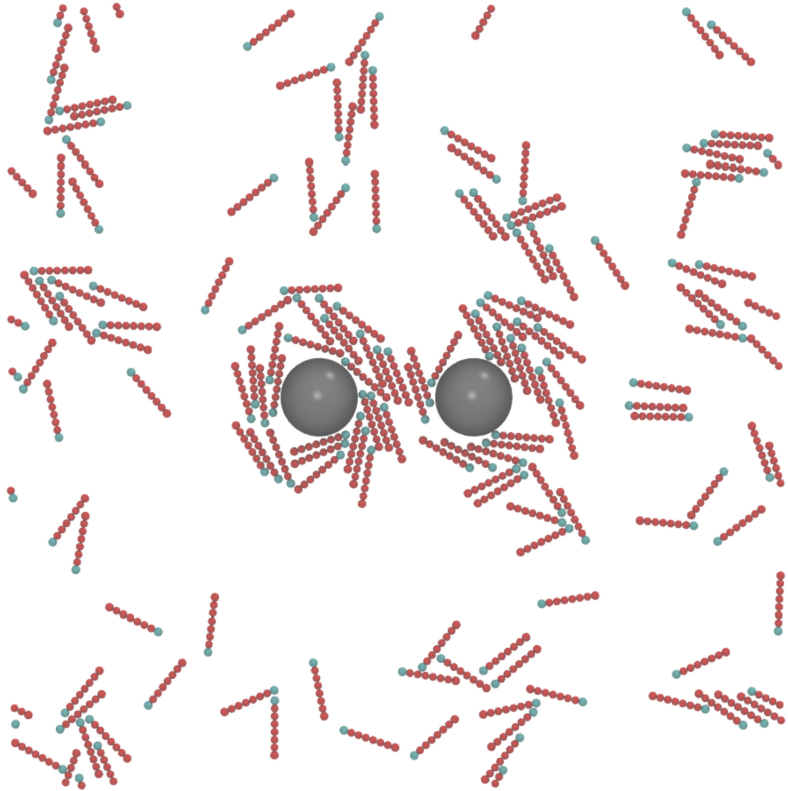
However, in fluids composed of anisotropic, elongated (‘rod-like’) particles something quite striking occurs – swirling structures form spontaneously around the embedded objects. At a particular, optimal chirality, these swirling vortices become especially pronounced. If the embedded objects are placed close together within the active medium, the vortices that from around the objects can influence and disrupt one another, leading to more frequent collisions. These vortex-driven collisions are not merely aesthetically pleasing – they are physically significant. Under optimal conditions, the resulting forces can be several orders of magnitude stronger than in non-chiral systems, in which the active fluid particles have no preferred sense of rotation. Reza Shaebani summarizes the team's observations as follows: ‘Chirality acts as a hidden amplifier of mechanical activity in living and synthetic materials.’ The potential strength of these fluctuation-induced forces may help explain how in real biological systems – such as the cytoskeleton – surprisingly large forces can be generated that are capable of propelling organelles or deforming cell membranes.
Beyond these fundamental insights, the study suggests interesting new design principles for active materials. ‘By deliberately tuning the chirality of the active fluid so that the mean curvature of active particle trajectories matches the boundary curvature of the embedded objects, it should be possible to steer how particles self-organize – or to separate components of different handedness. The findings could inform the design of microrobots, self-organizing materials or bio-inspired systems that harness chiral motion to control inter-particle forces and organization at the microscale,’ says Reza Shaebani, outlining potential applications. The study was supported by Collaborative Research Centre SFB 1027 at Saarland University.
Original article:
H. Fatemi, H. Khalilian, J. Sarabadani, and R. Shaebani, ‘Optimal Chirality Enhances Long-Range Fluctuation-Induced Interactions in Active Fluids.’ Adv. Sci. (2025): e09539. https://doi.org/10.1002/advs.202509539
Further information:
Interim Prof. Dr. Reza Shaebani,
Tel.: +49 681 302-3964
Email: shaebani(at)lusi.uni-sb.de