Information for
 Quick links
 Faculties


Higher storage capacities using materials that are both readily available and environmentally far less problematic. The results have now been published in the journal Chemistry of Materials.
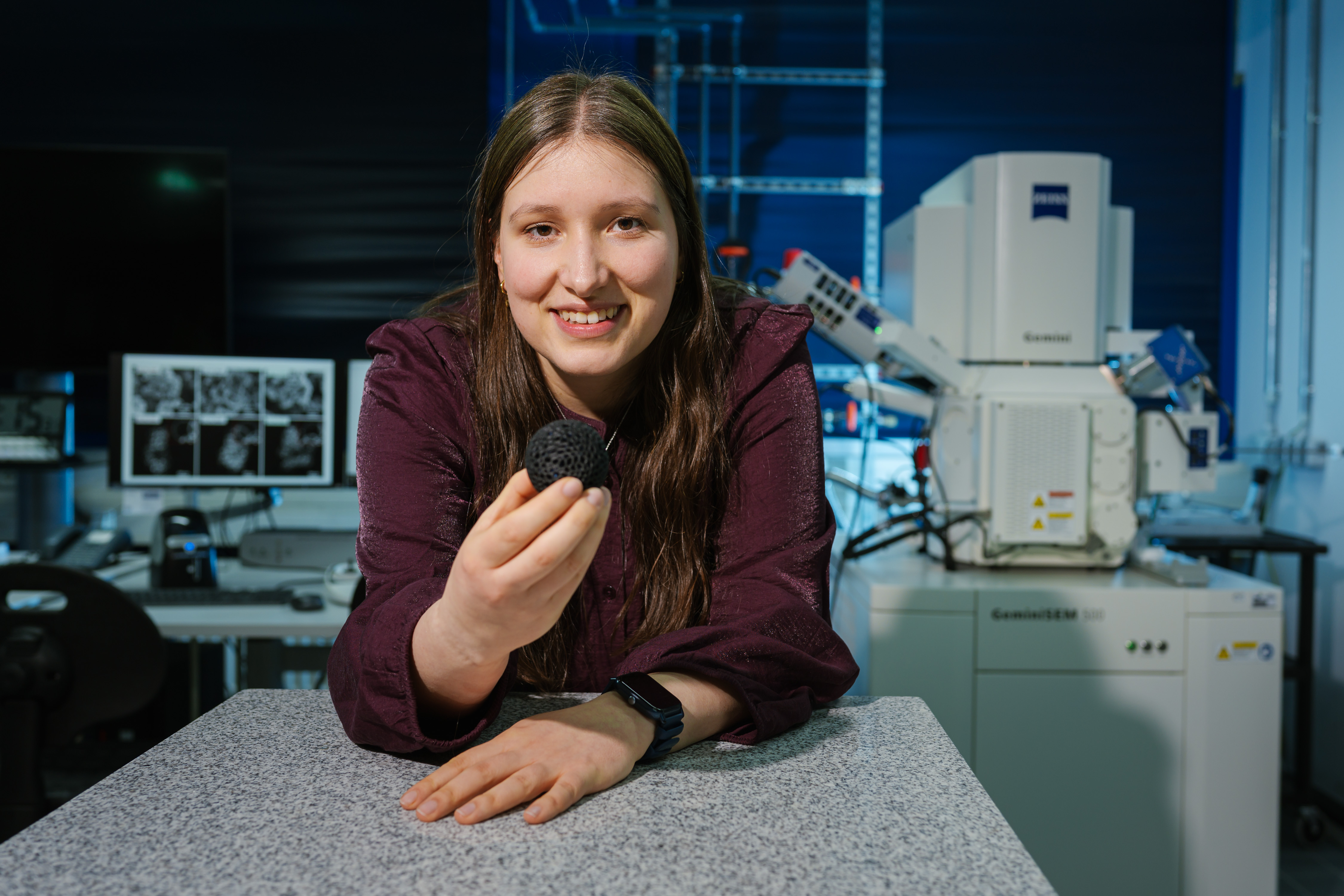
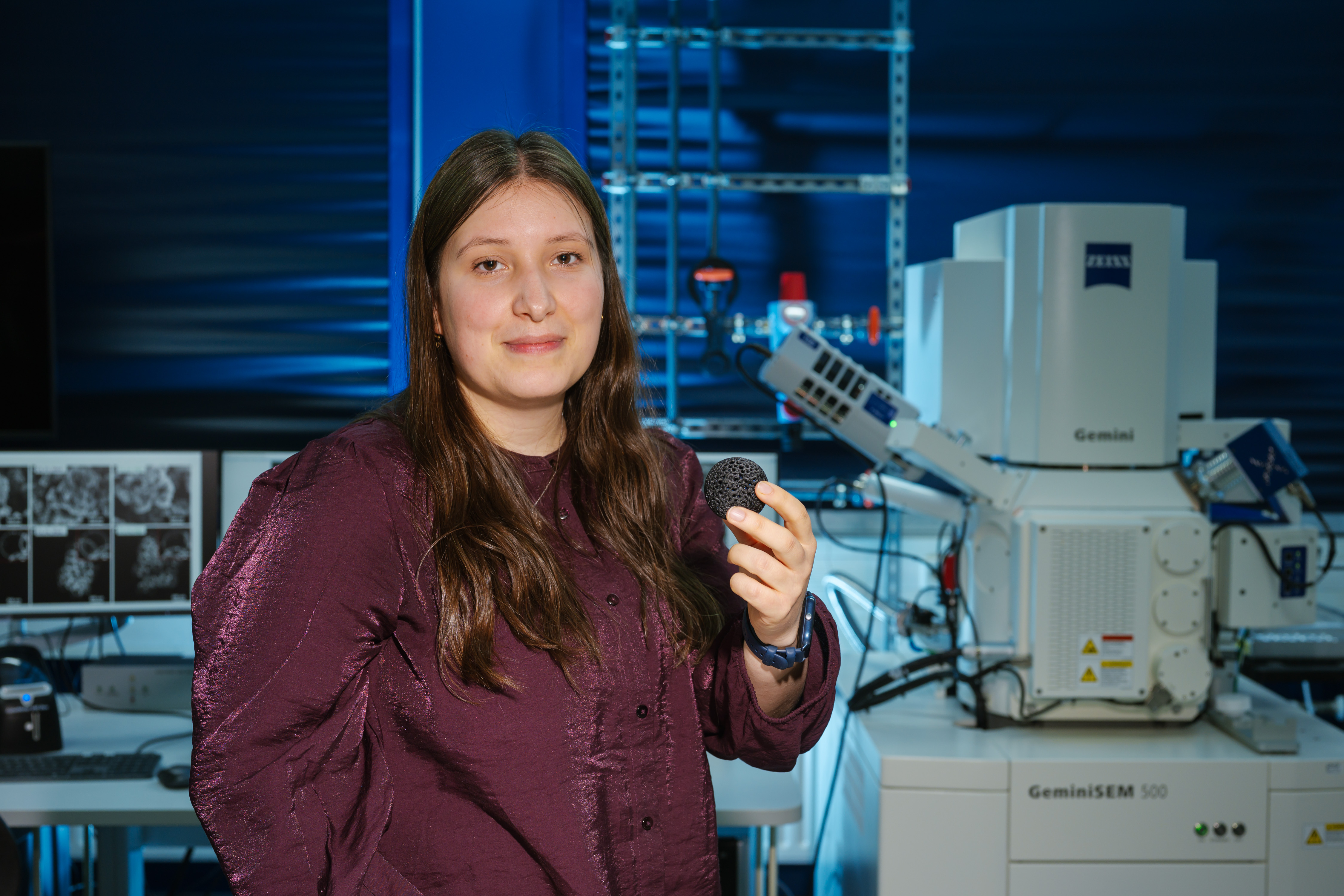
Anyone who has ever been to Salzburg in Austria will be acquainted with Mozartkugeln – the famous chocolate-coated balls of marzipan and nougat. And Mozartkugeln are a simple way of imagining the hollow carbon spheres that were developed by researchers at Salzburg University and are now being used at Saarland University to advance lithium-ion battery technology. Known as carbon spherogels, these novel materials are nanometre-sized units around 250 nm in diameter that offer a large surface area and high electrochemical capacity. ’The challenge for us is to use chemical synthesis to fill the cavity inside these spheres with suitable metal oxides,’ explains materials scientist Stefanie Arnold. After a set of initial experiments with titanium dioxide, whose ability to store and release lithium ions was relatively low, the team turned their attention to iron oxide, which most of us commonly refer to as rust.
‘Iron has a number of advantages: it is abundant worldwide, it offers – in theory at least – a high storage capacity, and it's easy to recycle,’ says Stefanie Arnold, a postdoctoral researcher at Saarland University working with Professor Volker Presser, Professor of Energy Materials. Using a scalable synthesis methodology based on iron lactate, the Salzburg team was able to integrate different quantities of iron into the carbon framework of the hollow spheres, producing robust porous networks with evenly distributed iron nanoparticles. ‘What was particularly interesting was that the storage capacity (i.e., the amount of electric charge that can be reversibly stored and released per gram of active electrode material) continued to increase while the battery was in use. The longer the battery was used, the better it performed. This is because the elemental metallic iron in the nanoparticles first has to react with oxygen to form iron oxide. This process of electrochemical activation of the iron embedded in the carbon spherogel matrix is not immediate but happens progressively. It takes around 300 charge-discharge cycles until all the cavities in the carbon spheres are filled with iron oxide and the maximum storage capacity is reached,’ explains Arnold.
’Rust-based batteries’ are still a work in progress
However, further research is still needed before this mechanism can be used on an industrial scale. The activation process needs to be faster so that batteries can reach their maximum storage capacity sooner. In addition, the iron oxide-filled carbon spherogels are currently used as the battery anode; a suitable cathode still needs to be developed to obtain a complete cell. ‘We are confident that our approach will facilitate the development of environmentally friendly buffer storage systems for renewable energy,’ says Volker Presser, who also heads the Research Department Energy Materials at the INM – Leibniz Institute for New Materials in Saarbrücken. The new material will also be tested for sodium-ion batteries, which Chinese automotive manufacturers are already deploying. ‘These materials form a versatile technology platform that allows a wide variety of other substances to be integrated in situ into the spherogels in a single synthesis step, opening up opportunities for a wide range of technological applications,’ adds Michael Elsässer.
Developing new recycling methods and a climate-friendly energy supply
As part of the ‘EnFoSaar’ project, Stefanie Arnold is also investigating how lithium can be recovered from batteries and how future batteries should be designed so that they can be dismantled on an industrial scale. ‘We need efficient recycling methods and closed-loop material systems to minimize resource consumption and reduce waste in the battery supply chain,’ says Arnold. EnFoSaar is a major project that is being funded by the Saarland state government with €23 million from the Saarland Transformation Fund. It aims to develop innovative approaches for a climate-friendly energy supply and to drive the transformation of Saarland’s energy industry and the associated research landscape by developing innovative, scientifically sound, and practically implementable methodologies.
Original publication:
Iron-Loaded Carbon Spherogels as Sustainable Electrode Materials for High-Performance Lithium-Ion Batteries, Authors: Saeed Borhani, Le Thi Thao, Gregor A. Zickler. Antje Quade, Michael S. Elsaesser, Volker Presser, Stefanie Arnold
https://pubs.acs.org/doi/10.1021/acs.chemmater.5c02442
Further information:
EnFoSaar transformation project: https://enfosaar.de/
Professor Volker Presser's research group: https://www.leibniz-inm.de/en/research/scientific-units/energy-materials/
Press release on the launch of the EnFoSaar project: https://www.uni-saarland.de/aktuell/enfosaar-35353.html
Questions can be addressed to:
Prof. Dr. Volker Presser
Department of Energy Materials at Saarland University
E-Mail: volker.presser(at)leibniz-inm.de
Dr. Stefanie Arnold
Department of Energy Materials at Saarland University
Tel. 0681 3024430
E-Mail: stefanie.arnold(at)uni-saarland.de