 Information for
 Quick links
 Faculties


Quantum Engineering (M.Sc.)
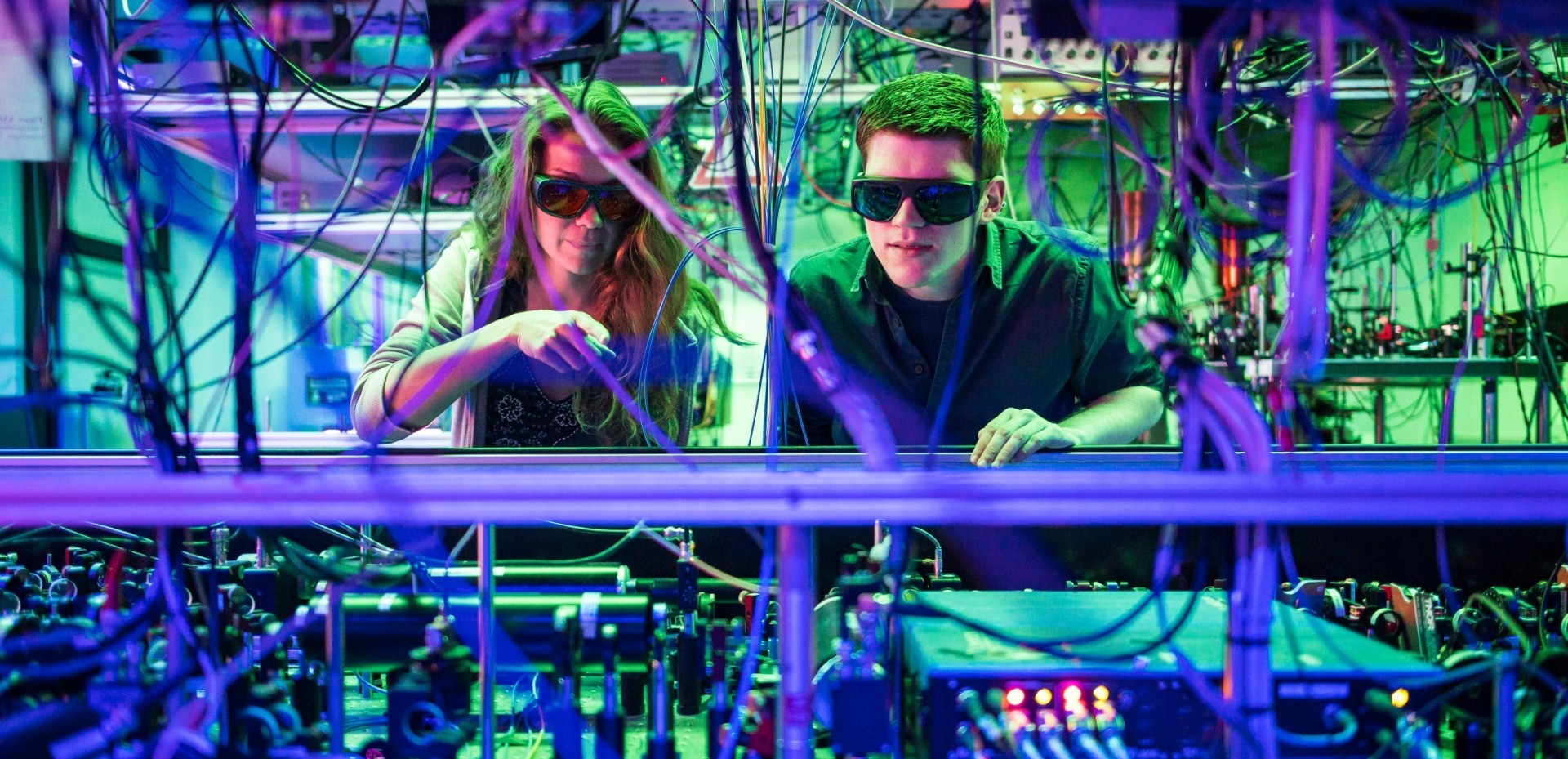
From quantum physics to the technologies of tomorrow
Quantum physics forms the foundation for new, revolutionary technologies and establishes a new qualification profile at the interface between natural sciences and engineering: quantum engineering. The Master's programme aims to provide both research-oriented and application-oriented training in modern quantum technologies, placing particular emphasis on an interdisciplinary systems approach.
The Master's programme develops the ability to conduct scientific work as well as in-depth knowledge for the technological implementation of research results. Graduates of the programme are uniquely qualified to transfer ideas from research laboratories into the development departments of industry.
The Master's programme in quantum engineering offers an interdisciplinary education at the intersection of fundamental natural sciences, particularly physics, and application-oriented engineering sciences, especially systems engineering. The program focuses on the research, development, and realization of quantum technologies.
Students can set individual emphases, shaping a more theoretical, experimental, or applied profile. They take courses from the core areas of quantum physics and systems engineering and deepen their knowledge through subject-specific elective modules, seminars, and practical skill classes selected from a broad range of offerings.
The elective modules serve to further deepen knowledge, enable practical implementation, and support the acquisition of interdisciplinary scientific competencies, for example through modules in economics or language courses. In addition, students may include work as a tutor as part of their studies.
A laboratory project, together with an associated project seminar, serves as preparation for the Master's thesis, which is completed in close collaboration with a research group.
The Master's programme comprises a total of 120 credits. Of these:
- 15 credits are allocated to a laboratory project, which serves to introduce students to a scientific research question, and
- 30 credits are allocated to the Master's thesis.
The modules to be completed are divided into the following categories:
- Core subject: Quantum Physics
- Core subject: Systems Engineering
- Subject-specific elective modules
- Subject-specific seminars, practical skill classes, and project seminars
- general mandatory elective module
- Laboratory project
- Master's thesis
The duration for completing the Master's thesis, including the Master's colloquium, is six months.
Graduates of the 'Quantum Engineering' programme have a wide range of career opportunities. They may pursue a doctoral degree and work in research, or take up positions in high-tech development, manufacturing, or sales in the field of quantum technologies, which are currently on the verge of transitioning from the research environment into widespread application.
Admission Requirements
1. A Bachelor's degree from a German university or an equivalent degree from a foreign university, with a primary focus in quantum engineering or a subject related to quantum engineering, with an overall grade of 'good' (2.5) or better. In doing so, the number of credits earned in lectures and exercises in the following areas should not fall below the specified amounts:
- Mechanics, optics, atomic physics, solid-state physics, and quantum mechanics in experimental and theoretical physics: 36 CP
- Fundamentals of electrical engineering, measurement technology, and sensor technology: 12 CP
- Electrodynamics or theoretical electrical engineering: 8 CP
- Electronics and circuit design: 10 CP
- Mathematical foundations: 20 CP
- Physics and engineering practical skill classes: 12 CP
2. Sufficient proficiency in English, usually at level B2 according to the Common European Framework of Reference for Languages (CEFR) or equivalent or higher.
How to apply
Studies can begin in either the winter semester or the summer semester. The application period generally runs from mid-June to 1 September for the winter semester and from mid-December to 1 March for the summer semester. A list of the required application documents, the link to the online application form, as well as further information can be found on the department's website
| Standard period of study | 4 semesters for full-time students Part-time studies are possible |
| Language of instruction | English |
| English language requirements | GER: B2 |
| Restricted entry | No |
| Application deadline | Winter semester: mid-June to 1 September Summer semester: 1 March |
| Tuition fees | Not applicable |
| Semester fee | See current fee structure |
| Homepage | Fachrichtung Physik | Fachrichtung Systems Engineering |
Programme adviser
Prof. Dr. Andreas Schütze
Professur für Messtechnik
Phone: 0681 302-4663
schuetze(at)lmt.uni-saarland.de
www.lmt.uni-saarland.de
Prof. Dr. Jürgen Eschner
Professur für Experimentalphysik
Phone: 0681 302-58016
juergen.eschner(at)physik.uni-saarland.de
www.uni-saarland.de/lehrstuhl/eschner
Carine Klap
Saarbrücken Campus
Building A5 1, Room 0.03
Phone: +49 681 302-4946
studium-se(at)uni-saarland.de
Central Student Advisory Service
Saarbrücken Campus
Building A4 4, Ground floor
Phone: +49 681 302-3513
studienberatung(at)uni-saarland.de
Central Student Advisory Service
Accredited study programmes
Saarland University was one of the first universities in Germany to achieve Quality Assurance Accreditation and has held the Accreditation Council's official quality mark continuously since 2012.
Quality management