Information for
 Quick links
 Faculties


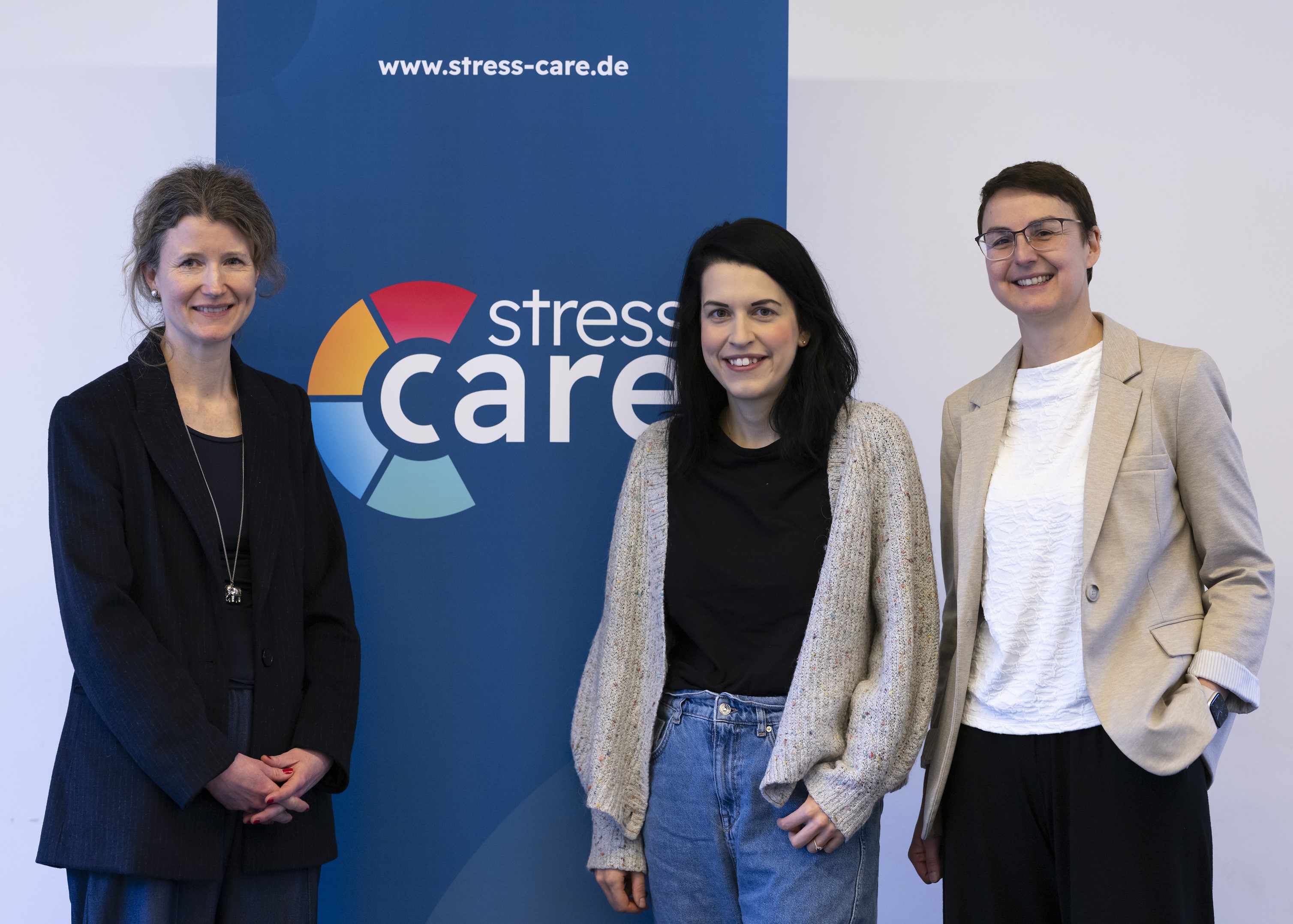
This is the goal of a nationwide consortium led by Professors Monika Equit, Sarah Schäfer and Daniela Fuhr, which is receiving €5.8 million in funding from the Federal Joint Committee.
The following text has been machine translated from the German with no human editing.
'With our project, we want to respond to the fact that young people have proven to be a particularly vulnerable group in recent years. Compared to other age groups, mental illness among young people has increased significantly, which is also reflected in significantly longer waiting times for outpatient and inpatient care,' says Monika Equit, professor of psychology at Saarland University. Together with junior professor Sarah Schäfer, Leibniz Institute for Resilience Research in Mainz, and professor Daniela Fuhr, Leibniz Institute for Prevention Research and Epidemiology – BIPS in Bremen, she is leading the large Germany-wide multicentre study.
In it, the researchers want to find out how young people can be supported in a low-threshold manner in school and personal contexts so that they are empowered to actively address their mental health and learn to better cope with psychological problems. 'Universities and research institutions in seven federal states are participating in the multicentre study, and we are also cooperating with statutory health insurance companies, school social work and school psychology services on site. Together, we want to develop an innovative prevention approach that can be offered in many schools in the long term and may eventually become standard care in Germany,' explains Sarah Schäfer.
This concept also convinced the Joint Federal Committee: the highest self-governing body in the German healthcare system has now commissioned the research team to implement the large-scale project called 'STRESS Care' over the next three and a half years. To this end, the Joint Federal Committee is providing a total of 5.8 million euros from the Innovation Fund, which is intended to develop and test new forms of care in the healthcare sector. From 47 project proposals, the committee selected a total of 15 initiatives for multi-year funding in a two-stage process.
The intervention targets pupils in grades 8 and 9 at mainstream schools. The first part of the prevention programme consists of a project day on mental health literacy and online training to strengthen emotion regulation. The aim is to teach pupils what mental health actually is, how to stay mentally healthy and what options are available for dealing with their own emotions. 'For example, they learn what can trigger stress and where to get help when they are feeling down,' explains Monika Equit. School psychological services or school social workers at the selected schools conduct these training sessions in class groups. After digitally recording their individual problems and strengths, the young people gain access to a mobile application. Over a period of three weeks, they work on modules tailored to their individual stress areas on their smartphones (e.g. learning to deal with rumination better or improving their ability to fall asleep and stay asleep).
'We want to help young people reduce their own risky behaviours. For example, if someone has sleep problems, they receive guidance on how to combat them with the help of relaxation techniques and simple rules around sleep. We also try to strengthen their mental resources by giving them tips on how to solve problems or strengthen their social relationships so they don't feel lonely,' says the psychology professor. During this digital training, the young people are accompanied by so-called eCoaches, who can respond to individual questions.
In the first phase of the project, the team will develop the intervention together with the target group. The young people themselves can contribute ideas and wishes, so that the smartphone application meets their needs exactly. The team will then examine the feasibility and acceptance of the prevention programme in a pilot study. Finally, the team will test the effectiveness of this programme in the third phase of the project in a nationwide study involving around 6,000 schoolchildren. 'With our programme, we want to support young people at an early stage in order to prevent the development of mental illness and its chronicity. In this way, we want to help ensure that treatment is not necessary in some cases,' says Monika Equit.
Against the backdrop of the strained supply situation in the field of child and adolescent psychotherapy in Germany, the systematic implementation of effective prevention services is of central importance. 'Low-threshold, school-based prevention approaches also enable equal opportunities regardless of social background and thus make an important contribution to sustainable relief and, at the same time, to strengthening psychosocial care structures. Successful implementation in existing education and care structures is therefore crucial to establishing mental health prevention as an integral part of healthcare in Germany in the long term,' explains Daniela Fuhr.
To ensure that the findings gained in the project contribute to improving school-based prevention programmes in Germany in the long term, various partners from the public health service and statutory health insurance funds are involved alongside scientific institutions.
The kick-off event for the STRESS-Care project took place on 28 January at the Innovation Center of Saarland University. STRESS-Care stands for 'Stepped Care Programme to Promote Resilience and Reduce Mental Stress in Young Schoolchildren'.
The following scientists are involved in the study:
Jun.-Prof. Sarah K. Schäfer, Leibniz Institute for Resilience Research (LIR) Mainz & Technical University of Braunschweig, Braunschweig; Prof. Dr. Daniela Fuhr, Leibniz Institute for Prevention Research and Epidemiology (BIPS), Bremen & University of Bremen; Prof. Dr. Julia Asbrand, Friedrich Schiller University Jena, Jena; Prof. Dr Julian Schmitz, University of Leipzig, Leipzig; Prof. Dr Michèle Wessa, Central Institute for Mental Health ( Seelische Gesundheit); Mannheim & Leibniz Institute for Resilience Research (LIR), Mannheim/Mainz; Prof. (apl.) Dr. Monika Equit & Prof. Dr. Tanja Michael, together with Prof. Dr. Eva Möhler & Andrea Dixius, Saarland University, and for the external evaluation: Dr. Hermann Pohlabeln, Leibniz Institute for Prevention Research and Epidemiology (BIPS), Bremen
Further information:
Press release from the Joint Federal Committee:
https://www.g-ba.de/presse/pressemitteilungen-meldungen/1299/
Questions answered by:
Prof. (apl.) Dr. Monika Equit
Chair of Clinical Psychology and Psychotherapy at Saarland University
Head of the University Psychotherapy Outpatient Clinic
Email monika.equit(at)uni-saarland.de
Jun.-Prof. Sarah K. Schäfer
Leibniz Institute for Resilience Research (LIR) in Mainz
and Technical University of Braunschweig
Email: sarah.schaefer [at] tu-braunschweig.de
Prof. Dr. Daniela Fuhr
Leibniz Institute for Prevention Research and Epidemiology (BIPS) in Bremen
and University of Bremen
Email: fuhr(at)leibniz-bips.de