 Information for
 Quick links
 Faculties


Research at Saarland University

Research with impact: Innovative, European and regionally rooted
Saarland University is synonymous with cutting-edge interdisciplinary research that couples strong social relevance with a proud and distinctive European profile. Situated in the heart of Europe in close proximity to neighbouring France, Saarland University is an ideal location for cross-border cooperation, borderlands research and European studies. The university addresses the central challenges of our time both in its four core research areas BioMed – Life and Materials, Computer Science, Interdisciplinary European Studies, and Sustainability, as well as in other areas of established expertise.
Saarland University provides an innovation-friendly environment to over 1,900 research scientists, scholars and academics from around the world. Our research ecosystem is broad and includes Collaborative Research Centres and Research Training Groups funded by the German Research Foundation (DFG), as well as European Research Council projects. In addition to national and international funding, projects financed through the Saarland Transformation Fund are becoming increasingly important. Ranging from sustainability and the circular economy to investments in quantum technologies and innovative collaborative work linking the social sciences with computer science, these projects are strengthening knowledge transfer to the regional economy, driving regional innovation and delivering positive social impact.

08 October 2026
Promotionspreise am 8. Oktober: Ausgezeichnet geforscht!


28 September 2026
New AI platform aims to simplify complex industrial planning processes

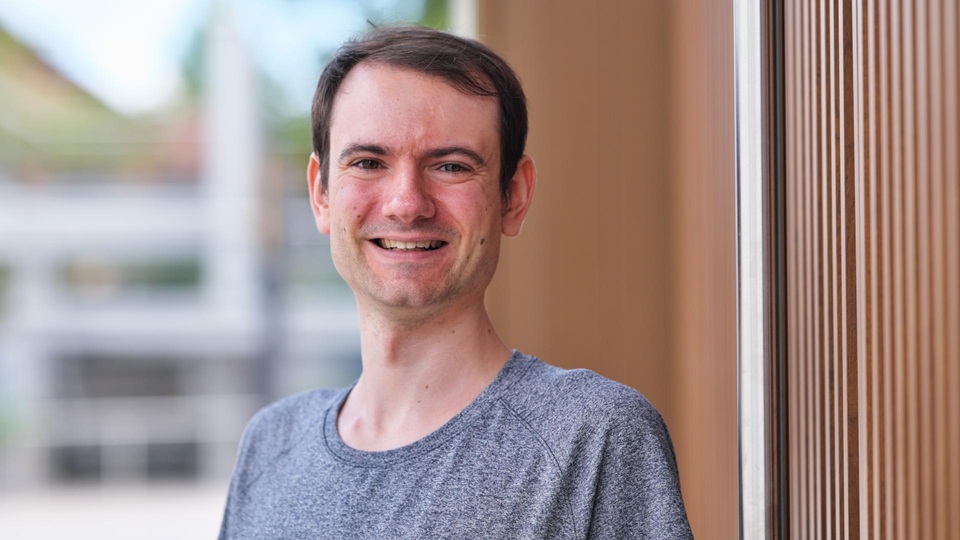
ERC Starting Grant for AI Research
Large language models such as ChatGPT are are being used, e.g., to gather information from multiple sources and to support complex planning processes. Yet these AI systems are not infallible and they continue to make mistakes – LLMs hallucinate and struggle to combine information in a logically rigorous manner. Computational linguist Michael Hahn has set out to strengthen the theoretical foundations of AI reasoning. He has now been awarded a European Research Council (ERC) Starting Grant worth €1.5 million over five years to pursue this work.

New Humboldt Professor brings €9.9 million in funding to Saarland University
Saarland University was successful with its nomination for Germany's most highly endowed research award. The internationally renowned structural biologist Nicholas Taylor is joining Saarland University as an Alexander von Humboldt Professor. At the heart of Taylor's research are complex molecular machines, and from 2027, he will help establish state-of-the-art molecular imaging capabilities at Saarland University.

€1.2 million for the health assistants of the future
Continuous monitoring of indoor air to assess health and wellbeing, smart bed linen that can track sleep quality, and intelligent hearing aid technology – international partners from academia and industry are developing novel health assistants as part of the SensorTech4Health 2030 research project. Against the backdrop of an ageing population and rising care costs, the project aims to use preventive approaches to help people remain fit and independent for longer. Saarland University will receive €1.2 million of the project's total €15 million in funding.

AI-based chemistry teaching concept awarded €80,000 in special funding
AI and digital tools are becoming increasingly common and increasingly indispensable in chemical research laboratories and industrial practice. At Saarland University, two researchers from chemistry and computer science are developing a teaching concept that will introduce chemistry students to data-driven methods early in their degree programmes and prepare them for the changing demands of academia and industry. The Fonds der Chemischen Industrie is supporting the project led by Professors Tanja Gulder and Andrea Volkamer with €80,000 from a special funding programme.
Vice-President for Research and Outreach
The Vice-President for Research and Outreach is responsible for promoting research at Saarland University in all its facets. His responsibilities cover all aspects of university research, from research infrastructure to research culture. As chair of the Research Committee, his focus is on securing an environment in which excellent research thrives. He is also responsible for steering the university's third mission, which is implemented as an outreach programme designed to strengthen the university's role in societal dialogue and community engagement. As patron of the 'UdS im Dialog' series, his role is to bring university research into the urban community and the civic sphere, promoting meaningful open dialogue between researchers and the wider public.
Research Management Division
The Research Management Division is Saarland University's central service unit that provides assistance to researchers at any stage of an externally funded research project. It offers researchers access to expertise and support services in the areas of research funding and research culture, contract management, clinical trials and managing external funds. Researchers who want to apply for external funding should first get in touch with the specialists in our funding advisory service. The Research Management Division is also responsible for managing the university's central research infrastructure. It advises the University Board on higher education policy relevant to research and provides support regarding the overall implementation of the university's institution-wide research strategy.