 Information for
 Quick links
 Faculties


Physics (M.Sc.)
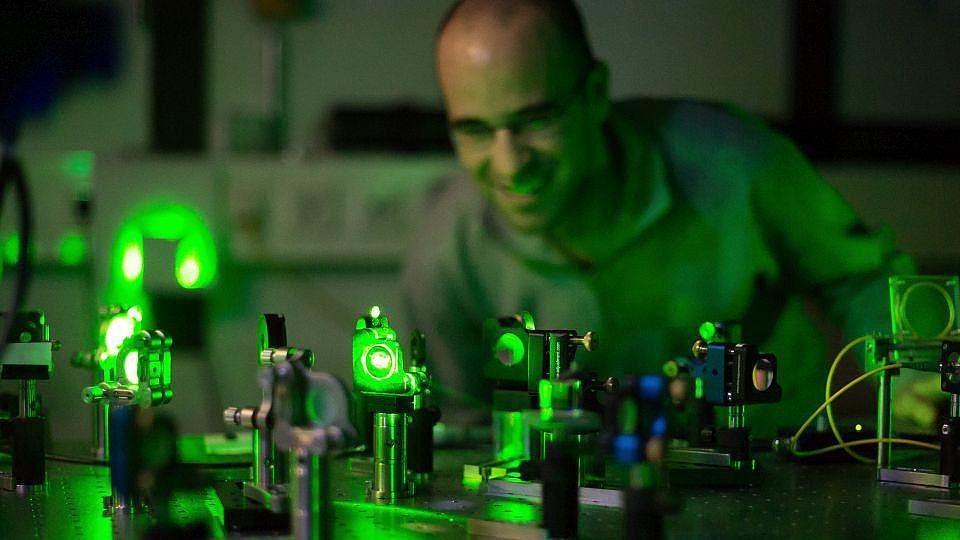
Physics is a scientific discipline that explores the universe from its very largest cosmological scale to the sub-nuclear scale of elementary particles, from the synthetic materials of solid-state physics and materials science to the living systems in biophysics and medical physics. Modern physics is therefore best defined not in terms of any one specific area of interest, but by the approach it adopts to examine the universe around us. Using well-designed experiments and measurements and formal analyses, physics provides a means of developing an overarching understanding of natural processes.
The education in the Saarbrücken Master's program "Physics" includes modules with experimental and theoretical focus. Students also gain an insight into the content and methods of neighboring disciplines. Students learn about applications of physics in engineering or life sciences or in medicine in a non-physics elective.
The Saarbrücken master's degree program "Physics" is all about research. In their theoretical-physical education, students first acquire in-depth knowledge in the subfields of quantum mechanics and static physics. In the experimental part of the master's program, they work on more advanced concepts in solid-state physics and atomic physics. The master's program also includes the practice and application of modern physics methods in research internships and in the working groups. The master's thesis then deals with a current problem in biophysics or soft matter, solid state and nanostructure physics or quantum technologies.
The Saarbrücken Master's program prepares physicists for jobs in industry, research institutions or public institutions. The fields of employment include, among others, the area of research/development with a focus on natural and engineering sciences, e.g. biotechnology, environmental technology, energy technology, optics and medical technology or the area of universities and research institutions as well as the service sector, e.g. for strategic management consulting. Likewise, the field of information technology is an important part of the job market for physicists. Very good graduates can also pursue a doctorate and, if appropriate, an academic career.
Physics spans the world of the very largest, such as in astronomy, to the world of the smallest elementary particles, from synthetic materials in solid-state physics and materials science to living systems in biophysics and medical physics. Modern physics is therefore not defined by a particular subject matter but rather by its approach. Through targeted experiments and measurements as well as formal analyses, it develops a holistic understanding of natural processes.
In the first year of study, advanced knowledge in the subfields of quantum mechanics and statistical physics is taught as part of the theoretical physics training (module "Theoretical Physics V").
In the experimental part of the program, more advanced concepts in solid-state physics and atomic physics are covered (module "Experimental Physics V"). This also includes the application of modern experimental methods in practical skill classes, as well as current projects conducted by experimentally oriented research groups.
The second year of the Master’s program can be characterized as a research phase. In the third semester, students are specifically prepared for conducting their Master’s thesis, which constitutes the final component of the program.
The Saarbrücken Master’s program prepares physicists for careers in industry, research institutions, or public sector organizations. Fields of employment include, among others, the natural and engineering sciences, laser technology and medicine, as well as information technology.
Outstanding graduates may also pursue a doctoral degree and, if desired, aim for an academic career.
Admission requirements
Admission to the consecutive Master’s program in Physics requires:
- A Bachelor’s degree or an equivalent university qualification with a primary focus in physics or in a subject related to physics, as well as
- special aptitude for Master’s studies. This is generally demonstrated by a Bachelor’s degree with an overall grade of 2.5 or better, or by passing an aptitude test.
For studies in physics, subject-specific competencies are required in the areas of mechanics, electrodynamics and optics, thermodynamics and statistical physics, atomic and molecular physics, condensed matter physics, nuclear and elementary particle physics, as well as quantum mechanics.
The number of credits obtained in lectures and exercises in experimental physics, theoretical physics, and mathematical foundations should not be less than 30 credits in each area. At least 20 credits should have been obtained through practical skill classes.
How to apply
Studies can begin in either the winter semester or the summer semester. The application period generally runs from mid-June to 1 September for the winter semester and from mid-December to 1 March for the summer semester. A list of the required application documents, the link to the online application form, as well as further information can be found on the department’s website (https://www.uni-saarland.de/en/department/physics/study-doctorate/physics/admission-requirements-for-the-masters-program.html).
| Standard period of study | 4 semesters for full-time students Part-time studies are possible |
| Language of instruction | English |
| English language requirements | B2 |
| Restricted entry | No |
| Application deadline | Winter semester: from mid-June to 1 September Summer semester: 1 March |
| Tuition fees | Not applicable |
| Semester fee | See current fee structure |
Prof. Dr. Ralf Seemann
Gebäude E2 9, Zi. 4.06
Tel.: +49/681-302-71799
r.seemann(at)physik.uni-saarland.de
Carine Klap
Phone: +49 681 302-4946
studium-physik(at)uni-saarland.de
Central Student Advisory Service
Saarbrücken Campus
Building A4 4, Ground floor
Phone: +49 681 302-3513
studienberatung(at)uni-saarland.de
www.uni-saarland.de/studienberatung
Central Student Advisory Service
Saarbrücken Campus
Building A4 4, Ground floor
Phone: +49 681 302-3513
studienberatung(at)uni-saarland.de
Central Student Advisory Service
Accredited study programmes
Saarland University was one of the first universities in Germany to achieve Quality Assurance Accreditation and has held the Accreditation Council's official quality mark continuously since 2012.
Quality management